
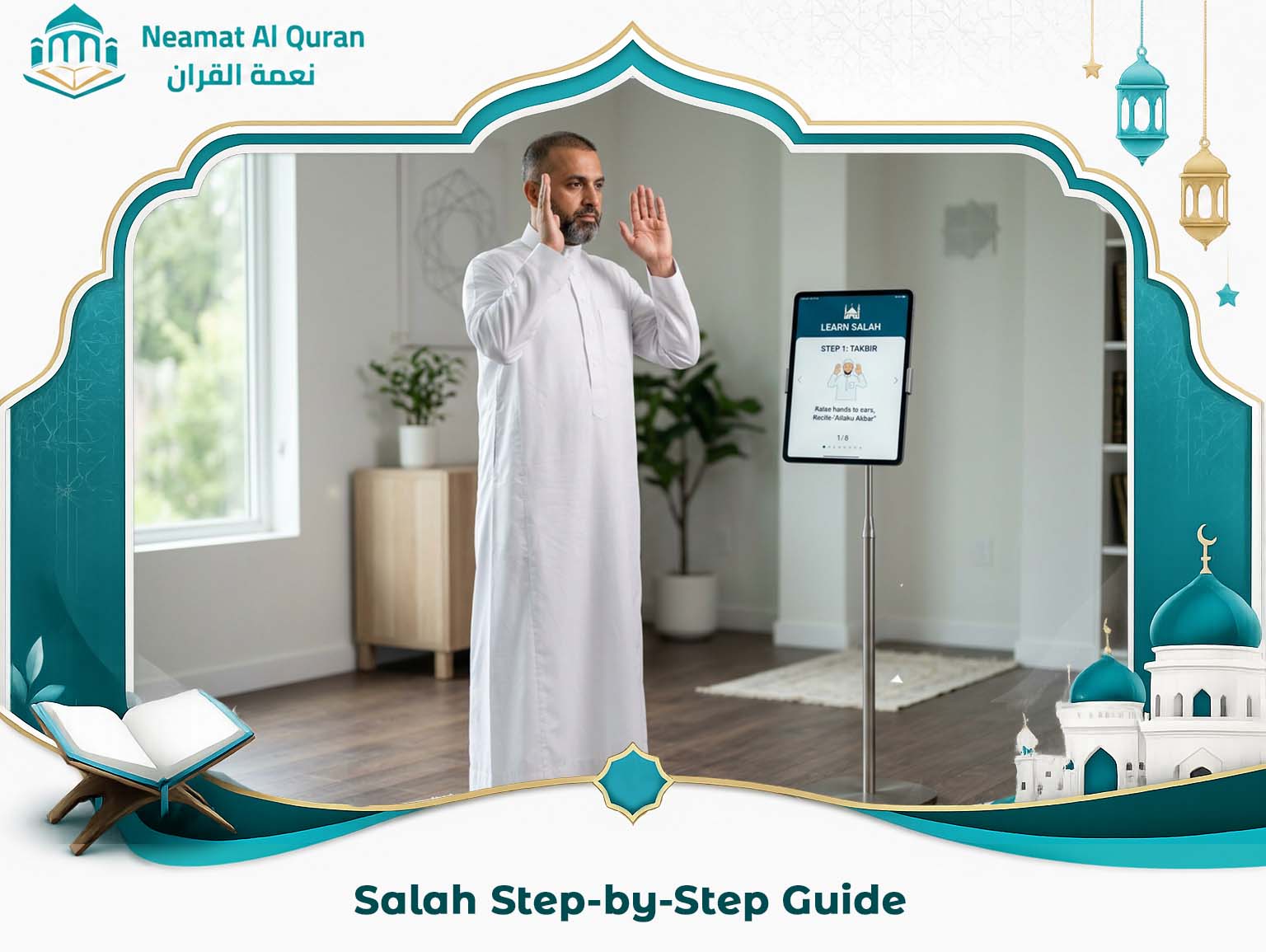
A step-by-step guide can make learning the prayer much easier for beginners who are still trying to understand what to do during each rakah. Salah is performed through a sequence of movements and recitations, and learning that sequence gradually can make the prayer feel more familiar and organized.
For someone learning how to pray, remembering every position and phrase at once may seem difficult. However, the prayer follows a clear structure. Each rakah includes standing, Quran recitation, bowing, and prostration, while additional sitting and recitation take place at specific points in the prayer.
This salah step-by-step guide breaks the process into manageable stages. Instead of trying to memorize the entire prayer immediately, a beginner can learn one movement at a time and then gradually connect those movements into complete rakahs.
With support from Neamat Al Quran Academy, learners can also approach salah as a practical skill that develops through understanding, repetition, and correction.
Understanding the Basic Structure
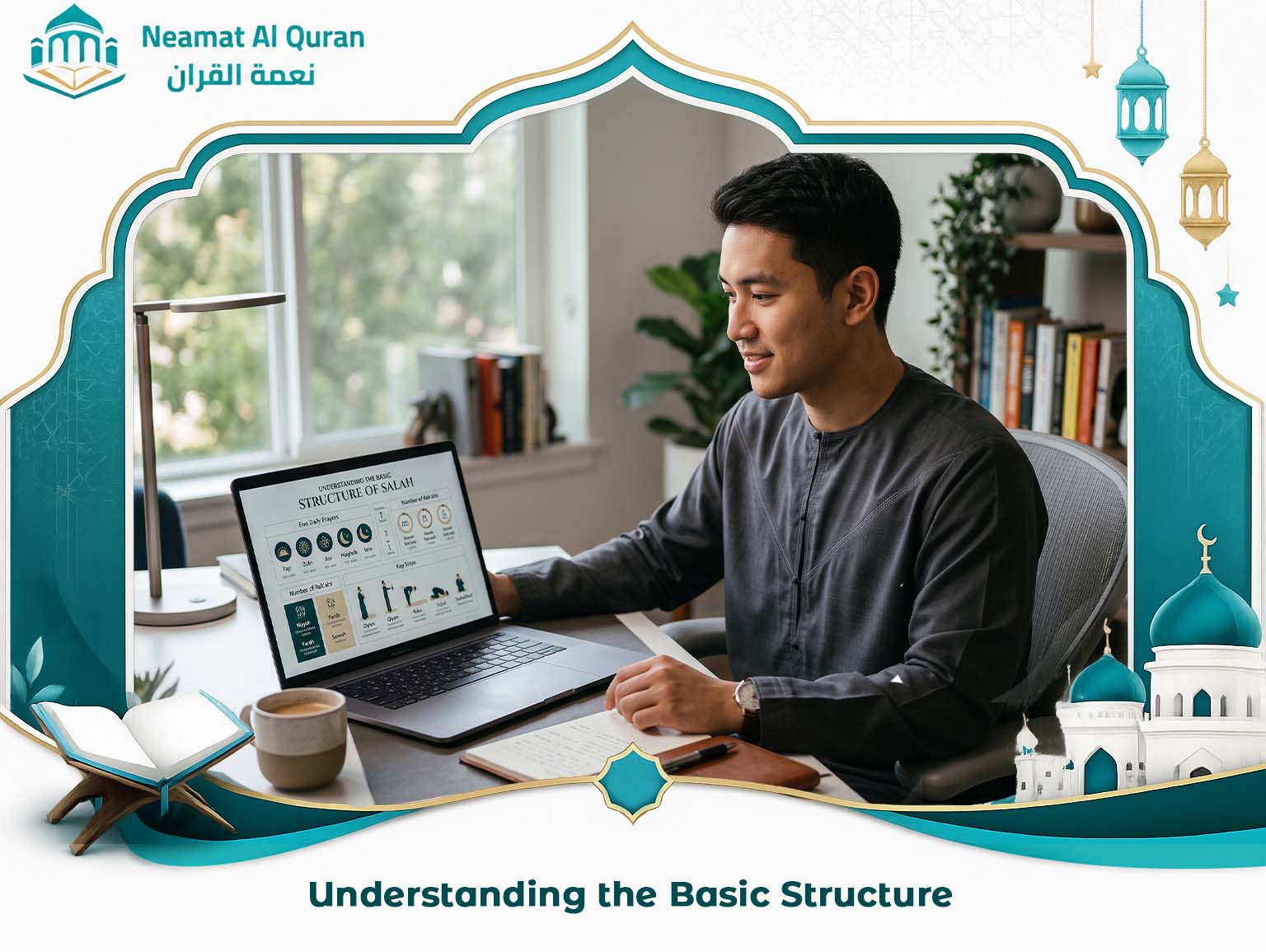
Before following a salah step-by-step guide, it helps to understand what a rakah means. A rakah is one unit of prayer. Although the number of rakahs differs between the five daily prayers, the basic sequence within a rakah remains organized around standing, recitation, ruku, and sujud.
The five daily prayers contain different numbers of rakahs:
- Fajr: 2 rakahs
- Dhuhr: 4 rakahs
- Asr: 4 rakahs
- Maghrib: 3 rakahs
- Isha: 4 rakahs
Therefore, learning one rakah carefully gives a beginner a foundation for understanding the structure of the complete salah.
This is why a practical salah step-by-step guide should not focus only on memorizing isolated phrases. Instead, it should show how each action connects to the next one.
Discover the Wisdom of the Quran with Neamat Al Quran Academy
Are you ready to go beyond simple recitation and understand the true guidance of the Quran in your daily life? At Neamat Al Quran Academy, qualified teachers help students explore the meanings of the Quran clearly and practically, which strengthens their faith.
Through structured online lessons, learners improve their understanding and apply Quranic teachings in real situations. Each class encourages reflection, growth, and a deeper connection with Allah’s words. Start your journey today with Neamat Al Quran Academy and build a stronger relationship with the Quran.

Step 1 — Make the Intention
The first part of this salah step-by-step guide is making the intention to pray. The intention is made in the heart before beginning the prayer.
At this point, the worshipper directs their attention toward the salah they are about to perform. The source explains that the prayer begins with an intention from the heart and that the person should focus on the prayer itself.
For a beginner, the important point is to understand that intention is not simply a physical movement. It is an internal decision to perform the particular prayer.
For example, before beginning Fajr, Dhuhr, Asr, Maghrib, or Isha, the worshipper knows which salah they are about to perform. This mental preparation helps establish the purpose of the prayer.
When learning through Neamat Al Quran Academy, students can treat the intention as the starting point of the complete sequence rather than as something separate from the prayer.
Step 2 — Say, Allahu Akbar
The next stage in this salah step-by-step guide is the opening takbir. The worshipper raises the hands and says “Allahu Akbar.”
According to the supplied source, saying “Allahu Akbar” marks the official beginning of the prayer. From that point, the worshipper is encouraged to focus completely on salah and avoid distractions.
The phrase is commonly translated as “Allah is the Greatest,” while the source explains its meaning as “Allah is Greater.” It presents the phrase as a reminder that Allah is greater than everything else and that the worshipper’s attention should be directed toward Him during salah.
For beginners following a salah step-by-step guide, this moment is particularly important because it marks the transition from preparing to pray into actually performing the prayer.
Step 3 — Place the Hands
After saying the opening takbir, the next position in this salah step-by-step guide is standing with the hands placed over the other.
The supplied material describes lowering the hands and placing the right hand over the left hand while standing.
At this stage, the worshipper remains standing and prepares for the Quran recitation. Learning the physical position alongside the words can make the sequence easier to remember.
Rather than memorizing every step independently, beginners can connect them:
- Make the intention.
- Raise the hands.
- Say “Allahu Akbar.”
- Place the hands.
- Prepare for recitation.
This sequence gives the learner a clear mental picture of the beginning of the rakah.
Step 4 — Focus the Eyes
The fourth part of this salah step-by-step guide concerns where the worshipper looks while standing.
The source explains that the eyes should remain focused on the ground in front of the worshipper, particularly toward the place where prostration will take place.
The source also mentions an opening supplication that may be recited after the opening takbir. It describes this dua as recommended rather than obligatory.
For a beginner, it can be useful to distinguish between the essential sequence being learned and additional recommended supplications. That distinction prevents the learner from feeling that every additional phrase must be mastered before understanding the basic movement of salah.
Step 5 — Recite Surah Al-Fatihah
The fifth stage of this salah step-by-step guide is Quran recitation. The opening chapter of the Quran, Surah Al-Fatihah, is recited during the prayer. The supplied source begins this section by mentioning seeking refuge from Shaytan before reciting Al-Fatihah and then presents the verses of the surah.
The meaning of Al-Fatihah includes praise of Allah, recognition of His mercy, worship of Him alone, asking Him for help, and asking for guidance to the straight path.
The source further states that another chapter from the Quran may be recited after Al-Fatihah and notes that Al-Fatihah is recited in every rakah.
For someone using a salah step-by-step guide, this part shows why learning Quran recitation is closely connected with learning salah itself.
Step 6 — Perform Ruku
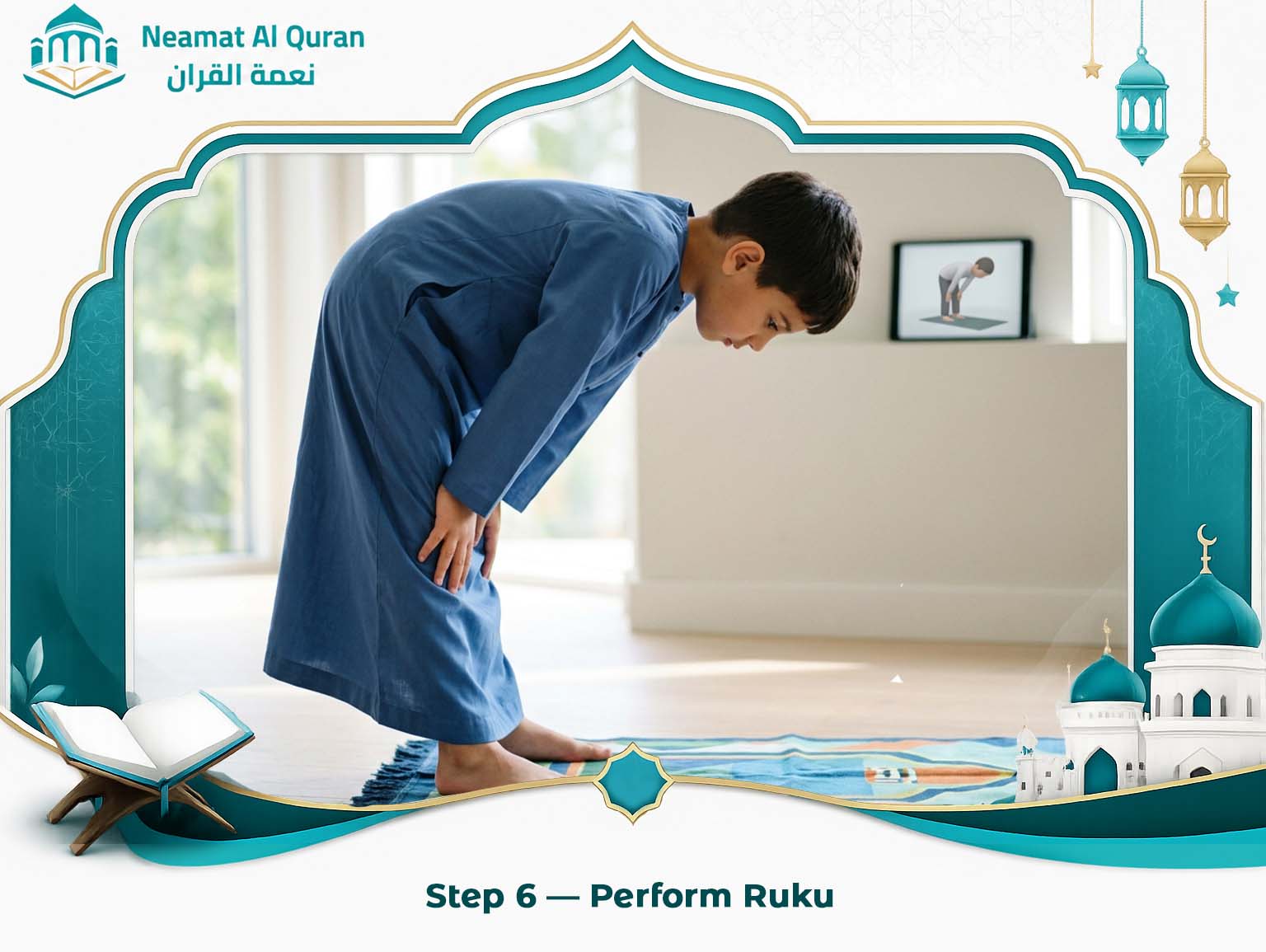
Once the standing recitation is complete, the next movement in this salah step-by-step guide is ruku, or bowing.
The worshipper says “Allahu Akbar” while moving into ruku. The supplied material explains that the back should remain straight, the hands should rest on the knees, and the eyes should remain focused toward the place of prostration.While in ruku, the source gives the following phrase:
Subhana Rabbiyal Adheem
It explains the meaning as praising Allah as the Magnificent. The supplied material also states that this phrase is said three times in the described form.
Beginners should therefore associate ruku with three elements: moving into the bowing position, maintaining the described posture, and performing the appropriate remembrance.
Step 7 — Return to Standing
After ruku, the next stage in this salah step-by-step guide is returning to an upright standing position. The source explains that while rising from ruku, the worshipper says:
Sami Allahu liman hamidah
The supplied translation explains this as “Allah hears those who praise Him.”Once fully upright, the worshipper says:
Rabbana wa lakal hamd
The source translates this as “Our Lord, to You is all praise.”
This transition is important because salah is not simply a sequence of static positions. Each position connects to the next through specific movement and remembrance.
Step 8 — Perform Sujud
The eighth stage of this salah step-by-step guide is sujud, or prostration. The worshipper moves from standing into prostration while saying “Allahu Akbar.” The supplied source explains that the forehead, nose, palms, knees, and toes should touch the ground during the described prostration position.
For beginners, this can initially feel like one of the more physically unfamiliar parts of salah. However, the movement becomes easier to recognize after repeated practice.
The key is to learn the position carefully instead of rushing through it. A learner can practice recognizing when to move, which body parts should make contact with the ground, and which remembrance belongs to the position.
Step 9 — Recite During Sujud
Once in sujud, this salah step-by-step guide continues with the remembrance associated with prostration.
Subhana Rabbiyal A’la
It translates the phrase as praising Allah as the Most High and states that the phrase is said three times in the described sequence. Sujud is therefore not merely a physical position. It also includes verbal remembrance. For learners who want to strengthen their Quran pronunciation alongside their prayer practice, reviewing tips to improve quran recitation can provide additional support.
For learners, combining the movement with the phrase can make memorization more practical. Instead of learning the words without context, the student learns that this particular phrase belongs to this particular position.
That approach can make a salah step-by-step guide easier to follow during practice.
Step 10 — Sit Between the Two Sujoods
After the first prostration, the next stage in this salah step-by-step guide is to rise and sit briefly. The source explains that the worshipper says “Allahu Akbar” while rising from sujud and then sits on the left leg, with the left foot resting on the floor and the right foot upright. The hands are placed on the knees. A simple supplication mentioned in the source is:
Rabbighfir lee
The meaning given is “O my Lord, forgive me.”
This sitting position is brief, but it is an important part of the sequence. Consequently, a learner should avoid treating it as an unnecessary pause between two prostrations.
Step 11 — Perform the Second Sujud
The next part of this salah step-by-step guide is returning to sujud for the second prostration. The source explains that the worshipper performs another sujud and repeats the remembrance Subhana Rabbiyal A’la three times in the described sequence.
At this point, the learner has completed both prostrations associated with the first rakah. The easiest way to remember the middle portion is to connect the movements:
Ruku → standing → first sujud → sitting → second sujud
Once this pattern becomes familiar, moving through the rakah becomes less confusing. If a learner is still developing Quran reading skills, practicing how to read quran step by step can also help build greater confidence with Quranic recitation.
Step 12 — Rise for the Next Rakah
After the second sujud, the next stage in this salah step-by-step guide is rising again to a standing position.
The worshipper says “Allahu Akbar” while rising. The supplied material identifies this moment as the completion of one full rakah.
This is a useful milestone for beginners because it shows how the individual movements fit together.
One complete rakah contains the main sequence of:
- Standing
- Quran recitation
- Ruku
- Standing again
- First sujud
- Sitting
- Second sujud
After learning this sequence, the learner can begin understanding how multiple rakahs are combined to complete the daily prayers. Understanding how many juz are in the quran is a separate aspect of Quran study, but it can also help learners develop a broader understanding of the structure of the Quran they recite.
Step 13 — Perform the Tashahud
The final major stage in this salah step-by-step guide is the tashahud, which takes place after the relevant rakahs.
The supplied source explains that after completing two rakahs, the worshipper sits again and performs the tashahud. The material describes raising the right index finger while reciting the tashahud.
The tashahud includes praise of Allah, greetings of peace upon the Prophet, peace upon the worshippers and righteous servants, and testimony that there is no deity worthy of worship except Allah and that Muhammad is His servant and Messenger.
For beginners, the tashahud can require additional memorization. Therefore, learning it separately while understanding when it appears in the prayer can make the process more manageable.
Learners who want to continue their Quran studies beyond salah may also explore how to become a hafiz of quran online, especially when building a longer-term memorization routine.
Finally, each of these resources can support a different part of the learner’s journey, while the salah step-by-step guide remains focused on understanding the sequence of the prayer.
Salah Step-by-Step Guide: Final Tashahud and Salawat
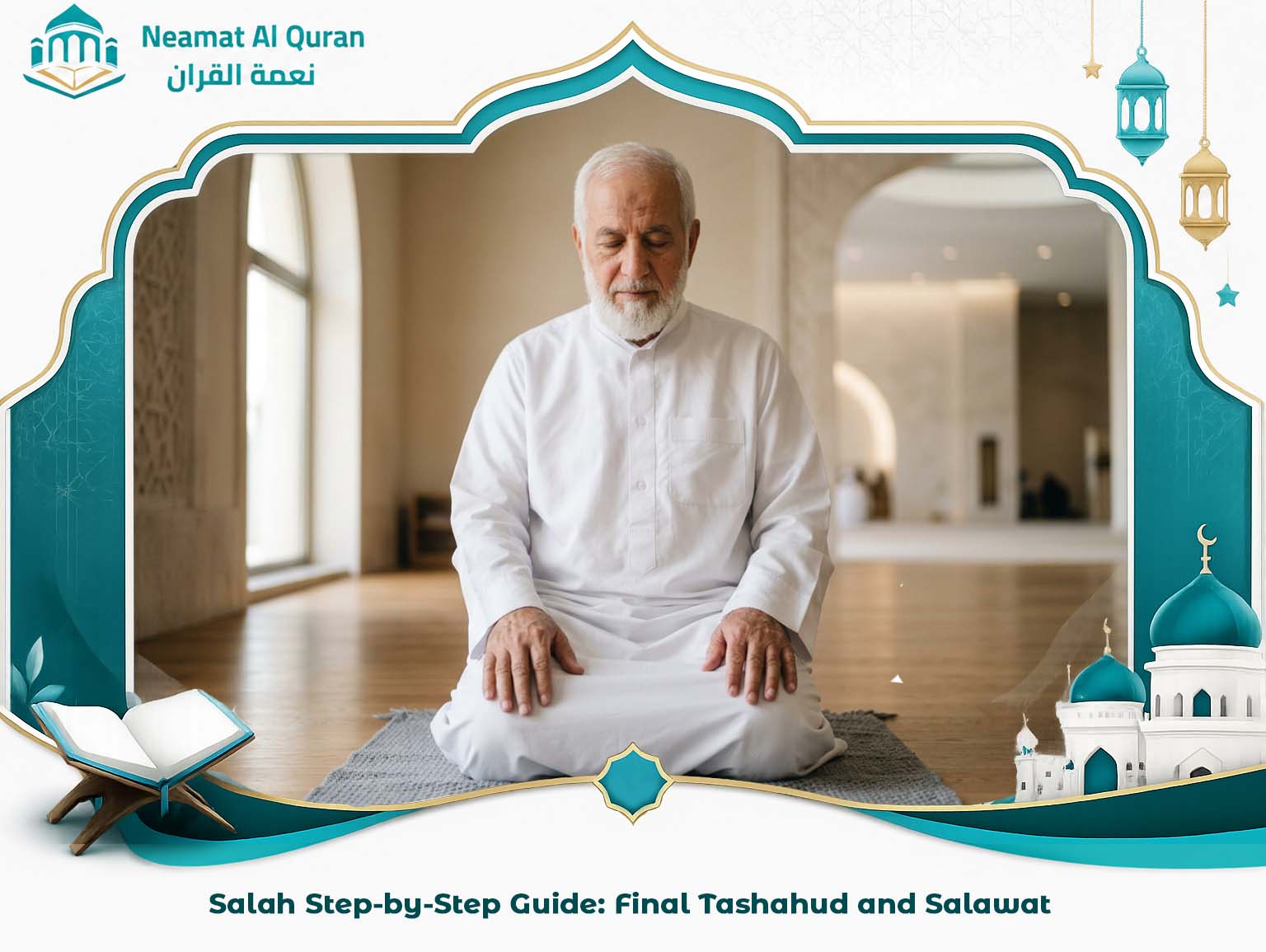
When the tashahud occurs at the final sitting of the prayer, this salah step-by-step guide includes an additional part.
The supplied material presents the salawat upon Prophet Muhammad and his family, comparing the wording to the prayers and blessings sent upon Ibrahim and his family. This section comes after the basic tashahud and before the prayer is concluded.
Because the final sitting contains more recitation than the earlier sitting, beginners may benefit from learning the wording gradually. Neamat Al Quran Academy can provide a structured learning environment for students who want to practice Quranic recitation and the Arabic phrases associated with salah.
How to End the Prayer
The final stage of this salah step-by-step guide is the tasleem. After completing the final recitation, the worshipper turns to the right and says:
Assalamu alaykum wa rahmatullah
The worshipper then turns to the left and repeats the greeting. The supplied source explains that after saying the tasleem, the prayer has come to an end.
This gives the complete sequence a clear ending. Therefore, beginners can recognize that the prayer moves from intention and opening takbir through standing, recitation, ruku, sujud, sitting, tashahud, and finally tasleem.
How the Rakahs Fit Together?
Understanding a salah step-by-step guide becomes easier when the learner stops viewing each prayer as an entirely different process.
The five daily prayers use different numbers of rakahs. Fajr consists of two rakahs, Dhuhr and Asr contain four, Maghrib contains three, and Isha contains four.
The basic rakah pattern remains the foundation. What changes is how many rakahs are combined and where the sitting portions occur.
A beginner can therefore study salah in two stages:
- Learn one rakah: Understand the physical movements and associated recitations.
- Learn the complete prayer: Understand how two, three, or four rakahs are combined.
This approach reduces the amount of information that has to be remembered at one time.
Salah Step-by-Step Guide for Beginners: What to Practice First
Someone searching for a salah step-by-step guide may feel overwhelmed by the amount of information available online. A more manageable approach is to divide the learning process into small goals.
Start by becoming familiar with:
- The meaning of a rakah.
- The five daily prayers and their rakah counts.
- The opening intention.
- The opening takbir.
- The standing position.
- Surah Al-Fatihah.
- Ruku and its remembrance.
- The standing position after ruku.
- Sujud and its remembrance.
- Sitting between the two sujoods.
- The second sujud.
- Tashahud.
- Tasleem.
Once these elements become familiar, the learner can practice connecting them into a continuous prayer.
Salah Step-by-Step Guide: Common Learning Challenges
Following a salah step-by-step guide is helpful, but beginners can still encounter several challenges.One common difficulty is trying to memorize every Arabic phrase immediately. This can make prayer practice feel like a test instead of a gradual learning process.
Another challenge is remembering when each phrase is said. A learner may know the words but become uncertain about whether they belong in standing, ruku, sujud, or sitting.
Physical movements can also take time to become natural. For example, moving from ruku to standing and then into sujud requires attention to both posture and timing.
To make progress more comfortable, learners can:
- Study one section at a time.
- Practice the Arabic phrases repeatedly.
- Connect each phrase with its position.
- Review one complete rakah before adding more rakahs.
- Ask a qualified teacher to observe and correct the prayer when possible.
At Neamat Al Quran Academy, students can approach these challenges through guided learning rather than trying to memorize everything independently.
Learning Salah Through Understanding and Repetition
A good salah step-by-step guide should help the learner understand the reason for the sequence rather than simply memorize a list.
For instance, when a student understands that ruku is followed by standing, and that standing is followed by sujud, the physical pattern becomes easier to remember. Likewise, connecting each remembrance to its position creates stronger associations.
Repetition also matters. A beginner may understand the entire process after reading it once but still need repeated practice before performing it comfortably.
That is normal in skill-based learning. Reading explains the sequence, while practice helps the sequence become familiar.
For learners who need regular guidance, Neamat Al Quran Academy can be part of a structured learning routine where questions and pronunciation difficulties can be addressed during study.
Salah Step-by-Step Guide: Improving Quran Recitation
The Quran recitation portion is one of the central parts of a salah step-by-step guide. Since Surah Al-Fatihah is recited during the prayer, learners need to work on both memorization and accurate pronunciation.
A student who is still learning Arabic may find some sounds difficult. In that situation, simply reading transliteration repeatedly may not provide enough correction.
A teacher can listen to the learner and identify pronunciation issues that may not be obvious to the student. In addition, regular practice can help the learner become more confident with the words.
This is especially useful when studying with Neamat Al Quran Academy, where the learner can treat Quran recitation and salah practice as connected parts of the same learning journey.
Why a Clear Salah Step-by-Step Guide Helps?
The main advantage of a salah step-by-step guide is organization. Instead of presenting the prayer as one long sequence, the guide separates it into identifiable stages. That makes it easier to locate the part that a beginner does not understand.
For example, if a learner understands standing and Al-Fatihah but becomes confused during the transition to ruku, they can focus specifically on that section. Similarly, if the movements are understood but the tashahud is difficult to remember, the learner can practice that portion separately.
This method also makes progress easier to recognize. Completing one rakah correctly provides a practical foundation before moving to the complete prayer.
A Practical Study Routine for New Learners
A salah step-by-step guide can become more useful when combined with a simple practice routine. A learner might begin by reviewing the complete sequence before practicing. Then, instead of repeating the entire prayer immediately, they can focus on one section.
For example:
- Review the opening and standing position.
- Practice Al-Fatihah.
- Review ruku and the transition back to standing.
- Practice both sujoods.
- Learn the sitting position.
- Review tashahud.
- Practice the final tasleem.
- Finally, connect the sections into complete rakahs.
The exact pace can vary according to the learner. What matters is consistent practice without turning the process into unnecessary pressure.
Neamat Al Quran Academy can support learners who prefer having a teacher guide their progress and help them identify areas that need additional practice.
Salah Step-by-Step Guide: Learning at Home
A salah step-by-step guide is particularly useful for people learning at home because it gives them a reference they can return to whenever they forget a movement or phrase.
However, written instructions should be treated as a learning aid rather than a substitute for direct correction when the learner needs help with pronunciation or physical positioning.
A practical home routine could include reviewing the sequence, listening carefully to the required recitations, practicing the movements, and then performing the complete rakah.
With regular review, the learner can gradually move from thinking about every individual instruction to recognizing the sequence more naturally.
For families learning together, Neamat Al Quran Academy can also provide a structured educational setting for students who need ongoing Quran and Islamic learning support.
What to Remember From This Salah Step-by-Step Guide?
The most important lesson from this salah step-by-step guide is that salah has an organized structure.The learner begins with intention and the opening takbir. Then comes standing and Quran recitation, followed by ruku and returning to standing. After that, the worshipper performs two sujoods with a sitting position between them.
After the required number of rakahs, the worshipper performs the tashahud. In the final sitting, the additional salawat is recited, followed by the tasleem that concludes the prayer.
Learning these stages gradually can make the prayer easier to understand and remember.
The goal should not be to rush through memorization. Instead, learners can build familiarity with each movement, understand the associated recitations, and practice the sequence consistently.
How Can Neamat Al Quran Academy Support Salah Learning?

For students who want structured guidance, Neamat Al Quran Academy can be included as part of a learning plan focused on Quran recitation and Islamic education.
Learning salah involves more than knowing the names of the movements. Students may also need help with Arabic pronunciation, memorizing recitations, understanding where each phrase belongs, and becoming comfortable with the sequence.
A guided learning environment can make it easier to identify these challenges early. Moreover, regular practice gives learners opportunities to review the steps rather than depending on a single reading of a written guide.
Whether a learner is beginning from the basics or reviewing the prayer after a long period without practice, a structured approach can make the learning process clearer.
Frequently Asked Questions
Frequently Asked Questions about Salah provide clear answers to common questions about prayer steps, positions, and essential practices.
1. How long does it usually take to memorize the full salah sequence?
The time varies from one learner to another. Someone who already knows the required Arabic recitations may become familiar with the sequence more quickly, while a complete beginner may need additional practice with both memorization and pronunciation.
2. Can children learn the prayer using a step-by-step method?
Yes. Breaking the prayer into small sections can make it easier for children to understand individual movements before connecting them into a complete rakah. Short, repeated practice sessions can also make learning more manageable.
3. Should a beginner learn the Arabic phrases or their meanings first?
Learning both together can be useful. Understanding the meaning gives the learner context, while practicing the Arabic wording helps develop familiarity with the recitations used during salah.
4. What should I do if I keep forgetting the order of the prayer?
Return to one rakah and practice its sequence separately. Once the order becomes familiar, add the sitting and tashahud portions and then practice combining multiple rakahs. A teacher can also help identify exactly where the confusion occurs.
In conclusion, this salah step-by-step guide provides a structured way to understand the movements and recitations that make up a rakah. The process begins with intention, continues through standing and Quran recitation, moves into ruku and sujud, and then progresses to tashahud and tasleem.
The five daily prayers contain different numbers of rakahs, but learning the basic rakah first provides the foundation for understanding those differences.
For beginners, the most practical approach is to learn gradually. First, understand the sequence. Then practice the individual movements and recitations. Finally, connect everything into complete rakahs and complete prayers.
With consistent study and appropriate guidance, the process can become more familiar over time. Neamat Al Quran Academy can support learners who want a structured environment for improving Quran recitation and developing a clearer understanding of salah.