

Namaz classes online offer a convenient way for Muslims to learn how to perform Salah, understand essential recitations, and develop a consistent prayer routine. Whether you are a beginner, a parent helping a child, or an adult seeking to improve your knowledge, namaz classes can make the process easier to follow.
Learning Namaz involves more than memorising movements. Students also need to understand preparation for prayer, the sequence of actions, the words recited during Salah, and the importance of following reliable Islamic guidance. Therefore, choosing an appropriate learning method can make a meaningful difference in how confidently a student practices.
For families far from an Islamic learning centre, namaz classes provide educational support from home. In addition, learners can review difficult parts, ask questions, and organize their practice around school, work, and family responsibilities.
This guide explains what to look for in namaz classes, how beginners can approach Salah step by step, and how to assess whether a learning program suits their needs. It also discusses children’s learning, pronunciation practice, common mistakes, and the questions worth asking before enrolling.
Who Can Benefit from Namaz Classes Online?

Namaz classes can support different learners, but the right approach depends on age, knowledge, and goals. Identifying these needs first helps students avoid lessons that are either too basic or unnecessarily complicated.
Namaz Classes Online for Beginners
Beginners often need a clear introduction to the foundations of Salah. Rather than trying to memorize every detail at once, they can learn through manageable stages and regular practice. A suitable learning plan may introduce:
- The purpose and importance of the five daily prayers.
- The basic preparations required before Salah.
- The general sequence of prayer movements.
- Essential recitations and their pronunciation.
- The difference between learning a movement and understanding its requirements.
- Common questions that arise during early practice.
Additionally, beginners benefit from revisiting previous lessons before moving to new material. This approach helps them identify unfamiliar terms and remember the order of the actions.
Namaz Classes Online for Children
Children usually learn more comfortably when explanations are short, concrete, and appropriate for their developmental stage. For example, a younger child may benefit from visual demonstrations and simple repetition, while an older student may be ready to discuss the meaning of common recitations.
Parents can support this process by encouraging practice without turning every session into a test. Positive reinforcement, realistic expectations, and a predictable routine can help children develop a constructive relationship with prayer.
Before selecting a course, parents should consider whether the teaching approach suits the child’s attention span, language ability, and existing Islamic knowledge.
Namaz Classes Online for Adults
Adults may approach prayer lessons with different goals. Some want to learn Salah from the beginning, while others already pray but need clarification about pronunciation, preparation, or specific actions.
A useful program should respect the learner’s existing knowledge and provide opportunities to ask questions without embarrassment. Moreover, adults often appreciate explanations that connect practical instructions with the reasoning behind them.
Namaz classes can help adults balance learning with work, family responsibilities, and different time zones. However, convenience should not replace careful attention to the accuracy of religious instruction.
Discover the Wisdom of the Quran With Neamat Al Quran Academy
Studying Quranic meanings can help learners develop a deeper understanding of the guidance they encounter during recitation. Neamat Al Quran Academy offers an option for learners researching structured online Quran education. Before choosing a course, consider your reading level, learning goals, and the kind of teacher guidance you need.
A suitable learning plan should explain Quranic passages clearly, use reliable references, and give students opportunities to ask questions. Explore the available options and determine whether they match your goals for Quranic learning.

What Do Namaz Classes Online Teach?
Namaz classes vary by provider, so students should check the syllabus rather than assume every course covers the same subjects. A well-organised learning plan should explain what the student will study and how the lessons build on one another.
1. Understanding Salah and Its Importance
Namaz classes can explain Salah’s role in Muslim daily life and the significance of observing prescribed prayers. This introduction gives learners a meaningful context for the practical material that follows.
Namaz classes should do more than teach a sequence to memorise. Instead, students should gradually understand why preparation, concentration, and consistency matter in their worship.
2. Preparing for Prayer
Namaz classes should explain preparation before prayer. Depending on the course, this section may cover cleanliness, Wudu, appropriate clothing, the prayer space, and awareness of prayer times.
Learners should also understand that particular circumstances can affect religious rulings. Therefore, questions about validity, exemptions, or special situations should be addressed through a qualified teacher or reliable source appropriate to the learner’s Islamic tradition.
3. Learning the Sequence of Salah
Namaz classes online may use demonstrations to teach the order of the main prayer positions. Lessons may introduce standing, bowing, prostration, sitting, and the transitions between these positions.
However, watching a demonstration does not automatically mean that a learner has understood every requirement. Students should have an opportunity to review the sequence, ask questions, and correct misunderstandings.
4. Practising Essential Recitations
Prayer includes Arabic recitations that learners may need to practice carefully. Depending on the syllabus and the student’s level, instruction may address Al-Fatihah, additional Quranic recitation, and other words used during Salah.
In particular, learners who do not read Arabic fluently may need guided pronunciation practice. Listening to a recording can help, but it should not be treated as a complete substitute for feedback when a student repeatedly struggles with particular sounds.
5. Reviewing Common Learning Difficulties
Students sometimes confuse the order of movements, forget a recitation, or struggle to distinguish between similar Arabic sounds. These difficulties can be addressed more effectively when learners identify the exact point that needs attention.
For example, a student who understands the movements but struggles with Arabic pronunciation needs a different practice plan from someone who is still learning the basic sequence.
Consequently, a clear learning plan should leave room for revision rather than forcing every learner to progress at the same speed.
How to Learn Namaz Step by Step?
Namaz classes online are easier to manage when learners progress gradually. Instead of trying to memorize everything in one sitting, learners can divide their study into practical stages and review each stage regularly.
Step 1: Identify Your Current Level
In namaz classes online, begin by identifying what you already know. Can you identify the prayer positions? Do you understand the preparation required before prayer? Can you recite the essential passages, or do you need help with Arabic reading?
These questions help you select the right starting point. They also make it easier to explain your needs to a teacher.
Step 2: Learn the Preparation Requirements
Namaz classes online should next cover preparation before Salah. This includes learning Wudu where applicable, understanding cleanliness, and becoming familiar with the conditions associated with prayer.
Because detailed rulings may differ across Islamic schools of thought, learners should identify the tradition they wish to follow. A teacher can then explain the relevant guidance without confusingly mixing different rulings.
Step 3: Practice the Main Movements
In namaz classes online, practice the prayer sequence gradually. Focus on the order of movements and the transitions between them. It may help to practice one section at a time before reviewing the complete sequence. Nevertheless, practice should follow reliable instruction, particularly when questions concern required actions or the validity of prayer.
Step 4: Improve Arabic Pronunciation
Namaz classes online should include recitation practice rather than treating pronunciation as a minor detail. Listen carefully, repeat short passages, and note the words or sounds that remain difficult.
For learners who are unfamiliar with Arabic, learning the letters and vowel sounds may provide a useful foundation. However, transliteration alone cannot represent every Arabic sound accurately, so students should use authentic Arabic text and suitable audio or teacher guidance.
Step 5: Review and Ask Questions
During namaz classes online, write down any point that remains unclear. You might need to revisit a movement, clarify a term, or practice a particular recitation.
As a result, the next learning session becomes more focused. Rather than repeating the entire lesson without a plan, you can concentrate on the areas that require attention.
Step 6: Develop a Sustainable Routine
Namaz classes online are easier to sustain through regular, manageable practice. Choose a realistic time for revision and keep your learning materials organized.
For instance, you might review one recitation, revisit the prayer sequence, or summarise a lesson’s main points. The exact routine should depend on your level and the guidance you receive.
How to Choose the Right Namaz Classes Online?

Choosing namaz classes online requires more than comparing websites. Learners should evaluate the teaching approach, the suitability of the curriculum, and the practical arrangements before making a decision.
Check the Teacher’s Islamic Knowledge
Good namaz classes online require a teacher who can explain Salah accurately and answer relevant questions. It is reasonable to ask about relevant qualifications, teaching experience, and the religious framework followed in the lessons.
Furthermore, a teacher should recognize when a question requires a more detailed scholarly answer instead of offering an unsupported ruling.
Review the Course Curriculum
Before enrolling in namaz classes online, check whether the syllabus matches your goals. A beginner may need a structured introduction, while a more experienced learner may want to improve recitation or clarify specific aspects of prayer.
Look for clear learning objectives and an understandable progression between lessons. If the provider does not publish a detailed syllabus, ask what topics the course actually includes.
Understand the Class Format
Namaz classes online may involve live individual lessons, group sessions, recorded material, or a combination of formats. Each option has advantages and limitations.
| Learning format | Potential advantage | What to check |
|---|---|---|
| Individual live lessons | More opportunity for personal feedback | Whether questions and corrections are included |
| Group lessons | Learning alongside other students | Group size and time available for individual questions |
| Recorded lessons | Convenient revision | Whether feedback is available when difficulties arise |
| Mixed learning | Combines instruction and independent review | How the different learning activities fit together |
No format is automatically best for every learner. The appropriate choice depends on the need for direct feedback, the student’s independence, and the available schedule.
Ask About Progress Assessment
A useful course should make it possible to identify what the student has learned and what still requires practice. This does not necessarily require formal examinations.
Instead, progress may be reviewed through guided demonstrations, recitation practice, questions, and feedback on specific learning objectives. Ask how the teacher will communicate areas for improvement.
Check Scheduling and Communication
Time-zone differences can affect students who live outside the teacher’s country. Before registering, confirm the available class times, expected lesson frequency, and procedure for rescheduling.
It is also useful to know how questions are handled between lessons. Clear communication helps prevent misunderstandings about attendance, homework, and learning expectations.
Namaz Classes Online vs. Self-Study
Some learners compare namaz classes online with videos and written guides. These resources can introduce basic concepts and make revision convenient. Nevertheless, self-study and teacher-guided lessons do not provide exactly the same learning experience.
When Self-Study Can Help?
Namaz classes online can complement independent review, repeated listening, and learning common Islamic terms. It also allows you to study at your own pace. However, a video cannot always identify whether you have misunderstood an instruction or pronounced a word incorrectly.
When Is Teacher Guidance Useful?
In namaz classes online, a teacher can answer questions, explain confusing points, and give feedback. This may be especially valuable when learning Arabic recitation or clarifying the requirements of Salah. On the other hand, the value of a lesson depends on the teacher’s competence and the quality of the instruction. Live attendance alone does not guarantee accurate learning.
Can You Combine Both Methods?
Yes. Namaz classes online can complement independent revision when resources are reliable and consistent with the instruction followed. For example, a student might review a recitation between classes and then ask the teacher about a sound that remains difficult. This approach can make lesson time more productive while keeping the learning process manageable.
Namaz Classes Online for Children and Adults: Different Learning Needs
Namaz classes online can serve children and adults, although their learning needs may differ. A suitable learning approach takes account of age, language skills, attention, and prior knowledge.
Helping Children Learn Gradually
In namaz classes online, children may respond well to demonstrations, repetition, and simple explanations. Parents can support learning by maintaining a calm environment and encouraging questions. Rather than expecting immediate mastery, focus on the specific skill being taught. For example, a session may concentrate on recognising the prayer sequence or practising a short recitation.
Supporting Teenagers
Namaz classes online can balance practical instruction with a deeper understanding of religious concepts for teenagers. They may also prefer to ask questions privately, especially when they feel uncertain about something they have learned.
Therefore, the teacher should provide a respectful environment in which questions are taken seriously and explanations remain appropriate to the student’s knowledge. For broader Quranic questions, learners can also explore what is tafseer to understand the purpose of interpreting Quranic passages.
Accommodating Adult Learners
Namaz classes online can fit around adults’ work, family responsibilities, and existing commitments. Some may also feel uncomfortable explaining that they are beginners.
A respectful instructor should focus on the learner’s current needs rather than making assumptions about what an adult should already know. Adults who are also developing their Arabic reading skills may benefit from this guide to learn to read quran for adults. In addition, clear goals can help adults recognise progress without unnecessary pressure.
How to Track Your Progress in Salah?
Tracking progress in namaz classes online can show improvement without turning worship into a competition. The purpose is to recognize areas that need more practice and seek reliable guidance where necessary.
Use a Simple Learning Checklist
Use namaz classes online to build a checklist based on lesson topics. You might record whether you can explain a concept, demonstrate a movement, or recite a passage with increasing confidence. For example, your checklist could include:
- Understanding the preparation required before prayer.
- Recognizing the main sequence of Salah.
- Practicing essential Arabic recitations.
- Identifying questions that require clarification.
- Reviewing material from previous lessons.
- Following a consistent revision routine.
This checklist should reflect your teacher’s guidance rather than replace it. In particular, self-assessment cannot determine every question concerning religious validity.
Focus on One Improvement at a Time
During namaz classes online, select one manageable priority for your next practice session. You might work on a particular Arabic sound or review the transition between two prayer positions. Adults revising Quranic passages alongside their lessons may also find these quran memorization tips for adults useful for organizing their revision.
Afterward, reassess the same skill. This makes it easier to notice progress and reduces the frustration that can arise when you try to change too many things simultaneously.
Ask for Specific Feedback
In namaz classes online, describe the point you want to understand instead of asking only whether your prayer is correct. For example, you could ask the teacher to explain a particular movement or listen to a specific recitation.
Specific questions usually make the learning conversation clearer. Moreover, written notes can help you remember the explanation and review it later.
Common Mistakes to Avoid When Learning Namaz
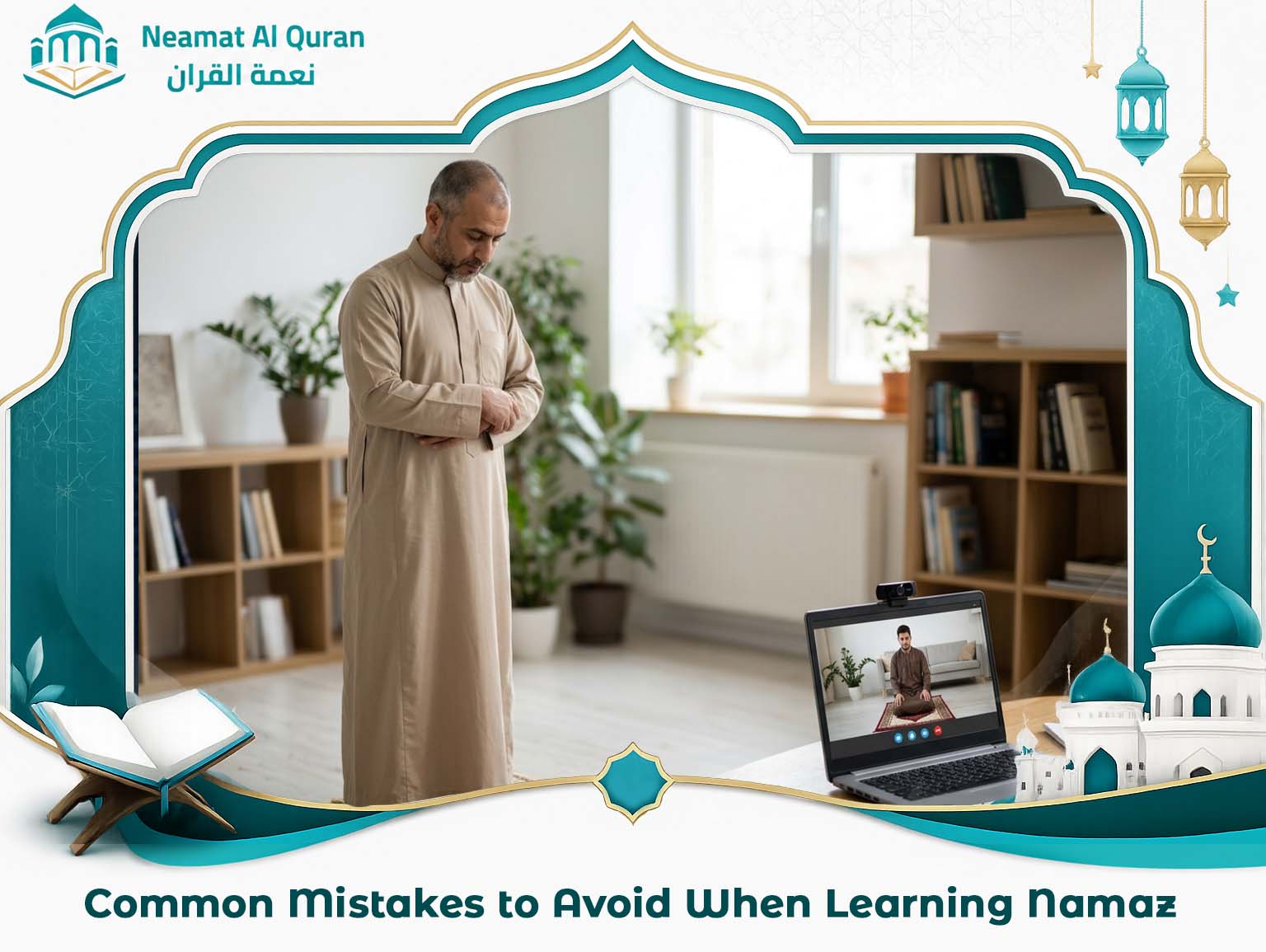
Namaz classes online are more useful when students recognize their learning difficulties. These points are learning considerations, not a substitute for a qualified explanation of Islamic rulings.
Trying to Memorize Everything at Once
Namaz classes online can feel overwhelming when learners study too many details at once. Instead, divide the material into manageable sections and return to previous lessons regularly.
Relying Only on Transliteration
Transliteration can offer an initial reference for learners who cannot yet read Arabic. However, different spellings may represent the same sound differently, and some Arabic sounds are difficult to express through English letters.
Whenever possible, use authentic Arabic text with suitable audio and teacher feedback. Learning about the benefits of learning quran with tajweed can also help learners understand why accurate pronunciation and guided recitation practice matter.
Ignoring Questions About the Learning Method
Students choosing namaz classes may assume every course teaches Salah the same way. In reality, the explanation of certain details can differ between Islamic schools of thought.
Therefore, ask which tradition the teacher follows and seek consistent instruction. If you are unsure about a religious ruling, consult a suitably qualified scholar rather than relying on an unverified online comment.
Choosing a Course Based Only on Price
Cost matters, but it should not be the only consideration. A low price does not establish that a course is suitable, just as a high price does not prove that its teaching is effective.
Compare the syllabus, teacher qualifications, lesson format, communication, and cancellation arrangements. Then assess whether the program meets your actual learning needs.
Expecting Instant Mastery
Every learner progresses differently. Someone familiar with Arabic may need less pronunciation practice than a learner encountering the language for the first time.
Consequently, compare your current skills with your previous performance rather than with another student’s progress. Consistent practice and appropriate guidance are more useful than unrealistic expectations.
What Should You Ask Before Joining Namaz Classes Online?
Before registering for namaz classes, prepare practical questions. Clear answers can help you understand the service and avoid confusion after lessons begin. Consider asking:
- What topics are included in the curriculum, and which level is suitable for me?
- What Islamic school of thought or instructional framework does the teacher follow?
- Will I receive feedback on prayer movements and Arabic recitation?
- Are lessons individual or group-based, and how long does each session last? If individual attention is important, review the format of 1-on-1 online quran classes.
- What happens if I need to change a scheduled lesson?
- Are learning materials available for revision between sessions?
- How are fees, cancellations, and payment arrangements explained?
- How will the teacher help me identify areas that need further practice?
These questions are relevant to both parents selecting lessons for children and adults choosing a learning program for themselves. Most importantly, they help you evaluate the actual service rather than relying solely on promotional statements.
Learning with Neamat Al Quran Academy

Neamat Al Quran Academy provides online Quran education for children and adults, with published services that include Quran recitation, memorization, Tajweed, Arabic language instruction, and Quran interpretation. Its website also describes individual learning sessions, teacher selection, flexible scheduling, and a free trial for its advertised programs.
For learners exploring namaz classes, it is important to distinguish between Quran education and a dedicated Salah course. Neamat Al Quran Academy should confirm whether it currently offers prayer instruction that matches the learner’s needs.
How Its Learning Approach May Support Your Goals?
A structured online learning environment can be useful for students who need guidance, regular practice, and a clear way to communicate with a teacher. Before choosing a program at Neamat Al Quran Academy, confirm that its curriculum covers your subject. When contacting Neamat Al Quran Academy, consider asking:
- Whether dedicated Namaz or Salah lessons are currently offered.
- Whether the teacher can explain prayer movements and related recitations.
- Which learning approach is followed for questions about Islamic rulings.
- Whether lessons can be adapted to a child’s or adult’s current level.
- What the available schedules, fees, and learning arrangements are.
These questions help determine whether Neamat Al Quran Academy’s services fit your goals. They also avoid assuming that every Quran course automatically includes comprehensive prayer instruction.
Choosing the Right Starting Point
Neamat Al Quran Academy may be relevant if your main goal is Quran recitation or Tajweed. However, if you need to learn the practical requirements of Salah, confirm that the selected program explicitly covers them.
Neamat Al Quran Academy’s published course information can serve as a starting point for discussing your learning needs. Ask Neamat Al Quran Academy for current details before registering for dedicated Namaz instruction.
When comparing namaz classes, choose a program that matches your goals, offers accurate instruction, and welcomes questions.
Frequently Asked Questions About Namaz Classes Online
These answers address common questions about namaz classes online, including lesson content, suitable learners, practice, and choosing an instructor.
1. Can I learn Namaz if I do not speak English fluently?
Yes, provided the teacher can communicate in a language you understand or offer suitable language support. Before enrolling, ask which languages are available and how unfamiliar Islamic and Arabic terms will be explained.
2. Do I need special equipment to attend online prayer lessons?
In most cases, a suitable internet connection, a phone or computer, and a quiet learning space are enough. You may also need a notebook and access to the lesson materials. Confirm the provider’s technical requirements before your first session.
3. Can I ask a teacher about a prayer situation that happens only occasionally?
You can ask whether the teacher is qualified to address your question. Some situations require a detailed explanation of Islamic jurisprudence, so the instructor may need to refer you to a qualified scholar. Do not assume that every general prayer course covers individual legal questions.
4. What should I do if I miss several lessons?
Contact the provider to ask about revision materials, rescheduling, and the recommended way to resume learning. Review the last completed topic before continuing, and request clarification if you are unsure whether an important concept was covered.
Conclusion
Namaz classes online help learners approach Salah through instruction, demonstrations, pronunciation practice, and revision. The most suitable option depends on your current level, preferred learning format, language needs, and the kind of guidance you require.
Before enrolling, examine the syllabus, ask about the teacher’s qualifications, and confirm that the program addresses your specific goals. In addition, use self-study resources carefully and seek qualified guidance whenever a religious question requires more than a general explanation.
Neamat Al Quran Academy offers several forms of online Quran education, but you should confirm whether dedicated Salah instruction is currently available before choosing it for that purpose. With an appropriate learning plan and realistic expectations, you can build your knowledge gradually and approach prayer with greater understanding and confidence.