
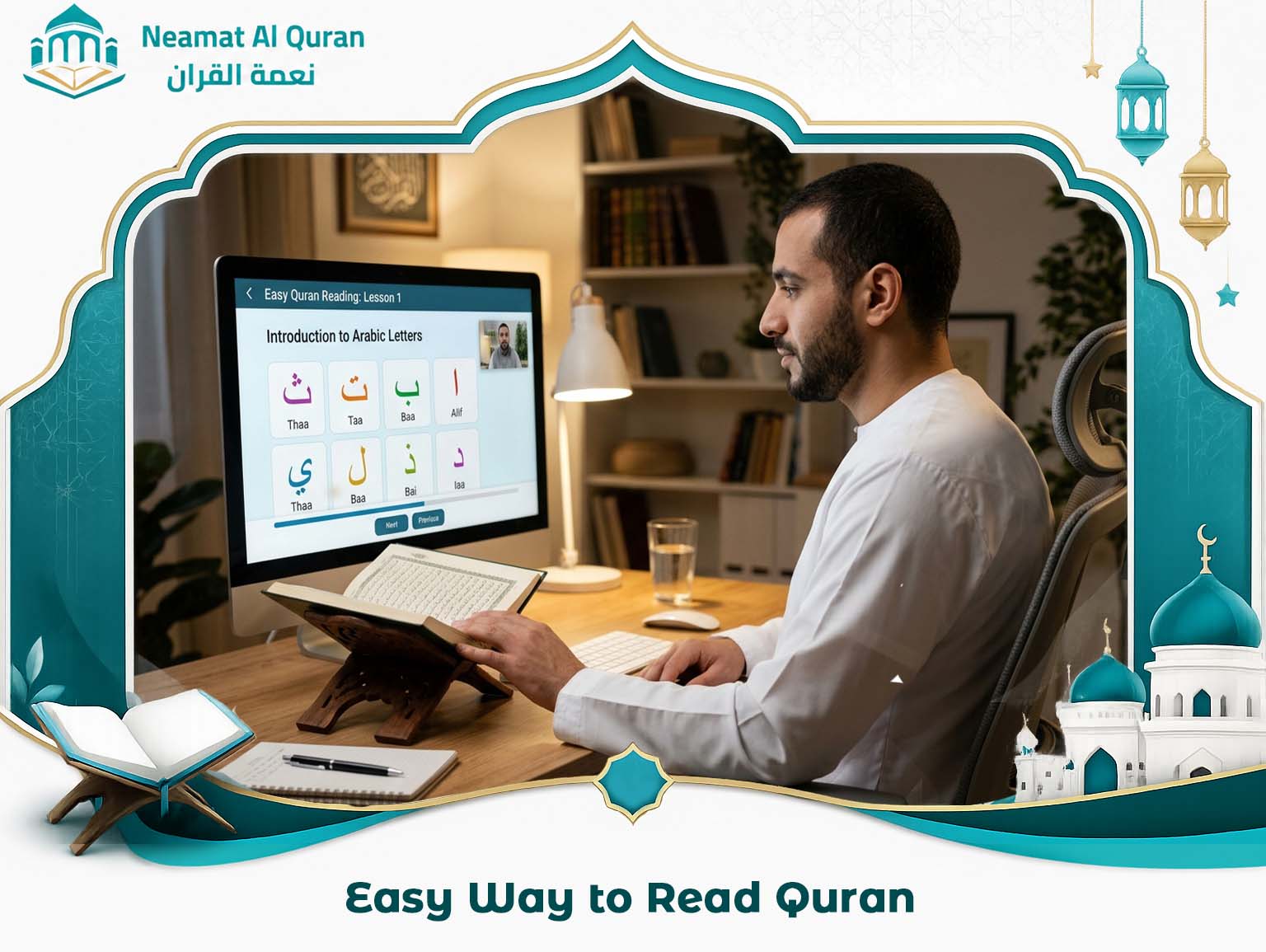
Finding an easy way to read quran can make learning the words of Allah more manageable for beginners, adults, and children. Many Muslims want to improve their Quran reading but feel uncertain about Arabic letters, pronunciation, or Tajweed rules. Fortunately, learning does not have to be complicated when you follow a clear plan and practice consistently.
Reading the Quran correctly is a gradual process that combines recognizing Arabic letters, understanding their articulation points, applying basic Tajweed rules, and listening to experienced reciters. Therefore, beginners should focus on accuracy before attempting to increase their reading speed.
Whether you are opening the Mushaf for the first time or returning to Quran reading after several years, the right learning approach can help you develop confidence. In addition, short daily exercises can make progress easier to maintain alongside work, education, and family responsibilities.
This guide explains practical methods, essential pronunciation rules, common mistakes, and daily exercises that support an effective learning journey. It also explores how Neamat Al Quran Academy can be considered when looking for structured Quran learning support.
Why Does Finding an Easy Way to Read Quran Matters?
Learning to read the Quran is more than recognizing Arabic words. It involves developing the ability to pronounce every letter correctly, observe its characteristics, and follow the rules of recitation.
For beginners, an organized learning method makes these responsibilities easier to understand. Instead of trying to memorize every Tajweed rule immediately, learners can develop their skills through manageable stages. Finding an easy way to read quran is particularly important for people who:
- Have never studied Arabic letters before.
- Can recognize Arabic words but struggle with pronunciation.
- Learned Quran reading during childhood but stopped practicing.
- Want to improve their recitation before memorising additional surahs.
- Need a manageable learning routine alongside daily responsibilities.
- Want to read independently without depending on transliteration.
Moreover, learning gradually helps students recognize their weaknesses before they become repeated pronunciation habits.
The goal should not be to finish several pages quickly. Rather, learners should develop accurate recitation that becomes more natural through regular practice.
The Spiritual Importance of Reading the Quran Correctly
The Quran occupies a central place in Muslim worship and daily life. Consequently, learning to read it correctly is a meaningful goal for Muslims of different ages. Allah says:
“وَرَتِّلِ الْقُرْآنَ تَرْتِيلًا”
This instruction appears in Surah Al-Muzzammil, verse 4, encouraging measured and deliberate Quran recitation.
Furthermore, the Prophet Muhammad ﷺ explained the reward associated with reading the Quran. In a hadith narrated by Abdullah ibn Masud, he stated that whoever reads a letter from Allah’s Book receives a good deed multiplied by ten.
This narration is recorded in Jami’ at-Tirmidhi, Hadith 2910.
The teaching provides encouragement for beginners who may feel discouraged by their initial difficulties. Every improvement in pronunciation represents meaningful progress.
However, the spiritual value of recitation should not become a reason to neglect accuracy. Instead, learners should combine sincere effort, patience, and the desire to improve their reading.
Start Your Quran Learning Journey with Confidence
Are you ready to improve your Quran reading and recite the words of Allah with greater confidence? Take the first step with Neamat Al Quran Academy and discover a learning experience designed around your individual needs.
Whether you are a complete beginner, an adult returning to Quran study, or a parent looking for suitable lessons for your child, guided instruction can help you strengthen your Arabic reading, master essential Tajweed rules, and improve your pronunciation.
Don’t let uncertainty or a busy schedule delay your progress. Contact Neamat Al Quran Academy today, explore the available Quran learning programmes, and begin your journey towards accurate and confident Quran recitation.

What Is the Easiest Way to Read the Quran for Beginners?
The easiest approach is to divide Quran reading into smaller skills rather than studying everything simultaneously.
A complete beginner needs to understand the Arabic alphabet before moving towards connected words and longer passages. Afterwards, learning pronunciation and basic Tajweed becomes more manageable. The following progression provides a practical starting point:
- Recognise the Arabic alphabet and distinguish similar letters.
- Learn the short vowels and other pronunciation marks.
- Practice combining letters into simple words.
- Study the correct articulation points of Arabic letters.
- Understand basic Tajweed rules.
- Read short Quranic passages with guidance.
- Listen to experienced reciters and imitate their pronunciation.
- Review previous lessons regularly.
This sequence prevents beginners from feeling overwhelmed by unfamiliar terminology.
For example, someone who struggles to distinguish between ح and ه should practise these sounds separately before attempting complicated Quranic passages.
Similarly, a learner who understands individual letters but cannot connect them should spend more time reading short combinations.
An easy way to read quran should always match the learner’s current ability. Starting with familiar material and gradually increasing difficulty usually makes practice more productive.
Step 1: Learn the Arabic Letters Before Reading the Quran
Arabic has 28 basic letters, and each has a distinctive written form and pronunciation. Although some letters resemble one another, their sounds and articulation points can be different. Therefore, memorising their shapes alone is not enough.
Beginners should study the letters individually before practicing connected words. Pay particular attention to similar-looking letters:
- ب، ت، ث
- ج، ح، خ
- د، ذ
- ر، ز
- س، ش
- ص، ض
- ط، ظ
- ع، غ
These differences become easier to recognize when students combine visual practice with listening exercises.
A useful exercise is to select five letters each day, pronounce them aloud, and write their different forms. Afterwards, review the previous letters before introducing new ones.
The Noorani Qaida is a widely used foundational resource for introducing Arabic letters, vowel marks, combinations, and basic reading patterns.
It provides a progressive introduction that can help beginners move from isolated letters towards reading connected Arabic text.
Consequently, studying the Qaida can be an effective part of an easy way to read quran, especially for learners without previous Arabic reading experience.
Step 2: Understand Arabic Harakat and Pronunciation Marks
After recognizing the letters, learners need to understand the marks that determine how many Arabic letters are pronounced.
These marks are essential because changing or overlooking them can affect pronunciation and sometimes the meaning of a word.
The main beginner marks include:
| Mark | Arabic name | Basic function |
|---|---|---|
| َ | Fatha | Produces a short vowel sound similar to a |
| ِ | Kasra | Produces a short vowel sound similar to i |
| ُ | Damma | Produces a short vowel sound similar to u |
| ْ | Sukoon | Indicates that the letter has no vowel |
| ّ | Shaddah | Indicates that the letter is doubled |
| ً ٍ ٌ | Tanween | Adds an ending nasal vowel sound |
For example, the letter ب changes its pronunciation according to the vowel mark:
- بَ: Ba
- بِ: Bi
- بُ: Bu
Practise these combinations repeatedly until you can recognise them without stopping. Furthermore, pay attention to Sukoon and Shaddah because they require different pronunciation patterns.
Understanding these marks gives beginners a stronger foundation for reading Quranic words accurately.
Step 3: Practice Reading Connected Arabic Words
Recognizing individual letters does not automatically mean that someone can read complete Quranic words.
Arabic letters connect differently depending on their position within a word. Some letters also have different written forms at the beginning, middle, or end.
Therefore, beginners should practise moving from individual letters towards short combinations.
Start with simple exercises:
- Read two-letter combinations.
- Move towards three-letter words.
- Practice words containing different vowel marks.
- Identify letters with Sukoon.
- Read words containing Shaddah.
- Repeat familiar combinations until they become easier.
For example, learners can practice reading short words from familiar Quranic surahs under appropriate guidance.Avoid moving too quickly into long passages before becoming comfortable with connected letters.
An easy way to read quran requires patience during this stage because reading fluency develops through repetition rather than memorizing letter names alone.
Once you can recognize familiar combinations, begin reading short verses while maintaining correct pronunciation.
Easy Way to Read Quran Through Correct Makharij
Makharij refers to the articulation points from which Arabic letters originate. Learning these points is one of the most important parts of Quran recitation because several Arabic sounds do not have direct equivalents in English.
For instance, English-speaking beginners may confuse ع with أ or ح with ه. Although these letters might initially sound similar to an inexperienced listener, they have different articulation points.
Incorrect pronunciation can sometimes change the meaning of a Quranic word.
Therefore, learning makharij should involve listening, imitation, and correction rather than relying entirely on written explanations.
The Five Main Areas of Arabic Articulation
Traditional Tajweed instruction identifies five major areas associated with the articulation of Arabic letters.
1. Al-Jawf (The Empty Space)
Al-Jawf refers to the open space inside the mouth and throat. It is associated with the three mad letters:
- Alif (ا).
- Waw (و) when functioning as a long vowel.
- Ya (ي) when functioning as a long vowel.
These letters are important when studying natural elongation and other Madd rules.
2. Al-Halq (The Throat)
The throat produces six Arabic letters:
ء، ه، ع، ح، غ، خ
These letters emerge from different positions within the throat.
Beginners should listen carefully to distinguish their sounds, particularly ع and ح, which often require additional practice.
3. Al-Lisan (The Tongue)
The tongue is responsible for the articulation of the largest group of Arabic letters.
Different areas of the tongue interact with the teeth, gums, or roof of the mouth to produce particular sounds.
Examples include:
- ق and ك.
- ج، ش، ي.
- ض and ل.
- ن and ر.
- ت، د، ط.
4. Ash-Shafatan (The Two Lips)
The lips contribute to the pronunciation of four letters:
ف، ب، م، و
Learners should observe how the lips move when producing these sounds.
5. Al-Khayshum (The Nasal Passage)
Al-Khayshum is associated with the nasal sound known as Ghunnah.
This sound appears in particular Tajweed situations involving Noon and Meem.
Understanding these five areas provides an essential foundation for anyone searching for an easy way to read quran without developing incorrect pronunciation habits.
How to Practise Makharij at Home
You can improve your awareness of articulation points through short exercises.
Try the following routine:
- Choose one Arabic letter that you find difficult.
- Listen to a qualified Quran teacher pronouncing it.
- Repeat the sound slowly.
- Compare it with a similar letter.
- Record your pronunciation.
- Ask a knowledgeable teacher to identify mistakes.
For example, practise distinguishing between س and ص.
The first is pronounced with a lighter sound, while the second has a heavier quality. Repeating both letters in suitable words helps develop awareness of the difference.
Nevertheless, recordings and written descriptions cannot replace direct pronunciation correction. A teacher can identify mistakes that beginners might not recognise themselves.
Easy Way to Read Quran by Learning Sifat Al-Huruf
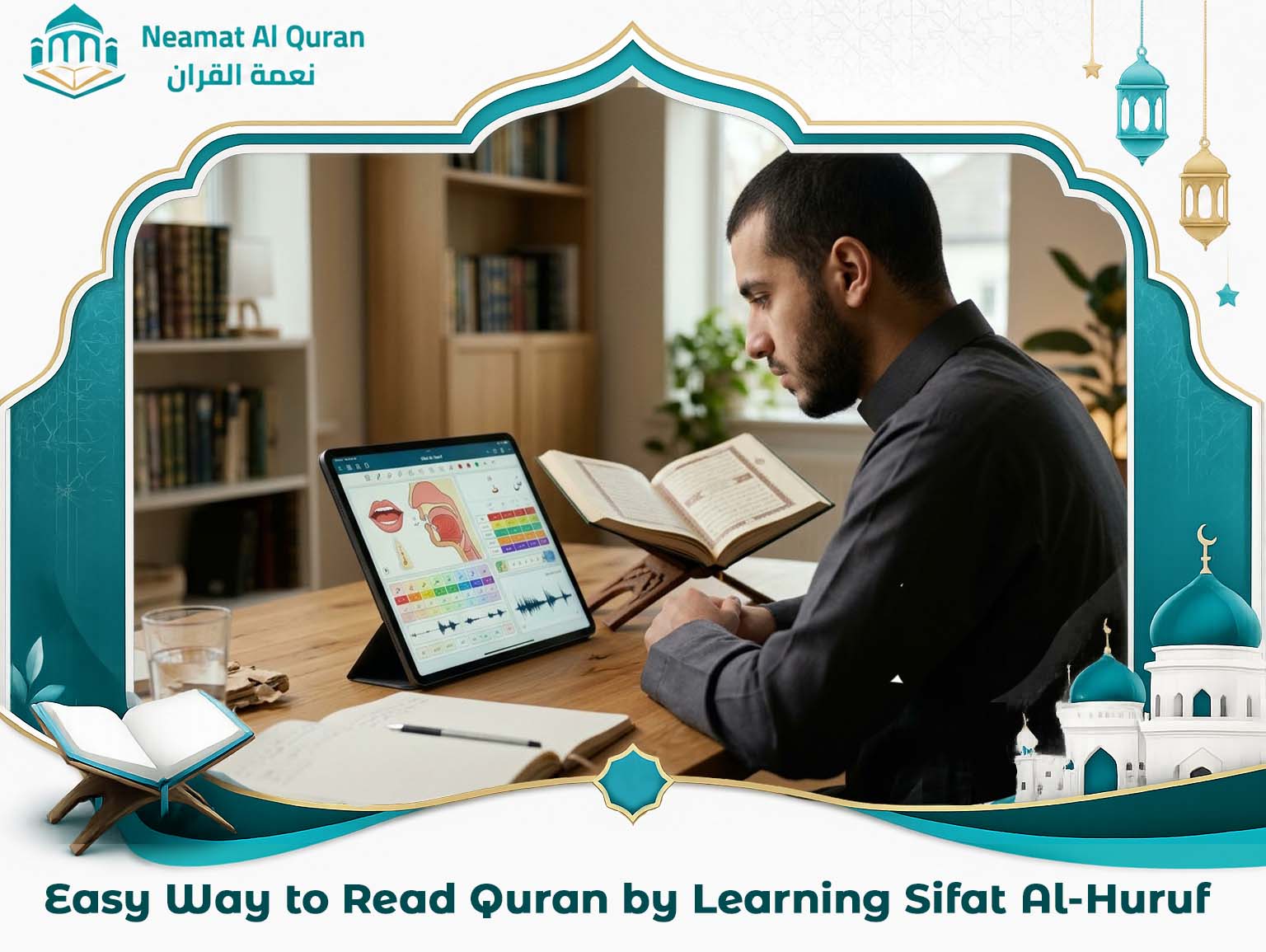
Makharij explains where a letter originates, while Sifat Al-Huruf describes its pronunciation characteristics. These characteristics help distinguish Arabic letters even when they share similar articulation points.
For beginners, learning selected characteristics is more practical than attempting to memorise the entire Tajweed system immediately.
1. Tafkhim and Tarqiq
Tafkhim means pronouncing a letter with heaviness, while Tarqiq refers to lightness.
The commonly recognised letters of Tafkhim are:
خ، ص، ض، غ، ط، ق، ظ
These letters are generally pronounced with a fuller sound.
Other Arabic letters are generally pronounced lightly, although certain letters, particularly ر and the letter ل in the name of Allah, have specific conditions.
Consequently, learners should study these exceptions with appropriate examples.
2. Qalqalah
Qalqalah is a slight echoing or bouncing quality heard when certain letters have Sukoon.
The five Qalqalah letters are:
ق، ط، ب، ج، د
A common way to remember them is the expression:
قُطْبُ جَدٍّ
Beginners should practise these letters in Quranic examples while avoiding the addition of an unnecessary vowel.
3. Hams and Jahr
Hams and Jahr describe characteristics related to the flow of breath during pronunciation.
Hams involves the continuation of breath, while Jahr involves a different pattern of breath restriction during articulation.
Understanding these characteristics helps students recognise how Arabic letters differ.
4. Shiddah and Rakhawah
Shiddah and Rakhawah describe the behaviour of sound during pronunciation. With Shiddah, the sound is stopped at the articulation point. With Rakhawah, the sound continues. Between these characteristics is Tawassut, which represents an intermediate condition.
Learning these differences gradually helps beginners develop greater control over their pronunciation. An easy way to read quran should introduce these characteristics through practical examples instead of overwhelming students with terminology.
Easy Way to Read Quran by Understanding Basic Tajweed Rules
Tajweed is the set of rules that guides the correct pronunciation of Quranic letters and words. Beginners do not need to master every advanced rule before starting Quran reading. However, they should learn the essential rules gradually and apply them during practice.
The following topics provide a useful starting point.
1. Learn Madd and Quranic Elongation
Madd refers to extending a vowel sound according to specific Tajweed rules. Natural Madd, known as Madd Tabee’i, is generally held for two counts.
Other types have different durations depending on the conditions surrounding the madd letter.
For example:
- Madd Tabee’i: Two counts.
- Madd Muttasil: Generally four or five counts in Hafs, depending on the recognised method.
- Madd Munfasil: Generally four or five counts in common teaching methods, with recognised variations.
- Madd Lazim: Six counts.
Beginners should first understand natural Madd before moving towards more complicated categories. A useful practice is to listen to one Quranic example and count the elongation carefully. Afterwards, repeat the example several times until the duration becomes more consistent.
2. Understand Ghunnah
- Ghunnah is a nasal sound produced through the nasal passage.
- It is particularly noticeable with Noon and Meem carrying Shaddah.
- The sound is generally held for two counts in the relevant situations.
- Beginners should listen carefully to distinguish Ghunnah from ordinary pronunciation.
- For better practice, select short Quranic examples containing Noon or Meem with Shaddah and repeat them slowly.
3. Study the Four Rules of Noon Sakinah and Tanween
Noon Sakinah and Tanween have four main Tajweed rulings. These rules determine how Noon is pronounced when followed by particular Arabic letters.
Izhar
Izhar means clear pronunciation. It applies when Noon Sakinah or Tanween is followed by one of the six throat letters:
ء، ه، ع، ح، غ، خ
Idgham
Idgham means merging one sound into another under specific conditions. It applies when Noon Sakinah or Tanween is followed by one of the letters:
ي، ر، م، ل، و، ن
Some Idgham situations include Ghunnah, while others do not.
Iqlab
Iqlab means changing the Noon sound into a concealed Meem sound with Ghunnah. It occurs when Noon Sakinah or Tanween is followed by the letter ب.
Ikhfa
Ikhfa means concealing the Noon sound between clear pronunciation and complete merging. It applies when Noon Sakinah or Tanween is followed by one of the remaining fifteen letters.
These four rules become easier when students study them separately and practise Quranic examples.
4. Learn the Rules of Meem Sakinah
Meem Sakinah also has three important rulings.
They are:
- Ikhfa Shafawi: Occurs when Meem Sakinah is followed by ب.
- Idgham Shafawi: Occurs when Meem Sakinah is followed by another Meem.
- Izhar Shafawi: Applies when Meem Sakinah is followed by letters other than ب and م.
Understanding these rules helps beginners improve their pronunciation and recognise how letters interact during recitation.
Instead of memorising definitions alone, read examples aloud and listen to how qualified reciters apply each ruling.
Easy Way to Read Quran by Listening and Imitating Expert Reciters
Listening is an important part of Quran education because recitation is transmitted through oral learning.Written explanations can describe articulation points and pronunciation rules. However, listening allows beginners to hear how these principles work together in actual verses.
The traditional method of learning through a teacher is known as Talaqqi.In this approach, the student listens to the teacher, repeats the passage, and receives correction.
A similar learning routine can be followed through online lessons when the student has suitable audio equipment and an opportunity for direct interaction.
Choose One Reciter for Regular Listening
Beginners often benefit from choosing a reciter whose pronunciation is clear and measured.
Some well-known reciters include:
- Sheikh Mahmoud Khalil Al-Husary.
- Sheikh Muhammad Siddiq Al-Minshawi.
- Sheikh Mishary Rashid Alafasy.
Listen to a short passage rather than attempting to follow an entire surah immediately. The purpose is to recognise individual sounds, pauses, elongations, and pronunciation patterns.
Follow the Listen-and-Repeat Method
This technique makes listening an active learning exercise.
Follow these steps:
- Play one short Quranic verse.
- Listen carefully without speaking.
- Pause the recording.
- Repeat the verse aloud.
- Play the original recitation again.
- Compare your pronunciation.
- Repeat the exercise until you become more comfortable.
Furthermore, focus on one pronunciation difficulty at a time. For example, if you struggle with the letter ع, pay particular attention to verses containing that letter.
Record Your Quran Recitation
Recording yourself provides an additional opportunity to review your progress. Use your phone to record a short passage once or twice each week. Then compare your recording with the selected reciter or discuss it with your teacher. Pay attention to:
- Incorrect letter pronunciation.
- Missing or shortened elongations.
- Unnecessary pauses.
- Weak application of Ghunnah.
- Confusion between heavy and light letters.
However, do not depend entirely on self-assessment. A beginner may not recognise every mistake without professional guidance.
This combination of listening, repeating, and receiving correction makes an easy way to read quran more practical and measurable.
The Three Levels of Quran Recitation Explained
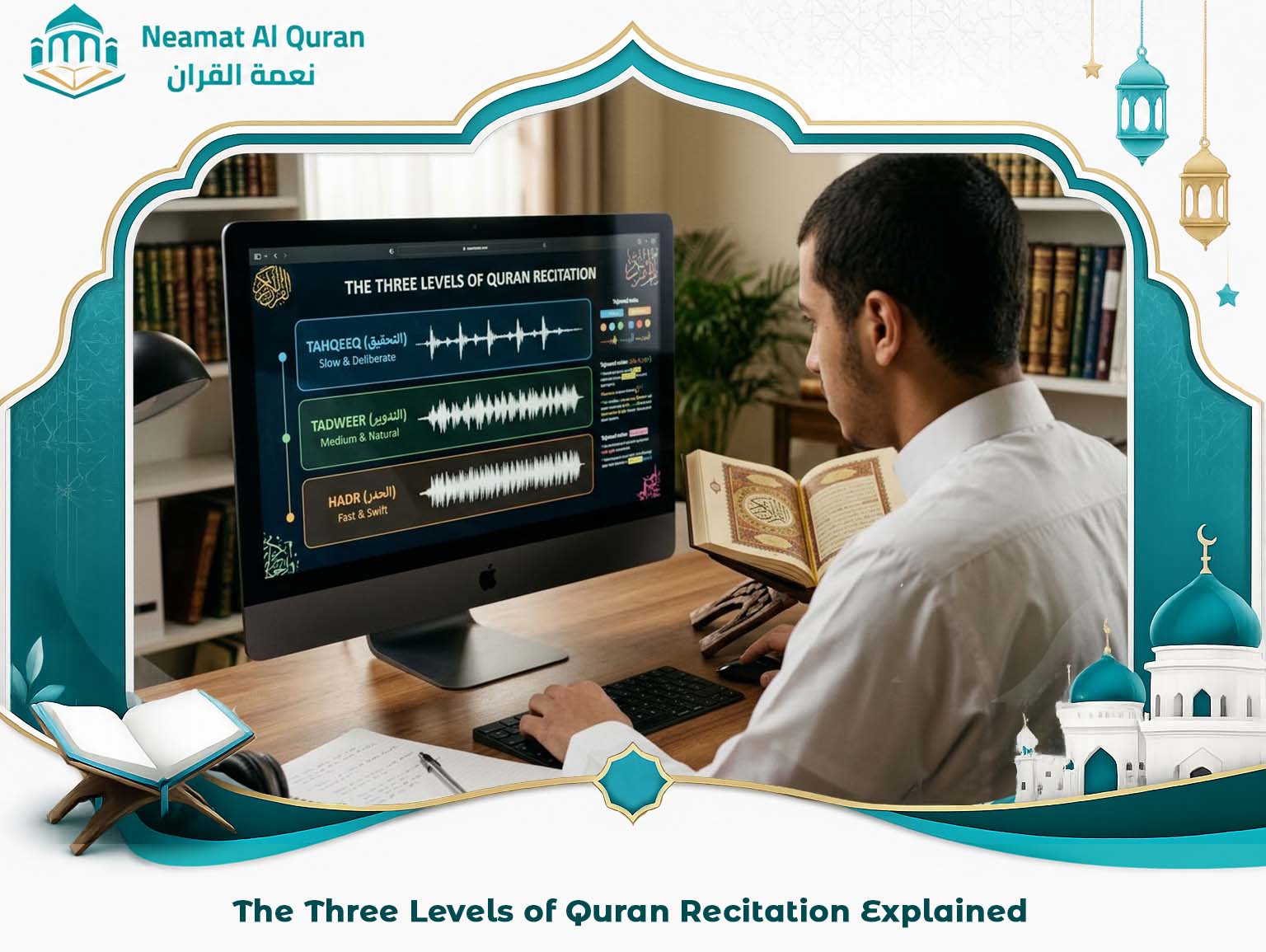
Quran recitation has different recognised speeds. Understanding these levels helps beginners avoid confusing fluent reading with hurried reading.
The three commonly discussed levels are Tahqiq, Tadwir, and Hadr.
1. Tahqiq: Slow and Careful Recitation
Tahqiq is the slowest pace of recitation. It is particularly useful when learning new pronunciation rules because the reciter has more time to demonstrate each letter.
During this stage, learners can focus on:
- Correct articulation points.
- Letter characteristics.
- Madd durations.
- Ghunnah.
- Appropriate pronunciation.
Therefore, Tahqiq is a suitable learning pace for beginners who need to improve accuracy.
2. Tadwir: Moderate Recitation
Tadwir is a middle pace between Tahqiq and Hadr. It is useful for regular reading and allows the reciter to maintain a comfortable rhythm while observing Tajweed rules.
Once beginners become more familiar with pronunciation, they can gradually practise this pace under suitable guidance.
3. Hadr: Faster Recitation
Hadr is a faster pace generally used by experienced reciters. However, faster recitation does not mean ignoring Tajweed or shortening required elongations.
Every letter must retain its correct pronunciation and applicable characteristics. Beginners should not attempt Hadr before developing sufficient accuracy.
The most practical progression is to begin slowly, improve consistency, and increase speed only when pronunciation remains correct.
A 30-Minute Daily Routine: Easy Way to Read Quran Consistently
Consistency is more important than completing long lessons occasionally. A beginner who practises for thirty minutes regularly can develop better reading habits than someone who studies for several hours without maintaining a routine. The following schedule divides daily practice into three manageable sections.
| Practice | Time | Main objective |
|---|---|---|
| Arabic letters and Noorani Qaida | 10 minutes | Improve letter recognition |
| Quran reading | 10 minutes | Apply pronunciation rules |
| Listening and repetition | 10 minutes | Develop listening skills |
First 10 Minutes: Review Arabic Letters
Start with the letters or combinations you studied previously. Do not introduce new material immediately if you still struggle with earlier lessons. Once you can recognise these patterns comfortably, move towards new exercises.
Instead:
- Read familiar letters aloud.
- Practise difficult combinations.
- Review Fatha, Kasra, and Damma.
- Repeat words containing Sukoon and Shaddah.
Next 10 Minutes: Read from the Mushaf
Choose a short passage that matches your current reading ability. Beginners can start with Surah Al-Fatihah and familiar short surahs.
Read slowly and concentrate on applying the rules you have already studied. For instance, if you recently learned Madd Tabee’i, identify examples during your reading exercise. Avoid trying to correct every possible weakness simultaneously.
Final 10 Minutes: Listen and Repeat
Choose one verse from a trusted reciter. Listen carefully, pause, and repeat the verse. Afterwards, compare your pronunciation and note any difficult sounds. If possible, share your recording with a qualified teacher for feedback. An easy way to read quran becomes more sustainable when each practice session has a clear purpose.
Weekly Quran Reading Schedule
A weekly schedule can help learners organise their progress without making daily practice unnecessarily complicated.
| Day | Main learning activity |
|---|---|
| Monday | Review Arabic letters and vowel marks |
| Tuesday | Practise connected Arabic words |
| Wednesday | Study makharij and difficult letters |
| Thursday | Review basic Tajweed rules |
| Friday | Read familiar Quranic passages |
| Saturday | Listen, imitate, and record recitation |
| Sunday | Review previous lessons and identify weaknesses |
You can adjust this schedule according to your responsibilities and current level.For example, adults with limited free time may prefer shorter sessions after Fajr or Maghrib.
The important point is to maintain regular contact with the Quran rather than waiting for a perfect opportunity to study.
Common Mistakes That Make Quran Reading Difficult
Many beginners face similar challenges when learning Quran reading. However, recognising these mistakes early can prevent incorrect pronunciation habits and make improvement easier.
1. Learning Without Pronunciation Correction
Books and educational videos explain Tajweed concepts, but they cannot identify every individual pronunciation mistake.
For example, a learner may repeatedly pronounce ق incorrectly without noticing the problem. Therefore, direct feedback from a qualified teacher is essential, particularly when practising difficult Arabic sounds. Taking 1-on-1 online quran classes can provide opportunities to practise recitation and receive individual pronunciation guidance.
2. Reading Too Quickly
Some beginners try to increase their reading speed before mastering individual Arabic letters. Unfortunately, this habit can lead to shortened elongations, unclear pronunciation, and missed sounds.
Instead, practise slowly until you can pronounce each letter correctly. Gradually increase your reading speed only when you can maintain accurate recitation.
3. Ignoring Makharij
Recognising the Arabic alphabet does not automatically mean that every letter is pronounced correctly.
Letters such as ض، ظ، ح، ع، and ق require particular attention because their articulation points differ.
Therefore, dedicate separate practice sessions to these sounds instead of concentrating exclusively on reading complete pages. Learning about the benefits of learning quran with Tajweed also helps learners understand why correct pronunciation matters during recitation.
4. Memorising Tajweed Definitions Without Applying Them
Understanding the definition of Idgham or Ikhfa is only one part of learning Tajweed. Students must also recognise these rules in actual Quranic words and apply them during recitation.
For this reason, practical examples should accompany every new lesson. Ask your teacher to demonstrate each rule and provide exercises that help you recognise it independently.
5. Depending Entirely on Transliteration
Transliteration may help beginners recognise approximate Arabic sounds temporarily. Nevertheless, English letters cannot represent every Arabic pronunciation accurately.
Depending on transliteration for too long can create confusion, particularly with letters that have no direct English equivalents.
Instead, learn the original Arabic letters and practise their correct articulation. This approach provides a stronger foundation for reading directly from the Mushaf.
6. Practising Irregularly
Studying for several hours once a week may be less effective than practising for shorter periods regularly. A consistent routine helps learners remember previous lessons and identify areas requiring additional attention.
Even when your schedule becomes busy, maintain a short daily Quran reading session. Furthermore, connect your practice with your regular worship whenever possible.
7. Avoiding Difficult Verses
Some learners repeatedly read familiar surahs while avoiding passages containing difficult letters or Tajweed rules. Although reviewing familiar material is useful, improvement also requires practising weaker areas.
Ask your teacher to identify suitable exercises based on your actual reading difficulties. Additionally, understanding the meaning of unfamiliar passages can make your learning more engaging. Exploring what is tafseer can introduce you to the study of Quranic meanings and explanations.
How to Start Improving Your Quran Reading in Two Weeks?
A two-week preparation plan can help beginners organise their first learning activities. The objective is not to master Quran recitation within fourteen days. Instead, focus on establishing a foundation and identifying the skills that need further attention.
Days 1–3: Assess Your Current Reading Level
Start by checking whether you can recognise Arabic letters individually. Then, review their different written forms and vowel marks.
Write down any letters that you find difficult to pronounce or distinguish. This assessment will help you choose suitable exercises for the following days.
Days 4–6: Practise Basic Arabic Combinations
Move gradually from isolated letters towards connected words. Read short examples and practise Fatha, Kasra, Damma, Sukoon, and Shaddah.
If necessary, return to the Noorani Qaida to strengthen your foundation. Repeat familiar exercises until you can recognise the combinations more confidently.
Days 7–9: Focus on Makharij
Select difficult Arabic letters and practise their articulation points. Listen to qualified reciters and repeat suitable examples. Afterwards, record your pronunciation and review the sounds that need improvement. Whenever possible, ask a teacher to evaluate your pronunciation and correct mistakes.
Days 10–12: Introduce Basic Tajweed
Start with natural Madd and Ghunnah. Afterwards, explore the four rules of Noon Sakinah and Tanween. Focus on recognising these rules in Quranic words rather than memorising large amounts of information at once.
Days 13–14: Review and Read Short Passages
Choose familiar verses and read them slowly. Record your recitation and identify areas that require additional practice.
At the end of the two weeks, compare your current ability with your initial assessment. This approach provides a realistic starting point for anyone seeking an easy way to read Quran without expecting instant results.
How Can Adults Find an Easy Way to Read Quran?
Adults sometimes believe that learning Quran reading becomes difficult after childhood. However, people can develop their reading skills at different stages of life through suitable instruction and regular practice.
Their main challenge is often finding enough time to study alongside work, family responsibilities, and other commitments.
A manageable learning plan can make this process easier. Adults can also combine Quran reading with other Islamic learning activities, including quran memorization tips for adults, when they are ready to develop their memorization skills.
Set Realistic Learning Goals
Avoid setting goals that require several hours of daily study when your schedule cannot support them. Instead, establish achievable targets that fit your current ability.
For example:
- Recognise five new Arabic combinations.
- Review one Tajweed rule.
- Practise Surah Al-Fatihah.
- Read a short passage with a teacher.
- Record one recitation exercise.
Small goals help adults maintain motivation while managing their responsibilities. Moreover, completing manageable exercises regularly makes progress easier to recognise.
Start from Your Actual Reading Level
Adults who studied Quran during childhood may remember some letters but forget others. Therefore, they should not automatically begin from the absolute beginning or assume they can read fluently.
A simple assessment can identify the skills that need attention. Some learners may need to review the Arabic alphabet, while others can start directly with pronunciation and Tajweed correction.
Choose a Practical Study Time
The best learning time is one that you can maintain regularly.
Some adults prefer practising after Fajr because their surroundings are quieter. Others find evenings more convenient after completing work and family responsibilities.
Whichever time you choose, consistency matters more than following someone else’s routine. You can also organise your Islamic learning schedule around prayer times and explore namaz classes online if you want to improve your understanding of daily prayer.
Can Online Quran Lessons Provide an Easy Way to Read Quran?
Online Quran education offers an easy way to read quran for learners who cannot regularly attend in-person lessons. It can be convenient for adults, children, and families who prefer studying from home.
However, the learning experience depends on the teaching arrangement, lesson structure, and opportunities for pronunciation correction.
When evaluating online Quran lessons, consider these points:
- Does the programme offer an easy way to read quran at your current level?
- Can the teacher listen to your recitation directly?
- Are pronunciation mistakes corrected during lessons?
- Does the programme include practical Tajweed exercises?
- Can you review previous lessons?
- Are the lesson arrangements suitable for your schedule?
A live lesson supports an easy way to read quran by allowing learners to read aloud and receive feedback. Recorded lessons and supplementary materials can also support revision between sessions. Nevertheless, watching videos alone does not guarantee correct recitation.
An easy way to read quran through online education still requires active participation and regular pronunciation practice.
Choosing Neamat Al Quran Academy for Quran Learning
Learners seeking an easy way to read quran with additional guidance may consider Neamat Al Quran Academy when exploring Quran education options.
Before choosing a programme, understand the available support and whether it matches your current needs.
For example, a complete beginner may need foundational Arabic reading lessons, while someone who already reads the Mushaf may require focused Tajweed correction.
When considering Neamat Al Quran Academy, ask about the available learning levels, teaching arrangements, and opportunities for individual feedback. You should also clarify whether the learning approach includes:
- Arabic letter recognition.
- Correct pronunciation and makharij.
- Practical Tajweed instruction.
- Guided Quran reading.
- Regular revision activities.
- Assessment of individual learning progress.
These questions help determine whether Neamat Al Quran Academy offers an easy way to read quran that suits your goals.
Furthermore, learners should explain their previous experience before starting lessons. This helps identify whether they need Noorani Qaida, pronunciation practice, or advanced recitation exercises.
An organised learning approach makes finding an easy way to read quran more focused.
Questions to Ask Before Starting Quran Lessons
Before enrolling in Neamat Al Quran Academy, consider preparing questions about your learning requirements and your preferred easy way to read quran. For example:
- Which course suits someone who cannot read Arabic?
- How are students’ pronunciation mistakes corrected?
- Can lessons focus on difficult Arabic letters?
- What materials support beginner Tajweed?
- How is learning progress evaluated?
These questions help establish realistic expectations before beginning a programme. Additionally, explain whether you are learning independently, returning after a long break, or helping your child develop Quran reading skills.
The most suitable starting point depends on the learner’s actual ability rather than age alone. Neamat Al Quran Academy can be one option to investigate when comparing Quran learning opportunities. However, confirm the current programme details directly before making a decision.
Practical Tips to Make Quran Reading Easier Every Day
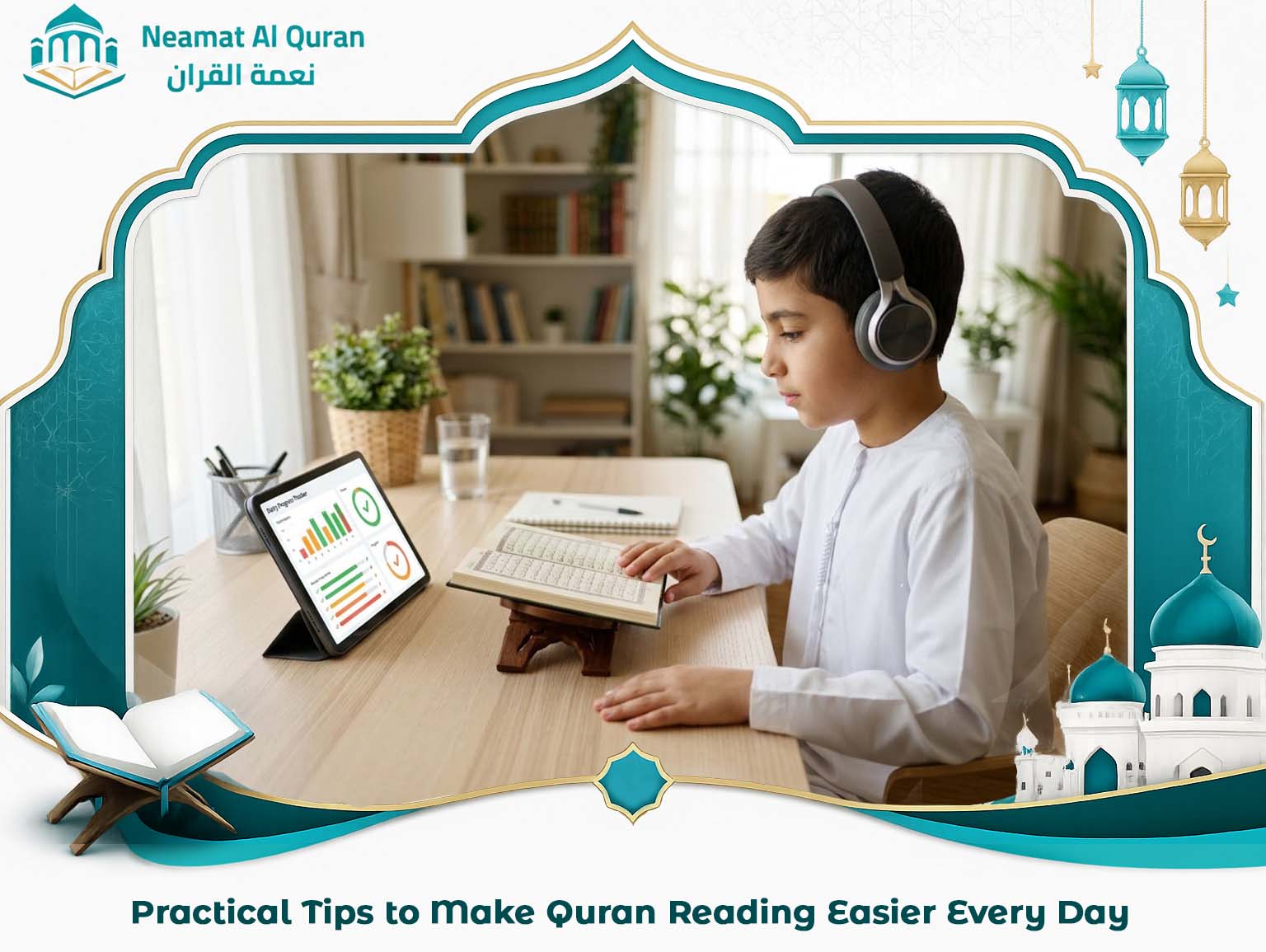
Developing good study habits provides an easy way to read quran more comfortably over time. These suggestions can support beginners without requiring complicated equipment or extensive preparation.
Keep Your Mushaf and Learning Materials Ready
Prepare your Quran, notebook, and study materials before each session. This creates an easy way to read quran by reducing interruptions and helping you focus.
A colour-coded Tajweed Mushaf may help learners identify certain pronunciation rules, provided they understand what the colours represent.
Read the Same Passage More Than Once
Repeated reading offers an easy way to read quran with greater familiarity. However, repetition should not become careless. Read slowly, identify difficult words, and ask for correction when necessary.
Learn One New Rule at a Time
Trying to study every Tajweed topic simultaneously can overwhelm beginners. Instead, choose one rule and practise it using suitable examples. Once you understand its application, introduce another rule.
Maintain a Learning Notebook
A learning notebook provides an easy way to read quran more systematically by recording difficult letters, pronunciation mistakes, and Tajweed topics requiring revision. For example, you might record:
| Learning difficulty | Practice activity |
|---|---|
| Confusing ح and ه | Listen and repeat |
| Weak pronunciation of ق | Practise makhraj exercises |
| Incorrect Madd duration | Count elongation |
| Forgetting Ikhfa | Review Quranic examples |
| Difficulty reading connected words | Return to Qaida exercises |
Celebrate Small Improvement
Progress is measured by pages read. Sometimes, pronouncing one difficult letter correctly marks an achievement and supports an easy way to read quran.
Reading a short surah without interruptions shows familiarity. Recognising these improvements encourages learners to continue at their own pace using an easy way to read quran.
Frequently Asked Questions About an easy way to read quran
These answers show how an easy way to read quran can support pronunciation, Tajweed practice, and consistent reading.
1. Should I learn Quran reading in Hafs or Warsh first?
The tradition depends on your environment and teacher’s guidance. Build your Arabic reading foundation before exploring recognised Qira’at and riwayat; this creates an easy way to read quran with greater confidence.
2. Can someone with dyslexia learn to read the Quran?
Yes. Dyslexia does not prevent Quran learning. Individual instruction, repeated exercises, clear visual materials, and an adapted pace can make an easy way to read quran more accessible.
3. Is an easy way to read quran possible without memorising Tajweed terminology?
No. Memorising every definition is unnecessary. Learn relevant rules gradually and apply them through guided recitation; this practical approach offers an easy way to read quran correctly.
4. Can an easy way to read quran help when I forget Arabic letters?
Return to short revision exercises and practise confusing letters in different combinations. Spaced repetition, writing, listening, and regular assessment strengthen recognition and help maintain an easy way to read quran over time.
Conclusion
Finding an easy way to read quran begins with understanding your current ability and following a structured learning progression.
Start with Arabic letters, practise vowel marks, develop your articulation, and gradually introduce Tajweed rules. Additionally, listen to experienced reciters, repeat short passages, and seek correction whenever possible.
Remember that accurate recitation develops through patience and consistency rather than rushing through lessons.
Whether you are an adult returning to Quran study or a parent helping a child begin, regular practice can make the learning journey more manageable.
You can also explore Neamat Al Quran Academy as an option when looking for suitable Quran learning support. Take time to understand the available programmes and choose an approach that matches your goals.
Ultimately, the best, easy way to read quran is one that combines correct instruction, consistent practice, and sincere dedication to the Book of Allah.