

Learn Tajweed rules online has become an effective way for Muslims around the world who want to improve their Quran recitation while receiving professional guidance from qualified teachers. Reciting the Quran correctly is not only about reading Arabic words; it is about preserving the pronunciation, meanings, and beauty of the words revealed by Allah Almighty.
Many beginners feel that learning Tajweed may be difficult because it includes different rules related to pronunciation, letter characteristics, elongation, and stopping signs. However, with a structured learning approach offered by Neamat Al Quran Academy, students can gradually understand these rules and apply them during Quran recitation with confidence.
Tajweed provides Muslims with the ability to pronounce every letter from its correct articulation point and avoid mistakes that may change the meaning of Quranic verses. For this reason, students who want to build a strong foundation often choose to learn Tajweed rules online because online learning provides flexibility, personal attention, and access to experienced instructors from anywhere.
Modern online Quran education has changed the way students approach Tajweed. Instead of depending only on local classes with limited schedules, learners can now attend live lessons, receive direct correction, and practice regularly from the comfort of their homes.
Whether you are a beginner who has never studied Tajweed before, a parent searching for Quran education for your child, or an adult who wants to improve your recitation, understanding Tajweed rules is an important step toward a stronger connection with the Quran.
What Is Tajweed and Why Is It Important?

The word Tajweed comes from the Arabic word “Jawwada,” which means improvement, perfection, or making something better. In Quranic studies, Tajweed refers to the set of rules that guide Muslims in pronouncing Quranic letters correctly and reciting verses according to the way they were transmitted from the Prophet Muhammad ﷺ.
The purpose of Tajweed is to protect the Quran from pronunciation mistakes. Since Arabic letters can have different meanings depending on their sounds, changing a letter’s pronunciation may affect the meaning of a word. Tajweed helps readers avoid these errors by teaching them the correct way to pronounce each letter. For example, some Arabic letters may sound similar to beginners, such as:
- س and ص
- ت and ط
- د and ض
- ه and ح
Without proper training, learners may pronounce these letters incorrectly. Tajweed teaches students how to recognize the differences between these sounds and produce them accurately.
When students learn Tajweed rules online, they can receive immediate correction from teachers who identify pronunciation mistakes and explain how to improve them. This direct feedback makes the learning process faster and more effective compared with learning only through books or recorded videos.
Discover the Wisdom of the Quran with Neamat Al Quran Academy
Deepening your understanding of the Quran is a meaningful step toward strengthening both faith and daily practice. At Neamat Al Quran Academy, experienced instructors guide students through the meanings of Quranic verses using clear explanations and a structured learning approach that makes complex concepts easy to understand.
Through interactive online lessons, learners gain valuable insights into the Quran while developing the ability to reflect on its teachings and apply them in everyday life. Each class encourages spiritual growth, thoughtful learning, and a stronger connection with the words of Allah. Join Neamat Al Quran Academy and begin a rewarding journey toward a deeper understanding of the Holy Quran.

The Benefits of Learning Tajweed for Quran Recitation
Learning Tajweed offers many spiritual and educational benefits of learning Quran online. It helps Muslims recite the Quran with confidence, respect, and accuracy.
1. Preserving the Correct Quranic Pronunciation
The Quran has been preserved through generations by careful transmission. Tajweed continues this tradition by ensuring that every letter is pronounced correctly.
Students who study Tajweed learn how to give each letter its proper rights, including its pronunciation point and characteristics. This creates a more accurate and beautiful recitation.
2. Improving Quran Understanding
Correct pronunciation supports better understanding of Quranic meanings. A small pronunciation mistake can sometimes change the meaning of a word, so Tajweed acts as a protection against such errors.
3. Increasing Confidence During Recitation
Many beginners feel nervous when reading Quran in front of others because they are afraid of making mistakes. Regular Tajweed practice builds confidence and encourages learners to recite more comfortably.
4. Developing a Consistent Learning Routine
Online Tajweed programs make it easier to create a regular study schedule. Students can choose suitable lesson times and continue learning without interrupting their daily responsibilities.
How to learn Tajweed rules online Step by Step?
Many beginners ask about the best way to start Tajweed. The answer is to follow a gradual learning plan that begins with basic pronunciation and slowly moves toward advanced rules. Students who want to learn Tajweed rules online can follow a structured approach that makes the learning process easier and more effective.
A successful Tajweed journey usually includes several important stages. To learn Tajweed rules online successfully, students should focus on understanding each rule, practicing regularly, and applying what they learn during Quran recitation.
Learn Tajweed rules online by Mastering Arabic Letter Pronunciation (Makharij)
The first and most important step in Tajweed is learning Makharij Al-Huroof, which means the articulation points of Arabic letters. When learners learn Tajweed rules online, they can receive practical explanations that help them understand how each Arabic letter should be pronounced correctly.
Every Arabic letter comes from a specific place in the mouth, throat, or lips. Understanding these points allows students to pronounce letters correctly and avoid common mistakes. The main goal when you learn Tajweed rules online is to build a strong pronunciation foundation before moving to advanced rules. The main articulation areas include:
1. The Throat
Some letters originate from different parts of the throat, including:
- ء (Hamzah)
- هـ (Ha)
- ع (Ayn)
- ح (Ha)
- غ (Ghayn)
- خ (Kha)
These letters require careful practice because some sounds may not exist in other languages. Students who learn Tajweed rules online can listen to correct examples and repeat them until their pronunciation improves.
2. The Tongue
Many Arabic letters are produced using different positions of the tongue, such as:
- ق (Qaf)
- ك (Kaf)
- ل (Lam)
- ن (Noon)
- ر (Ra)
Students who learn Tajweed rules online receive practical demonstrations that help them understand tongue placement and improve their pronunciation.
3. The Lips
Some letters depend on proper lip movement, including:
- ب (Ba)
- م (Meem)
- و (Waw)
- ف (Fa)
Practicing these sounds repeatedly helps beginners develop accurate Quran reading skills. Those who learn Tajweed rules online can improve their lip movement through continuous Quran teacher for kids online.
Understanding the Characteristics of Arabic Letters (Sifaat)
After learning letter pronunciation points, students move to understanding Sifaat, which means the characteristics of letters. The ability to learn Tajweed rules online helps students understand how letter qualities affect Quran recitation.
Each Arabic letter has unique qualities that affect how it should be pronounced. Important characteristics include:
Heavy and Light Letters
Some letters are pronounced with strength and heaviness, while others are lighter.
The heavy letters are known as letters of Tafkheem, including:
خ، ص، ض، غ، ط، ق، ظ
Knowing when to make a letter heavy or light improves the beauty and accuracy of Quran recitation. Students who learn Tajweed rules online can practice these differences with examples from Quranic verses.
Whispered and Strong Sounds
Some letters have a flowing breath sound, while others are stronger and clearer. Learning these differences helps students avoid common pronunciation mistakes.
A proper Tajweed teacher explains these details through practical examples from Quranic verses. This guidance is especially useful for students who learn Tajweed rules online because direct correction helps them improve faster.
The Importance of Learning Tajweed Gradually
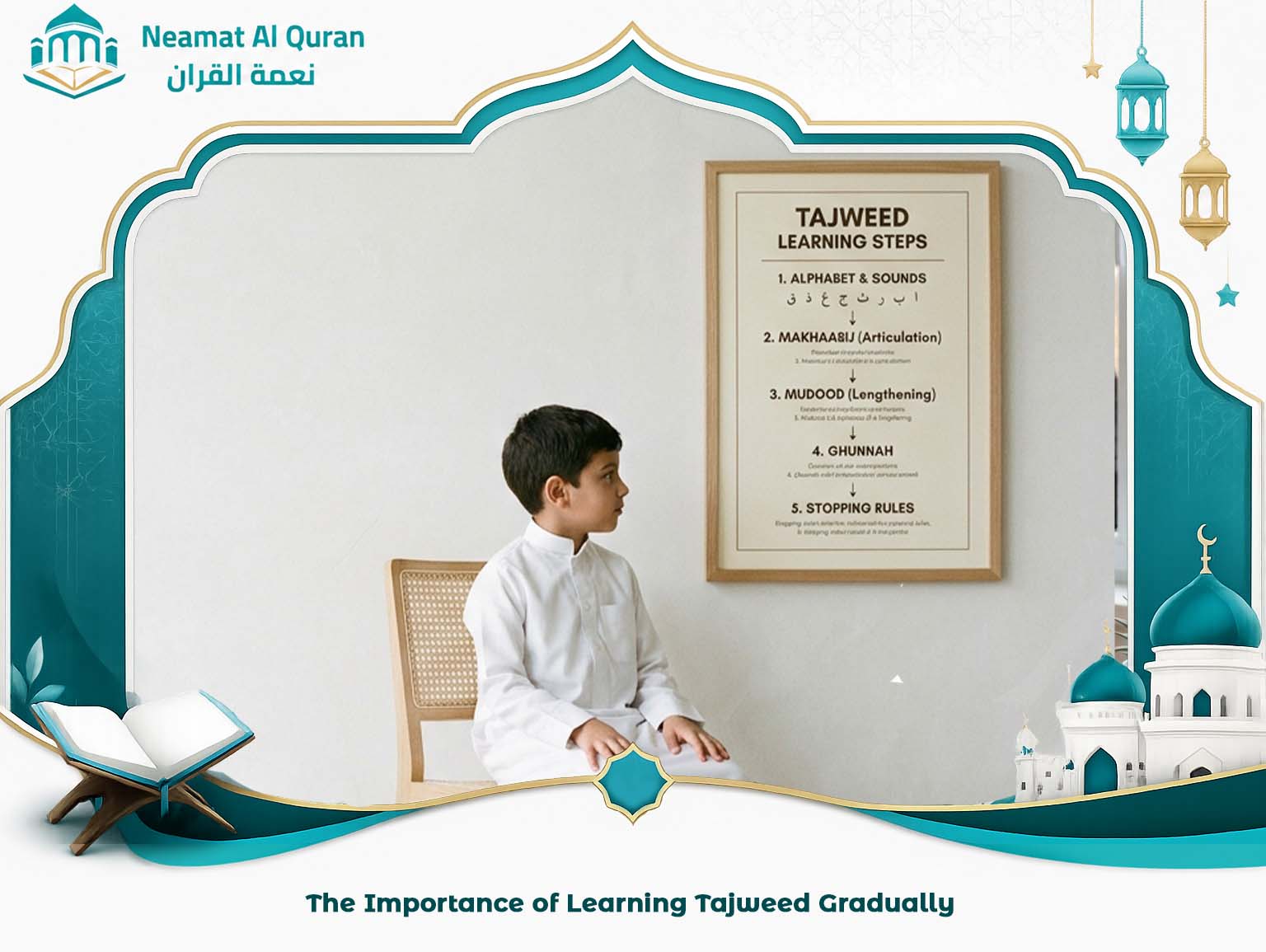
Many beginners make the mistake of trying to memorize all Tajweed rules at once. This can create confusion and reduce motivation. A better approach is to learn one group of rules at a time. Students should focus on understanding each rule, practicing it, and applying it during Quran reading before moving to the next level.
This gradual method is one reason why many learners choose to learn Tajweed rules online, as online courses often provide organized lessons based on the student’s level and progress. A clear learning plan allows students to improve step by step. When students learn Tajweed rules online with consistency, they can develop stronger Quran recitation skills and gain confidence over time.
Regular practice, listening to skilled reciters, and receiving teacher feedback are important parts of the learning process. Anyone who wants to learn Tajweed rules online should focus on patience, repetition, and continuous improvement.
Choosing the Right Online Tajweed Learning Program
Selecting the right learning environment plays an important role in achieving success. A good Tajweed program should include qualified teachers, clear explanations, practical correction, and a flexible schedule.
At Neamat Al Quran Academy, students receive structured Tajweed lessons designed to help beginners and advanced learners improve their Quran recitation skills. The academy focuses on individual attention, allowing teachers to identify mistakes and provide suitable guidance. A reliable online learning program should offer:
- Experienced Quran and Tajweed instructors.
- Individual or small-group lessons.
- Regular practice and feedback.
- Flexible class schedules.
- A learning plan suitable for different ages and levels.
When students choose a professional program like Neamat Al Quran Academy, they can follow a clear path instead of studying randomly without guidance.
Learn Tajweed Rules Online Through the Rules of Noon Sakinah and Tanween
After understanding the pronunciation points of Arabic letters and their characteristics, beginners move to one of the most important parts of Tajweed: the rules of Noon Sakinah and Tanween. Noon Sakinah means the letter ن with a sukoon, while Tanween refers to the double vowel sounds that appear at the end of some Arabic words:
- ـً (Fathatayn)
- ـٍ (Kasratayn)
- ـٌ (Dammatayn)
These rules appear frequently throughout the Quran, so mastering them helps students improve their recitation significantly.
When students learn Tajweed rules online, they usually spend enough time practicing these rules because they are essential for correct Quran pronunciation. The rules of Noon Sakinah and Tanween are divided into four main categories:
1. Izhar (Clear Pronunciation)
Izhar means making the Noon Sakinah or Tanween sound clear without hiding or merging it.This rule applies when Noon Sakinah or Tanween is followed by one of the throat letters:
ء، هـ، ع، ح، غ، خ
For example:
مِنْ هَادٍ
The Noon sound should be pronounced clearly without adding extra nasalization.
2. Idgham (Merging)
Idgham means combining the Noon Sakinah or Tanween sound with the following letter.The letters of Idgham are:
ي، ر، م، ل، و، ن
They are collected in the word:
يرملون
Idgham is divided into two types:
Idgham With Ghunnah
This occurs with:
ي، ن، م، و
The sound is merged with a nasal tone.
Idgham Without Ghunnah
This occurs with:
ل، ر
The Noon sound merges completely into the next letter. Understanding this rule allows learners to recite Quran more smoothly and naturally.
3. Iqlab (Changing the Sound)
Iqlab occurs when Noon Sakinah or Tanween is followed by the letter ب.In this case, the Noon sound changes into a hidden Meem sound with Ghunnah.For example:
أَنْبِئْهُمْ
Students who learn Tajweed rules online practice these examples repeatedly until the pronunciation becomes natural.
4. Ikhfa (Hiding the Sound)
Ikhfa means hiding the Noon sound between clear pronunciation and merging.It occurs with fifteen letters, including:
ت، ث، ج، د، ذ، ز، س، ش، ص، ض، ط، ظ، ف، ق، ك
The learner produces a light nasal sound while keeping the Noon partially hidden. This rule requires regular practice because the level of hiding must be balanced.
Learn Tajweed Rules Online by Understanding Meem Sakinah Rules
Another important section of Tajweed is the rules of Meem Sakinah. Meem Sakinah refers to the letter م with a sukoon. There are three main rules:
1. Ikhfa Shafawi
This happens when Meem Sakinah is followed by the letter ب. The Meem sound is hidden with Ghunnah.Example:
تَرْمِيهِمْ بِحِجَارَةٍ
The lips should come together gently while maintaining the nasal sound.
2. Idgham Shafawi
This occurs when Meem Sakinah is followed by another Meem. The two Meem sounds merge into one with Ghunnah.
Example:
لَكُمْ مَا
3. Izhar Shafawi
This applies when Meem Sakinah is followed by any letter other than ب and م. The Meem should be pronounced clearly. These rules help students maintain accurate pronunciation and avoid unnecessary mistakes during Quran recitation.
A structured course at Neamat Al Quran Academy helps learners practice these rules through direct correction and repeated Quran reading exercises.
Learn Tajweed Rules Online and Master Madd (Quranic Lengthening)
Madd is another essential Tajweed topic. It refers to extending certain sounds for specific counts according to Tajweed rules.
Correct Madd improves the rhythm and accuracy of Quran recitation. There are several types of Madd, but beginners usually start with the following:
Madd Asli (Natural Madd)
Madd Asli is the basic type of elongation. It occurs naturally without being followed by Hamzah or Sukoon. The sound is extended for two counts. Examples include words containing:
ا، و، ي
when they function as Madd letters.
Madd Far’i (Secondary Madd)
Madd Far’i occurs due to another reason, such as the presence of Hamzah or Sukoon. Some types may require longer stretching, depending on the rule. Students need guidance because incorrect stretching can affect the beauty and correctness of recitation.
Through a proper program where learners learn Tajweed rules online, they can hear correct examples and practice matching the required length.
Common Tajweed Mistakes Beginners Should Avoid
Many students make similar mistakes when starting their Tajweed journey. Recognizing these mistakes helps learners improve faster.
1. Pronouncing Similar Letters Incorrectly
Arabic contains sounds that may not exist in other languages. Beginners may confuse letters that have close pronunciation.
Examples include:
- ق and ك
- ص and س
- ض and د
Regular correction helps overcome these challenges.
2. Ignoring Letter Characteristics
Some learners pronounce all letters in the same way without considering whether a letter is heavy, light, strong, or soft. This affects the quality of Quran recitation.
3. Incorrect Ghunnah Timing
Ghunnah is a nasal sound that appears in specific Tajweed rules. Some beginners make it too short or too long. Proper training teaches the correct duration.
4. Stopping in Wrong Places
Stopping signs in the Quran have meanings and purposes. Incorrect stopping may affect understanding. Students should learn basic Waqf and Ibtida rules to know where to stop and where to continue.
How to Create an Effective Plan to Learn Tajweed Rules Online?

Success in Tajweed depends on consistency more than speed. A simple daily routine can create significant improvement over time.
Practice Every Day
Even fifteen or twenty minutes of daily practice can make a difference. Regular reading helps the tongue become familiar with Arabic sounds.
Listen to Skilled Quran Reciters
Listening is an important part of learning. Students should choose experienced reciters known for accurate Tajweed and repeat after them.
Record Your Recitation
Recording yourself allows you to notice mistakes and compare your pronunciation with correct examples.
Review Previous Lessons
Tajweed rules need continuous revision. Moving quickly to new topics without reviewing previous rules may cause students to forget important details.
Receive Teacher Feedback
Self-learning has benefits, but direct correction remains essential because many pronunciation mistakes cannot be noticed by the learner. This is why many students prefer to learn Tajweed rules online with qualified teachers who can monitor their progress.
Why Choose Neamat Al Quran Academy for Tajweed Learning?
Finding a trustworthy learning environment is an important step for anyone who wants to improve Quran recitation. Neamat Al Quran Academy provides organized Tajweed education designed according to students’ needs and different learning levels. The academy focuses on helping learners build strong foundations through practical lessons and continuous guidance.
Qualified Teachers
A successful Tajweed journey requires knowledgeable instructors who understand Quran pronunciation rules and teaching methods. Teachers at Neamat Al Quran Academy help students identify their mistakes, explain difficult concepts, and provide practical exercises.
Personalized Learning Approach
Every student has different abilities and challenges. Some learners need more focus on pronunciation, while others need improvement in fluency or applying Tajweed rules. Personalized lessons make learning more effective.
Flexible Online Classes
Online learning allows students to attend lessons according to their schedules. This makes Quran education accessible for busy adults, children, and families. Students who want to learn Tajweed rules online can continue their studies without needing to travel or follow fixed local class times.
Suitable for Beginners and Advanced Students
Whether you are reading Quran for the first time or want to improve your existing skills, a structured Tajweed program can help you progress step by step. At Neamat Al Quran Academy, learners receive guidance suitable for their current level.
The Role of Technology in Helping Students Learn Tajweed Rules Online
Technology has transformed Quran education and made learning Tajweed available to more people than ever before. In the past, students often needed to travel long distances or wait for suitable local classes. Today, anyone can access professional Quran instruction from home using a computer, tablet, or smartphone.
When students learn Tajweed rules online, they benefit from modern educational tools that make lessons more interactive and easier to understand. Online platforms allow teachers and students to communicate directly through live video sessions, share learning materials, and correct mistakes immediately.
One of the biggest advantages of online Tajweed learning is the ability to receive personal attention. Traditional group classes may not always provide enough time for every student to practice. However, online private lessons allow teachers to focus on individual weaknesses and create a learning plan based on the learner’s progress.
Technology also helps students review lessons whenever needed. Recorded explanations, digital Quran resources, and online exercises support continuous improvement and encourage students to maintain regular practice.
How Online Tajweed Lessons Help Children Improve Quran Recitation?
Children need a special teaching approach because their learning abilities and attention spans are different from adults. A successful Tajweed program for children should combine education with encouragement and interactive activities.
Many parents choose Tajweed classes online for beginners because children can learn in a comfortable environment without feeling pressure. They can attend lessons from their homes while receiving guidance from experienced teachers. When children learn Tajweed rules online, they gradually develop:
- Better Arabic pronunciation.
- Stronger Quran reading confidence.
- Improved listening skills.
- A deeper connection with the Quran.
Teachers who specialize in children’s education use repetition, examples, and positive motivation to make Tajweed easier and more enjoyable.
A supportive learning environment helps children see Quran study as a meaningful experience rather than a difficult obligation.
Tips for Adults Starting Their Tajweed Journey
Many adults hesitate to begin Tajweed because they believe they are too old to learn. However, Tajweed can be studied at any age, and many adults successfully improve their Quran recitation after starting from the basics. Here are some useful tips for adult learners:
- Start With Clear Goals: Before beginning, decide what you want to achieve. Some students want to correct their pronunciation, while others want to improve their fluency or prepare for Quran memorization classes online. Having a clear goal helps maintain motivation.
- Be Patient With Yourself: Learning Tajweed requires time and practice. Some sounds may feel difficult at the beginning, especially letters that are unfamiliar. Progress comes through consistent effort.
- Focus on Practice Rather Than Theory Alone: Understanding Tajweed rules is important, but applying them during Quran reading is the real goal. Students should spend enough time practicing verses with their teacher.
- Build a Daily Quran Routine: Small daily efforts create better results than occasional long sessions. Even a short daily practice can improve pronunciation and confidence. Those who learn Tajweed rules online often find it easier to maintain consistency because lessons can be arranged around their personal schedules.
The Difference Between Learning Tajweed Alone and With a Teacher
Some learners try to study Tajweed through books or online videos without a teacher. While self-study can provide useful information, it has limitations. Tajweed is a practical science that depends heavily on hearing and correction. A student may read a rule correctly but apply it incorrectly without realizing the mistake. A qualified teacher can:
- Listen to your recitation.
- Identify pronunciation problems.
- Explain difficult rules.
- Correct mistakes immediately.
- Encourage continuous improvement.
For this reason, guided learning is usually more effective than studying alone. Neamat Al Quran Academy provides students with structured lessons where teachers follow their progress and help them improve gradually.
Building a Long-Term Relationship With Quran Through Tajweed
Tajweed is not only a technical skill; it is also a way to develop a deeper relationship with the Quran. When Muslims recite the Quran with correct pronunciation, they experience greater focus and appreciation for the words they are reading. Learning Tajweed encourages:
- More frequent Quran reading.
- Better concentration during recitation.
- Greater confidence in worship.
- A stronger connection with Allah’s words.
The goal of Tajweed is not simply to complete a course but to develop a lifelong habit of beautiful and accurate Quran recitation.
Students who learn Tajweed rules online with dedication can continue improving even after completing beginner lessons because Tajweed is a lifelong journey.
Why Choose Neamat Al Quran Academy for Tajweed?

Choosing the right academy can make a significant difference in the learning experience. Students need a program that combines authentic Quran education with modern teaching methods.
Neamat Al Quran Quran Hifz Academy online focuses on providing a structured learning path that helps students understand Tajweed gradually. The academy offers:
- Professional Guidance: Students receive explanations from teachers who understand both Quran recitation and effective teaching methods.
- Organized Curriculum: Instead of studying random topics, learners follow a clear sequence that starts with basic pronunciation and moves toward advanced Tajweed rules.
- Comfortable Learning Environment: Online lessons allow students to study from home while maintaining regular communication with their teachers.
- Progress Monitoring: Tracking improvement helps students understand their strengths and areas that need more practice. For anyone who wants to learn Tajweed rules online, choosing an academy with a clear educational system can make the journey easier and more successful.
Frequently Asked Questions About Learning Tajweed Rules Online
Provides clear answers to common questions beginners have about starting Tajweed, choosing the right learning method, and improving Quran recitation through online lessons.
1. Can beginners learn Tajweed without knowing Arabic?
Yes. Beginners can study Tajweed even if they have limited Arabic knowledge. A good teacher explains pronunciation rules gradually and helps students improve step by step.
2. How often should I practice Tajweed?
Daily practice is recommended because consistency helps develop correct pronunciation habits. Even a short practice session every day can produce noticeable improvement.
3. Can children learn Tajweed through online classes?
Yes. Online Tajweed classes can be effective for children when lessons are designed according to their age and learning style.
4. How long does it take to improve Quran recitation with Tajweed?
The learning period differs from one student to another. Regular practice, teacher guidance, and commitment can help students see improvement within a few months.
5. Is learning Tajweed online as effective as traditional classes?
Yes. With qualified teachers, live correction, and consistent practice, online Tajweed learning can provide excellent results.
In conclusion, choosing to learn Tajweed rules online is a valuable step for anyone who wants to improve Quran recitation and understand the correct way of pronouncing Allah’s words. Tajweed may seem challenging at the beginning, but with a gradual learning approach, regular practice, and proper guidance, every student can make steady progress.
By mastering Makharij, Sifaat, and essential Tajweed rules, learners can recite the Quran with greater accuracy, confidence, and beauty. Online Tajweed lessons provide the flexibility and support needed for beginners, children, and adults to continue their learning journey from anywhere.
With commitment and continuous practice, students can develop a strong foundation in Tajweed and enjoy a deeper connection with the Quran for a lifetime.