
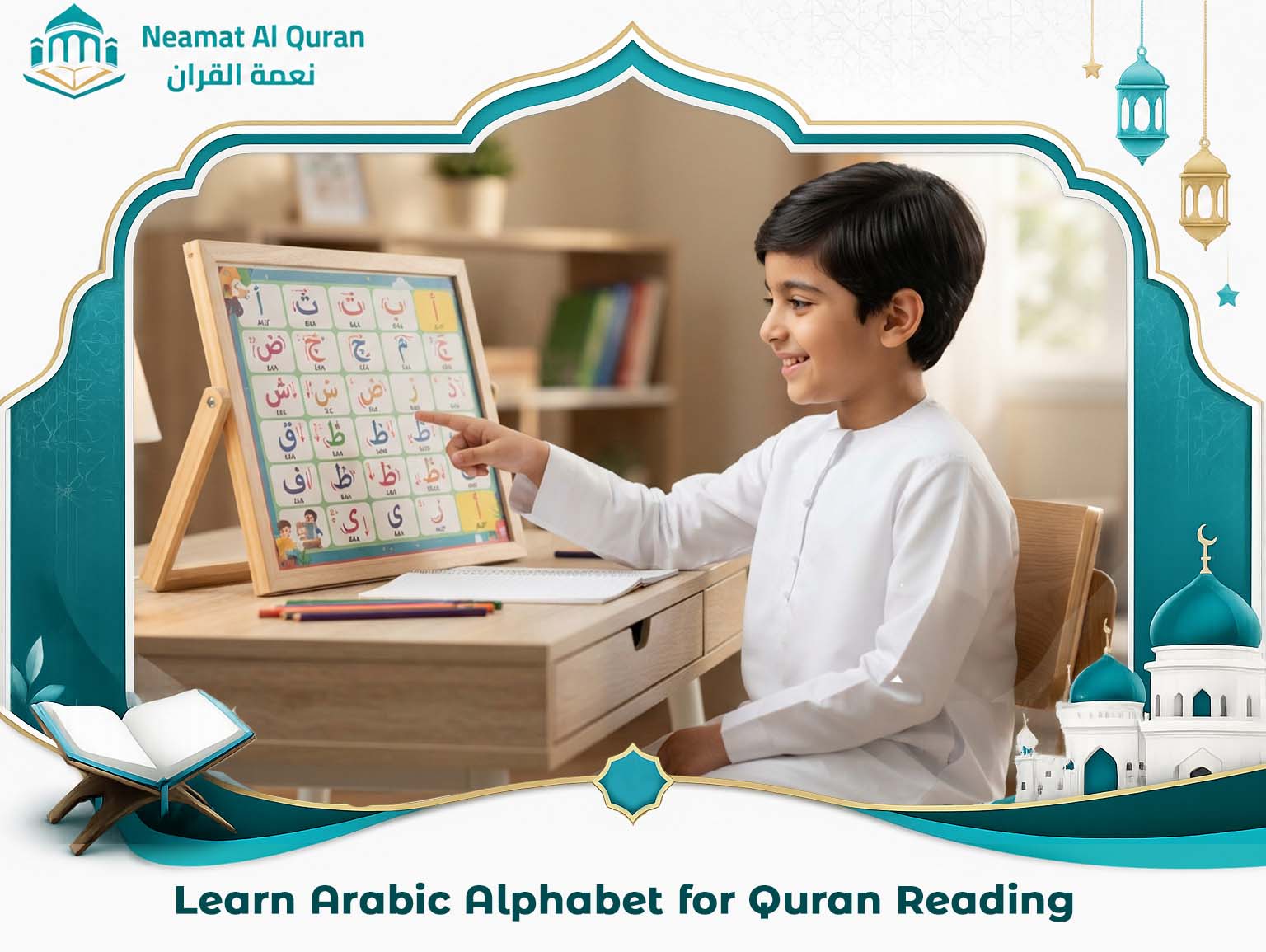
Learn the Arabic alphabet for Quran reading is the first and most important step for anyone who wants to recite the Holy Quran correctly. Every Muslim who decides to learn the Arabic alphabet for Quran reading builds the foundation needed for accurate pronunciation, Tajweed, and fluent Quran recitation. Before memorizing Surahs or studying Tajweed rules, students should first learn the Arabic alphabet for Quran reading through a clear and structured approach.
Many beginners think it is difficult to learn the Arabic alphabet for Quran reading because Arabic letters look different from English characters and are written from right to left. However, with the right teacher and consistent practice, anyone can learn the Arabic alphabet for Quran reading successfully, regardless of age or previous experience.
Whether you are an adult beginner, a parent teaching your child, or a new Muslim, choosing the right method to learn the Arabic alphabet for Quran reading will make your Quran journey easier and more rewarding.
If you are looking for expert guidance, Neamat Al Quran Academy offers structured online lessons designed to help students learn the Arabic alphabet for Quran reading with qualified teachers, interactive exercises, and personalized learning plans.
Why Learn Arabic Alphabet for Quran Reading? First Step to Quran?
Every language begins with its alphabet, and Arabic is no exception. Before studying grammar, vocabulary, or Tajweed, every student should learn the Arabic alphabet for Quran reading and master the pronunciation of each letter.
The Quran was revealed in Arabic, making it essential to learn the Arabic alphabet for Quran reading before attempting complete verses. Even a slight pronunciation mistake can change the meaning of a Quranic word. This is why scholars have always encouraged students to learn the Arabic alphabet for Quran reading before progressing to advanced Islamic studies.
Building this strong foundation offers many benefits:
- It improves pronunciation from the beginning.
- It prepares students for Tajweed rules.
- It makes Quran reading smoother.
- It reduces recitation mistakes.
- It builds confidence while learning.
Students who first learn the Arabic alphabet for Quran reading usually make faster progress than those who skip the basics.
Discover the Wisdom of the Quran with Neamat Al Quran Academy
Are you ready to go beyond simple recitation and understand the true guidance of the Quran in your daily life? At Neamat Al Quran Academy, qualified teachers help students explore the meanings of the Quran clearly and practically, which strengthens their faith.
Through structured online lessons, learners improve their understanding and apply Quranic teachings in real situations. Each class encourages reflection, growth, and a deeper connection with Allah’s words. Start your journey today with Neamat Al Quran Academy and build a stronger relationship with the Quran.

Understanding the Arabic Alphabet Before You Learn Arabic Alphabet for Quran Reading
Before you fully learn the Arabic alphabet for Quran reading, it is helpful to understand how to speak Arabic writing system works.
The Arabic alphabet contains 28 letters, each with its own pronunciation and writing style. Arabic is written from right to left, but students who learn the Arabic alphabet for Quran reading usually become comfortable with this writing direction after only a few lessons.
Each letter may appear in four different forms:
- Isolated form
- Beginning form
- Middle form
- Ending form
Although the appearance changes, the pronunciation remains the same. Learning these forms is an essential part of learning the Arabic alphabet for Quran reading because they help students recognize letters inside complete Quranic words.
Some letters connect with neighboring letters, while others remain separate. Understanding these connection rules makes it much easier to learn the Arabic alphabet for Quran reading confidently.
The Best Way to Learn Arabic Alphabet for Quran Reading Without Feeling Overwhelmed
Many beginners struggle because they try to memorize all 28 letters in one session. A better strategy is to learn the Arabic alphabet for Quran reading gradually through small daily lessons.
Learn only a few letters each day
Instead of memorizing every letter immediately, focus on three or four letters daily. This makes it much easier to learn the Arabic alphabet for Quran reading without feeling overwhelmed.
Review regularly
Daily revision strengthens memory. Students who consistently review previous lessons usually learn the Arabic alphabet for Quran reading faster than those who only study new material.
Listen before speaking
Several Arabic sounds do not exist in English. Listening carefully to an experienced teacher helps students learn the Arabic alphabet for Quran reading with correct pronunciation from the very beginning.
Practice writing
Writing each letter repeatedly improves recognition and helps learners learn the Arabic alphabet for Quran reading more efficiently.
Read aloud
Reading aloud strengthens pronunciation, confidence, and fluency. Every student who wants to learn the Arabic alphabet for Quran reading should make reading aloud part of their daily routine.
Essential Letter Groups to Master Before You Learn Arabic Alphabet for Quran Reading
Many Arabic letters share similar shapes. Learning these groups together makes it much easier to learn the Arabic alphabet for Quran reading.
For example:
- ب، ت، ث
- ج، ح، خ
- د، ذ
- ر، ز
- س، ش
- ص، ض
- ط، ظ
- ع، غ
- ف، ق
Most of these letters differ only in the placement or number of dots. Understanding these patterns allows students to learn the Arabic alphabet for Quran reading more quickly and recognize letters with greater confidence.
Teachers often introduce these groups gradually because this structured approach helps beginners learn the Arabic alphabet for Quran reading more effectively.
At Neamat Al Quran Academy, students follow carefully designed lessons that simplify the process of learning similar letters.
Common Challenges Beginners Face While They Learn Arabic Alphabet for Quran Reading
Every student experiences challenges when learning the Arabic alphabet for Quran reading, especially during the first few weeks.
Confusing similar letters
Many beginners confuse letters like ب، ت، and ث because they have nearly identical shapes.
Pronouncing unfamiliar sounds
Letters such as ح، خ، ع، غ، and ق require extra practice since these sounds are uncommon in many languages.
Reading from right to left
Reading Arabic feels unusual at first. However, students who consistently learn the Arabic alphabet for Quran reading quickly become comfortable with the writing direction.
Recognizing connected letters
Many beginners recognize isolated letters but struggle to identify them inside words. Continuous practice helps students learn the Arabic alphabet for Quran reading more naturally.
Staying motivated
Progress takes time. Students who dedicate just fifteen minutes a day to learn the Arabic alphabet for Quran reading often achieve excellent long-term results.
Qualified teachers help learners overcome these challenges before incorrect habits become permanent.
How Daily Practice Helps You Learn Arabic Alphabet for Quran Reading Faster?
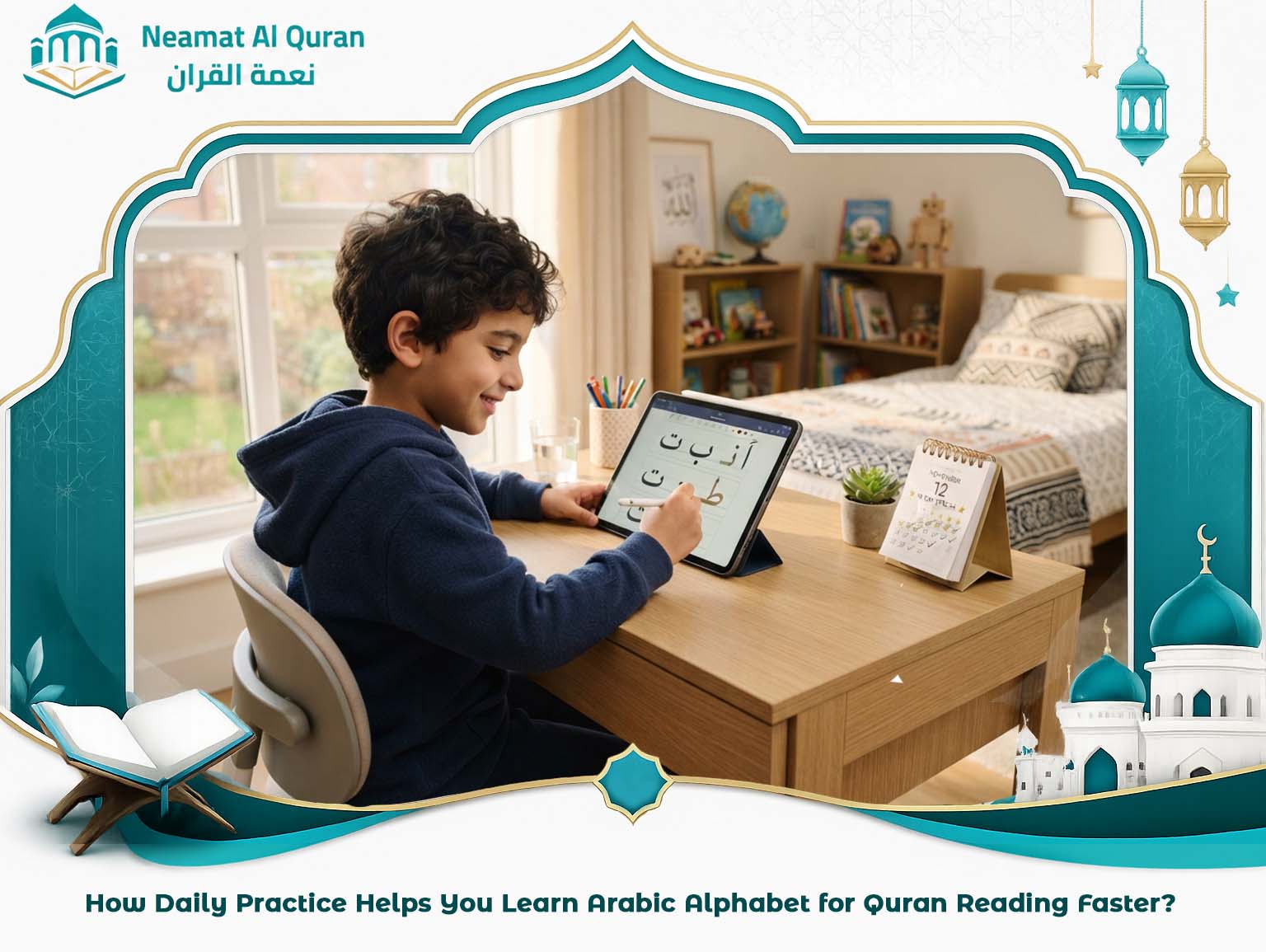
Consistency is the secret to success. Spending fifteen minutes every day is much more effective than studying for several hours once a week. A productive daily routine includes:
- Reviewing previously learned letters.
- Practicing pronunciation.
- Writing each letter multiple times.
- Reading simple letter combinations.
- Listening to native pronunciation.
Following this routine allows students to learn the Arabic alphabet for Quran reading steadily while improving visual recognition, pronunciation, and reading confidence.
Students at Neamat Al Quran Academy benefit from personalized lesson plans, experienced Quran teachers, and continuous feedback that helps every learner learn the Arabic alphabet for Quran reading accurately and efficiently.
Practical Steps to Learn the Arabic Alphabet for Quran Reading Successfully
Every learner progresses at a different pace, but the most successful students usually follow a clear plan instead of studying randomly. A structured learning path helps you stay motivated and reduces confusion.
1. Learn the Names of the Letters
The first step is becoming familiar with the names of all 28 Arabic letters. At this stage, you do not need to read words. Your goal is simply to recognize each letter instantly. Using alphabet charts, flashcards, and repetition can make this process much easier. Spend enough time identifying every letter before moving forward.
2. Master the Correct Pronunciation
Recognition alone is not enough. Every letter has its own articulation point, and several Arabic sounds are unique compared to English. Listening carefully to a qualified teacher allows you to hear subtle differences between similar letters. Correct pronunciation from the beginning prevents mistakes that are difficult to correct later.
3. Understand Letter Positions
Arabic letters appear differently depending on whether they are:
- Standing alone.
- At the beginning of a word.
- In the middle.
- At the end.
Although this seems challenging at first, the patterns quickly become familiar through regular practice.
4. Begin Reading Simple Syllables
Once you recognize individual letters, start combining two or three letters. Examples include:
- با
- بو
- بي
These simple combinations train your eyes to move naturally across Arabic words.
5. Read Short Quranic Words
Instead of memorizing long passages immediately, begin with short Quranic words that appear frequently.
Reading familiar words repeatedly improves confidence while strengthening letter recognition.
The Biggest Mistakes People Make When They Learn the Arabic alphabet for Quran Reading
Many beginners unknowingly slow their own progress. Fortunately, these mistakes are easy to avoid once you recognize them.
Trying to Learn Too Quickly
Some students attempt to finish the alphabet in a single weekend. While this sounds productive, the information is usually forgotten within days. Slow and steady learning produces much stronger results.
Ignoring Pronunciation
Reading the letters without learning their proper sounds creates habits that become difficult to fix later. Always prioritize accurate pronunciation over speed.
Skipping Daily Practice
Consistency is far more valuable than occasional long study sessions. Ten to fifteen minutes every day builds lasting improvement.
Learning Without Feedback
Self-study can be helpful, but learners often repeat the same mistakes without realizing it. Receiving corrections from an experienced teacher allows faster improvement and greater confidence.
Comparing Yourself to Others
Every learner has a unique pace. Some students become comfortable within a few weeks, while others need several months. Progress matters much more than speed.
Why Can Children and Adults Both Learn the Arabic Alphabet for Quran Reading?
Many adults believe learning Arabic is only easy for children. This is simply not true. Children often memorize quickly because their brains naturally absorb new sounds. Adults, however, usually understand explanations more easily and can build consistent study habits.
Learning as a Child
Children benefit from:
- Interactive lessons.
- Educational games.
- Visual learning.
- Repetition.
When learning remains enjoyable, children stay motivated for longer periods.
Learning as an Adult
Online Quran classes for adults often appreciate:
- Structured lessons.
- Clear explanations.
- Practical reading exercises.
- Flexible schedules.
Age should never become a barrier to Quran learning. Thousands of adults begin reading the Quran successfully every year after starting with the Arabic alphabet.
Learning Resources That Help You Learn Arabic Alphabet for Quran Reading
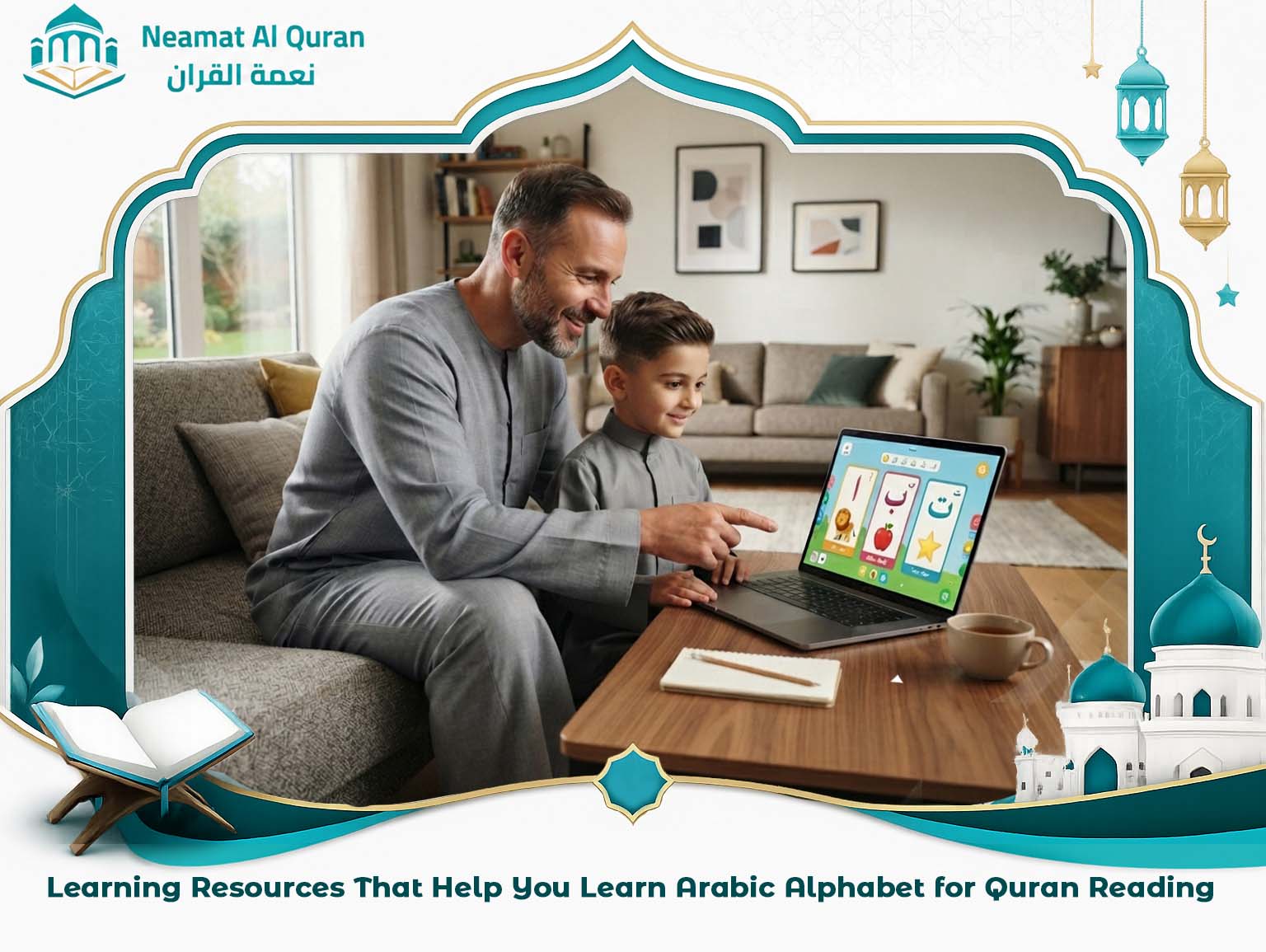
Using the right learning resources makes it easier to learn the Arabic alphabet for Quran reading and stay motivated throughout your journey. A combination of visual, audio, and practical tools helps beginners recognize letters, improve pronunciation, and build reading confidence.
Flashcards
Flashcards help students learn the Arabic alphabet for Quran reading by improving letter recognition and making daily revision simple and effective.
Writing Worksheets
Tracing and writing each letter strengthens handwriting, reinforces memory, and helps learners recognize different letter forms.
Audio Recordings
Listening to qualified Quran teachers improves pronunciation and helps students learn the Arabic alphabet for Quran reading with accurate articulation.
Reading Practice Books
Beginner books introduce letters gradually before moving to simple words and Quranic reading exercises, making it easier to learn the Arabic alphabet for Quran reading step by step.
Qualified Quran Teachers
Learning with an experienced Quran private Quran tutor online in certified Quran classes provides instant feedback and corrects mistakes early. At Neamat Al Quran Academy, beginners receive personalized online lessons that help them learn the Arabic alphabet for Quran reading confidently and efficiently.
Live Online Lessons
Live instruction provides immediate corrections, answers questions, and keeps learners motivated throughout the journey.
Students who receive consistent guidance generally achieve better pronunciation and greater reading confidence than those studying entirely on their own.
How Does Neamat Al Quran Academy Support Every Beginner?
Starting Quran reading becomes much easier when students follow a structured curriculum instead of trying to organize everything themselves.
Neamat Al Quran Academy, the best Quran academy online, provides beginner-friendly lessons designed specifically for learners with little or no previous knowledge of Arabic. Students begin with recognizing letters before progressing toward pronunciation, connected letters, vowels, and eventually Quran reading.
Teachers focus on correcting mistakes patiently while encouraging students to build confidence One-on-One Quran Classes Online at a time.
Another advantage is flexibility. Whether you are a busy professional, a university student, or a parent, lessons can fit different schedules without sacrificing learning quality.
Parents also appreciate the supportive environment offered by Neamat Al Quran Academy, where children learn through engaging activities while developing strong Quran reading skills.
Build a Daily Routine to Learn the Arabic alphabet for Quran reading
Creating a simple daily routine is one of the most effective ways to achieve steady progress. You do not need to spend hours studying every day. What matters most is consistency rather than the amount of time. A balanced routine may include:
- Reviewing previously learned letters.
- Practicing pronunciation for a few minutes.
- Reading simple letter combinations.
- Writing several letters by hand.
- Listening to Quranic pronunciation from a qualified teacher.
Repeating these activities every day strengthens recognition, pronunciation, and confidence. Even a short practice session becomes highly effective when repeated consistently over several weeks.
If you miss a day, simply continue the following day instead of trying to study for several hours to make up for lost time. Building a sustainable habit is far more important than occasional intensive study.
Tips to Stay Motivated Learning Arabic Alphabet for Quran
Motivation often changes from week to week, so relying only on enthusiasm is not enough. Instead, create habits that keep you moving forward even when learning feels challenging. Here are practical strategies that successful students use:
- Set small weekly goals instead of focusing only on long-term achievements.
- Celebrate every milestone, even recognizing a few new letters.
- Practice with a family member or friend whenever possible.
- Keep a notebook to track your progress.
- Read something every day, even if it is only a few words.
Remember that every fluent Quran reader once started with the very first letter of the Arabic alphabet. Progress comes from patience, not perfection.
A supportive teacher also plays an important role in maintaining motivation. Personalized feedback helps students recognize their improvement and correct mistakes before they become habits. This is one reason many learners choose Neamat Al Quran Academy, where teachers guide students step by step according to their individual level.
Frequently Asked Questions
Below are answers to some of the most common questions about learning the Arabic alphabet for Quran reading. These FAQs will help beginners understand the learning process and know what to expect as they start their Quran reading journey.
1. What is the best age to start learning the Arabic alphabet?
There is no perfect age. Children often learn quickly, while adults benefit from stronger concentration and study discipline. Anyone can begin successfully with the right learning method.
2. How long does it usually take to recognize all Arabic letters?
Most beginners can recognize all 28 letters within a few weeks of consistent daily practice. Reading fluently, however, requires additional time and regular revision.
3. Should I learn writing before reading?
It is beneficial to practice both together. Writing reinforces letter recognition and helps learners remember different letter shapes more effectively.
4. Is it necessary to speak Arabic before reading the Quran?
No. Many Muslims learn to read the Quran accurately without becoming fluent Arabic speakers. Reading skills and spoken language are separate learning goals.
5. What should I do if I keep confusing similar Arabic letters?
Spend extra time practicing similar letter groups, listen carefully to correct pronunciation, and review them regularly until you can recognize them confidently without hesitation.
In conclusion, learning the Arabic alphabet is the first milestone on the journey toward reading the Holy Quran with confidence and accuracy. Although the letters may appear unfamiliar at first, consistent practice, correct pronunciation, and gradual learning transform what once seemed difficult into an enjoyable and rewarding experience.
Rather than rushing through the process, focus on building a strong foundation. Learn each letter carefully, understand how letters connect inside words, practice writing, and read simple Quranic examples every day. Over time, these small efforts produce remarkable improvement.
Whether your goal is to read the Quran independently, prepare for Tajweed studies, or help your children begin their Islamic education, mastering the Arabic alphabet opens the door to lifelong learning and a deeper connection with the Book of Allah.
If you are looking for structured lessons taught by experienced instructors, Neamat Al Quran Academy provides a supportive learning environment that helps beginners progress with confidence through organized lessons, continuous feedback, and personalized guidance. With dedication, patience, and the right instruction, you will soon be able to read the Quran accurately and continue your journey toward deeper Islamic knowledge.