
Learn to read quran for adults is a practical goal for anyone who wants to read the Quran correctly, improve their pronunciation, or return to Quran study after many years away. Starting as an adult does not mean that you have missed your opportunity. In fact, many adults begin with little or no reading ability and gradually develop the skills they need through structured lessons, regular practice, and guidance from a qualified teacher.
The important point is to begin at the right level rather than comparing yourself with people who have studied the Quran since childhood. Some adults need to learn the Arabic letters first, while others can recognize letters but struggle to connect them, pronounce vowels, or read Quranic words fluently. Therefore, the learning plan should match the student’s actual ability.
For adults with work, family responsibilities, and limited free time, online learning can make the process easier to organize. With a suitable schedule and consistent practice, you can build your reading skills step by step without changing your entire daily routine.
Why Is Learning to Read the Quran for Adults Possible at Any Age?
Many adults postpone Quran learning because they believe that children have an automatic advantage. Although younger learners may have more time for practice, adults have their own strengths. They can understand explanations, recognize patterns, ask specific questions, and make deliberate decisions about their learning routine.
When adults learn to read Quran for adults, they also bring a clear personal motivation to the process. Someone who chooses to study after work, during a quiet morning, or after completing family responsibilities is usually making a conscious commitment.
Moreover, adults do not need to master everything at once. Reading the Quran develops through several connected skills:
- Recognizing Arabic letters.
- Understanding how letters connect.
- Reading short and long vowels.
- Identifying common Quranic reading patterns.
- Pronouncing Arabic sounds accurately.
- Reading words and verses without excessive hesitation.
- Applying essential Tajweed rules gradually.
- Building fluency through repeated reading.
Consequently, the goal is not simply to memorize the names of Arabic letters. The real objective is to become comfortable enough with the Mushaf to read its verses accurately and confidently.
Discover the Wisdom of the Quran with Neamat Al Quran Academy
Are you ready to go beyond simple recitation and understand the true guidance of the Quran in your daily life? At Neamat Al Quran Academy, qualified teachers help students explore the meanings of the Quran clearly and practically, which strengthens their faith.
Through structured online lessons, learners improve their understanding and apply Quranic teachings in real situations. Each class encourages reflection, growth, and a deeper connection with Allah’s words. Start your journey today with Neamat Al Quran Academy and build a stronger relationship with the Quran.

How to Learn to Read Quran for Adults From the Beginning
The best way to learn to read Quran for adults is to follow a logical sequence instead of jumping directly into long surahs. A complete beginner needs a foundation that explains how the Arabic script works before expecting fluent Quranic reading.
Start With the Arabic Letters
Arabic has 28 basic letters. However, recognizing their individual shapes is only the first step. Students also need to understand that some letters change their appearance depending on their position within a word.
For example, a learner may recognize a letter when it appears alone but struggle to identify the same letter when it occurs at the beginning, middle, or end of a word.
Therefore, beginner lessons should combine visual recognition with pronunciation practice. The teacher can introduce a small group of letters, listen to the student’s pronunciation, correct mistakes, and then gradually add new material.
This approach makes it easier to learn to read the Quran for adults without overwhelming the learner with too much information at once.
Learn the Short Vowels
After becoming familiar with the letters, the next important step is learning the basic short vowels:
- Fathah
- Kasrah
- Dammah
These marks change how a letter is pronounced. A beginner who understands the letters but does not recognize these vowel signs may still struggle to read Quranic words.
For that reason, the student should practice individual letters with vowels before moving into increasingly complex combinations.
Practice Letter Connections
Arabic writing is connected, so reading the Quran requires more than recognizing isolated letters.
At this stage, the learner practices how letters join together and how their shapes change within words. Gradually, combinations become easier to recognize without stopping after every letter.
This is an important turning point when adults learn to read Quran for adults, because reading begins to move from individual symbols toward complete words.
What Should You Learn to Read Quran for Adults First?
A structured beginner program should not introduce every Quranic rule immediately. Instead, the learner should progress from simple reading skills to more advanced recitation. A practical sequence can look like this:
- Arabic letters and their sounds.
- Connected letter forms.
- Fathah, Kasrah, and Dammah.
- Sukoon.
- Tanween.
- Long vowels.
- Shaddah.
- Basic Quranic word patterns.
- Reading short verses.
- Applying essential Tajweed rules.
This sequence gives the learner a stable foundation. In addition, it allows the teacher to identify weaknesses early instead of allowing incorrect pronunciation to become a permanent habit.
Adults who learn to read Quran for adults through a progressive curriculum can therefore concentrate on one skill at a time.
Learn to Read Quran for Adults With a Qualified Teacher
Self-study can introduce the Arabic alphabet, but Quran reading involves sounds that may be difficult for a beginner to evaluate independently. A learner might believe a pronunciation is correct simply because it sounds close to an English equivalent.
However, several Arabic letters require precise articulation. Letters such as ح، خ، ع، غ، ص، ض، ط، ظ can present challenges for learners who did not grow up speaking Arabic.
A qualified teacher can listen to the student reading aloud and immediately identify the source of the problem. This direct correction is particularly useful because pronunciation errors can become harder to change when repeated for months.
For that reason, anyone looking to learn to read the Quran for adults should consider guided lessons rather than relying exclusively on recordings or applications.
Why Can One-to-One Lessons Help?
One-to-one lessons give the student dedicated time with the teacher. Instead of waiting for other students to finish reading, the learner can spend the lesson practicing their own weaknesses.
This format can be particularly helpful for adults who feel uncomfortable making mistakes in front of a group.
At Neamat Al Quran Academy, the learning process can be structured around the student’s existing reading level, allowing beginners to start with foundational skills instead of being placed into a lesson that moves too quickly.
How Long Does It Take to Learn to Read Quran for Adults?
There is no single timetable that applies to every adult. The learning period depends on several factors, including previous exposure to Arabic, lesson frequency, age, pronunciation difficulties, and practice between lessons.
Someone who already recognizes Arabic letters may progress faster than a complete beginner. Likewise, a student who practices for ten or fifteen minutes every day may develop fluency more consistently than someone who studies only once a week. A general progression may look like this:
| Learning stage | Possible progress |
|---|---|
| Arabic letters | Building recognition and pronunciation |
| Basic vowel signs | Reading simple combinations |
| Connected letters | Reading increasingly longer words |
| Short Quranic passages | Developing reading confidence |
| Mushaf reading | Improving accuracy and fluency |
| Tajweed practice | Refining pronunciation and recitation |
These are learning stages rather than guaranteed deadlines. Therefore, adults should measure progress by skills rather than by comparing themselves with another student. The real objective when you learn to read Quran for adults is steady improvement.
How to Learn to Read Quran for Adults With a Busy Schedule?
One of the biggest challenges for adult learners is not ability but time. Adults may work full-time, care for children, manage a household, or have other responsibilities. Because of that, a learning plan needs to fit the student’s real life.
Instead of waiting for a completely free day, choose a fixed period that can realistically be maintained. For example:
- Twenty to thirty minutes before work.
- A short session after Fajr.
- A lesson after Maghrib.
- Practice before going to sleep.
- A weekend lesson combined with short weekday revision.
The specific time matters less than consistency.
Furthermore, daily practice does not need to be long. Ten focused minutes can be useful when the learner spends that time repeating the material from the lesson.
As a result, adults can learn to read Quran for adults without needing several uninterrupted hours every day.
A Simple Weekly Plan for Adult Quran Learners
A realistic weekly routine might include two or three teacher-led lessons combined with short independent practice.
On Lesson Days
Spend the lesson learning new material and correcting previous mistakes. Listen carefully to the teacher’s pronunciation and repeat the difficult sounds several times.
On Non-Lesson Days
Review what was covered previously rather than constantly introducing new material. Read the same words or verses aloud and focus on the corrections given by the teacher.
At the End of the Week
Review the week’s material as a whole. Notice which letters, vowels, or words still cause hesitation. This system makes it easier to learn to read the Quran for adults because each lesson builds on the previous one instead of starting from zero every time.
Common Mistakes Adults Make When Learning Quran
Many difficulties can be avoided when learners understand the common challenges from the beginning. Recognizing these obstacles early helps adults choose the right learning approach, practice more effectively, and save valuable time.
Starting With Advanced Surahs
Some beginners immediately try to read long surahs because they want to feel that they are already studying the Quran. However, difficult passages can contain unfamiliar vocabulary, complex pronunciation patterns, and numerous Tajweed rules. Starting with foundational reading exercises is usually more productive.
Depending Entirely on Audio
Listening to a skilled reciter can help students hear correct pronunciation. Nevertheless, listening alone does not tell you whether you are producing the same sound. Therefore, audio should support teacher-guided reading rather than replace it.
Practicing Without Correction
A learner can accidentally repeat the same pronunciation mistake hundreds of times. Once the incorrect movement becomes familiar, changing it may require additional effort. Regular correction is therefore an important part of the process.
Studying Irregularly
One long lesson followed by several weeks without practice rarely produces stable progress. Instead, shorter and more regular sessions make it easier to remember what has already been learned.
Learn to Read Quran for Adults Online From Home
Online Quran learning has made it possible for adults to study without traveling to a local classroom. This can be particularly useful for people who live far from qualified teachers or have demanding schedules. For learners who want to continue developing their Quranic skills, how to become a hafiz of quran online can provide useful guidance for a longer-term learning journey. A typical online lesson requires:
- A reliable internet connection.
- A computer, tablet, or suitable phone.
- A Quran or beginner reading book.
- A quiet place for the lesson.
- Headphones when necessary.
- A fixed study schedule.
The main advantage is flexibility. An adult can often arrange lessons around work and family responsibilities. In addition, learners can explore practical Islamic resources such as a salah step by step guide as they develop a more consistent Quran and worship routine.
At the same time, online learning should not mean unstructured learning. A student still needs a curriculum, a teacher, regular correction, and measurable progress.
That is why adults who want to learn to read Quran for adults should evaluate the teaching structure rather than choosing an online course based only on convenience.
What to Expect From an Online Quran Reading Lesson?
An online lesson can be simple and focused. First, the teacher reviews material from the previous session. Next, the student reads aloud while the teacher listens carefully. Whenever a pronunciation or reading error occurs, the teacher explains the correction and asks the learner to repeat it.
After that, new material is introduced according to the student’s level. The final part of the lesson may include a short assignment for independent practice.
This structure keeps the session focused on actual reading rather than filling the lesson with unnecessary explanations. For younger family members who may also be beginning their Quran journey, resources such as how to learn arabic alphabet for kids address the different needs of children learning the Arabic script.
For adults who learn to read Quran for adults, the most valuable part of the lesson is often the immediate feedback received while reading. This allows mistakes to be corrected before they become repeated habits.
When Should Tajweed Be Introduced?
Tajweed should not be treated as something that must be mastered before a beginner can read anything. Instead, it can be introduced gradually as the student’s reading ability develops.
Basic pronunciation and articulation should receive attention from the beginning. Then, as the learner becomes more comfortable with Quranic reading, additional Tajweed rules can be explained and practiced. A detailed resource explaining what is tajweed and why is it important can help learners understand the purpose of these rules. For example, students may gradually encounter:
- Madd.
- Ghunnah.
- Qalqalah.
- Noon Sakinah and Tanween rules.
- Meem Sakinah rules.
- Rules related to stopping and continuation.
- Detailed articulation points.
This gradual approach prevents the beginner from becoming overwhelmed.
More importantly, it connects each rule with actual Quranic reading. Therefore, the learner understands not only the definition but also when and how the rule appears.
Learn to Read Quran for Adults After Years Away From Study
Not every adult begins from zero. Some people studied Quran as children but stopped for many years. They may recognize most Arabic letters and remember parts of short surahs, yet struggle with fluency.
In this situation, starting from the very beginning may not be necessary. A teacher can assess the student’s reading and determine whether the main issue is:
- Slow reading.
- Weak pronunciation.
- Forgotten vowel signs.
- Difficulty connecting words.
- Lack of confidence.
- Inconsistent Tajweed.
- Limited exposure to the Mushaf.
The student can then focus on the specific weaknesses rather than repeating material they already understand. This assessment-based approach can make learning to read Quran for adults more efficient for returning learners.
Learn to Read Quran for Adults Without Knowing Arabic
It is important to distinguish Quran reading from learning the Arabic language. You do not need to understand every Arabic word before you can learn to read the Quran.
Reading involves recognizing the Arabic script and producing its sounds correctly, while understanding requires additional vocabulary, grammar, and language skills.
Therefore, a beginner can start learning Quranic reading even without conversational Arabic. Later, the student may decide to study Arabic to understand the meanings more deeply. Families may also explore structured options such as Quran Classes for Kids in the USA when children need a learning path appropriate for their age.
This distinction removes one of the biggest psychological barriers for adults who think they must learn an entire language before opening the Mushaf.
How Can Neamat Al Quran Academy Support Adult Learners?
Neamat Al Quran Academy can provide a structured environment for adults who want to develop Quran reading skills according to their starting level.
The most useful approach for a beginner is not to rush through a fixed number of lessons. Instead, the teacher should first understand what the student can already do and identify the areas requiring attention.
For example, one learner may need help with the Arabic alphabet, while another may already read words but struggle with pronunciation. Their lessons should therefore be different. A suitable adult learning plan can include:
- Initial level assessment.
- Beginner reading instruction.
- Pronunciation correction.
- Gradual Quranic reading practice.
- Introduction to Tajweed.
- Regular revision.
- Individual feedback.
- Progress-based lesson planning.
As a result, Neamat Al Quran Academy can help make the process of learning more organized and manageable for adults with different starting points.
How to Choose the Right Program to Learn to Read Quran for Adults?
Before joining an online program, adults should ask practical questions.
Is the Student’s Level Assessed?
A complete beginner should not receive the same starting material as someone who already reads Arabic.
Will the Teacher Correct Pronunciation?
Reading the Quran aloud requires feedback. A program should give the teacher enough time to hear the student’s recitation.
Is the Curriculum Progressive?
Lessons should move from basic skills toward increasingly complex reading rather than introducing unrelated topics.
Can the Schedule Fit Your Routine?
A program may be academically useful but difficult to maintain if the lesson times constantly conflict with work or family commitments.
Can You Ask Questions?
Adult learners often have specific questions about pronunciation and reading. The teaching environment should allow those questions to be addressed clearly.
When evaluating Neamat Al Quran Academy, these practical points can help an adult determine whether the learning approach matches their personal level and goals.
Learn to Read Quran for Adults Without Feeling Embarrassed
Learning to read the Quran as an adult should never be a source of embarrassment. Many people delay learning because they believe they should have started during childhood. However, learn to read Quran for adults is possible at any age, whether you are starting with Arabic letters or improving an existing reading ability.
Every learner has a different starting point. One adult may need to learn the alphabet, while another may recognize the letters but struggle with fluency or pronunciation. Therefore, progress should be measured against your own previous level rather than compared with younger students or family members.
A supportive teacher can make the process more comfortable by treating mistakes as part of learning. When you learn to read Quran for adults, corrections help identify areas that need more practice before they become lasting habits.
With patience, regular practice, and appropriate guidance, unfamiliar letters and reading patterns gradually become easier. The goal is not to learn quickly, but to build accurate and confident Quran reading skills step by step.
How to Practice Between Quran Lessons?
Teacher-led lessons are only one part of the process. If you want to learn to read the Quran for Adults effectively, short independent practice can reinforce what you study with your teacher. A useful practice session can follow this pattern:
- Review the previous lesson for two or three minutes.
- Read difficult letters or combinations aloud.
- Repeat words that caused mistakes.
- Read the assigned Quranic passage slowly.
- Record difficult words in a notebook.
- Re-read the same material without rushing.
For adults who learn to read the Quran for Adults, regular review is often more useful than attempting a large amount of new material in one sitting. Even a short practice session can strengthen recognition and pronunciation when repeated consistently.
Avoid trying to cover too much material during independent practice. Accuracy should come before speed, particularly during the early stages of Learn to Read Quran for Adults.
If a particular word remains difficult, mark it and ask the teacher about it during the next lesson. That way, your independent practice becomes connected to your next lesson instead of becoming isolated self-study.
This simple habit makes Learn to Read Quran for Adults more manageable because the student actively participates in correcting weaknesses and reinforcing newly acquired skills.
Measuring Your Progress as an Adult Quran Learner
Progress should not be measured only by the number of pages completed. When adults learn to read Quran for Adults, meaningful improvement can appear in several smaller abilities before reading becomes completely fluent. Instead, look for practical improvements such as:
- Recognizing letters more quickly.
- Reading vowel marks correctly.
- Connecting letters without hesitation.
- Pronouncing difficult sounds more accurately.
- Reading unfamiliar words with greater confidence.
- Making fewer repeated mistakes.
- Reading short passages more smoothly.
- Applying learned Tajweed rules consistently.
These indicators provide a clearer picture of development. For example, someone who is beginning to learn to read the Quran for Adults may initially need considerable time to identify each letter. After regular practice, that same learner may recognize the letters automatically and devote more attention to pronunciation.
Similarly, a learner who reads fewer pages but has significantly improved pronunciation may have made more meaningful progress than someone who rushes through several pages with repeated errors.
Therefore, when you Learn to Read Quran for Adults, evaluate progress by accuracy, confidence, recognition, and consistency. These measurements provide a more realistic picture than simply counting pages or lessons.
Learn to Read Quran for Adults Step by Step
The overall process can be summarized into a practical pathway. A structured approach makes it easier to Learn to read the Quran for Adults because each stage prepares the learner for the next one.
- Step 1: Assess your current level.
Determine whether you are a complete beginner, an Arabic-letter reader, or someone returning after years away. This first step helps you learn to read the Quran for Adults from the appropriate starting point. - Step 2: Build the foundation.
Study letters, connections, vowel signs, and basic reading patterns. These skills form the foundation for anyone who wants to learn to read the Quran for Adults correctly. - Step 3: Practice pronunciation.
Give special attention to sounds that are unfamiliar in your first language. Accurate pronunciation should develop alongside reading rather than being postponed until much later. - Step 4: Begin Quranic words and verses.
Move gradually from exercises into actual Mushaf reading. This allows learners to apply what they studied in meaningful Quranic passages. - Step 5: Introduce Tajweed progressively.
Learn each rule alongside practical examples. Instead of memorizing long lists of definitions, connect each rule with the verses where it occurs. - Step 6: Establish a routine.
Keep lessons and revision at predictable times. A stable routine makes it easier to continue even when work or family responsibilities become demanding. - Step 7: Review consistently.
Use short daily sessions to strengthen new skills. Repetition helps transform unfamiliar reading patterns into familiar ones. - Step 8: Reassess your progress.
Ask the teacher which areas have improved and which require additional practice. This keeps the learning plan focused.
This sequence gives adults a clear path instead of leaving them wondering what to study next. More importantly, it turns Learn to Read Quran for Adults into a series of achievable stages rather than one overwhelming objective.
Why Consistency Matters More Than Speed?
Adults sometimes want to progress as quickly as possible. However, rushing can create weak foundations, especially when pronunciation and letter recognition are still developing.
Reading the Quran correctly requires coordination between seeing the written word, recognizing its structure, remembering the appropriate vowel or pronunciation, and producing the sound accurately. That coordination develops through repetition.
Therefore, a learner who studies consistently for several months may build stronger reading habits than someone who studies intensely for a short period and then stops.
This principle is particularly relevant when you Learn to Read Quran for Adults. A short practice session repeated regularly can be more useful than a long session followed by several days without revision.
Ultimately, Learn to Read Quran for Adults should be approached as a sustainable learning journey rather than a race toward instant fluency. Give yourself enough time to understand each stage, correct mistakes, and develop confidence before moving ahead.
Learn to Read Quran for Adults at Neamat Al Quran Academy
For adults searching for a structured way to begin or restart Quran reading, Neamat Al Quran Academy can provide a learning path built around the student’s needs rather than age alone.
The first objective is to identify the learner’s current ability. From there, lessons can focus on the appropriate foundation, whether that means Arabic letters, vowel signs, connected words, Quranic reading, or further recitation development.
The learning process can also be adjusted as the student improves. Someone who begins with basic letters should not remain on the same material once those skills become secure.
Likewise, a returning learner who already recognizes Arabic can move toward fluency and correction rather than repeating the alphabet unnecessarily.
For adults, this flexibility is especially important because learning must fit around real responsibilities. A structured program can make it easier to learn to read the Quran for Adults while maintaining a realistic balance between lessons, work, family, and personal commitments.
Neamat Al Quran Academy can therefore be considered by adults who want guided Quran reading practice with a structured approach. Whether the learner is starting from the alphabet or returning to Quran study after years away, the appropriate starting point should be based on actual ability.
What to Expect When Learning to Read Quran for Adults?
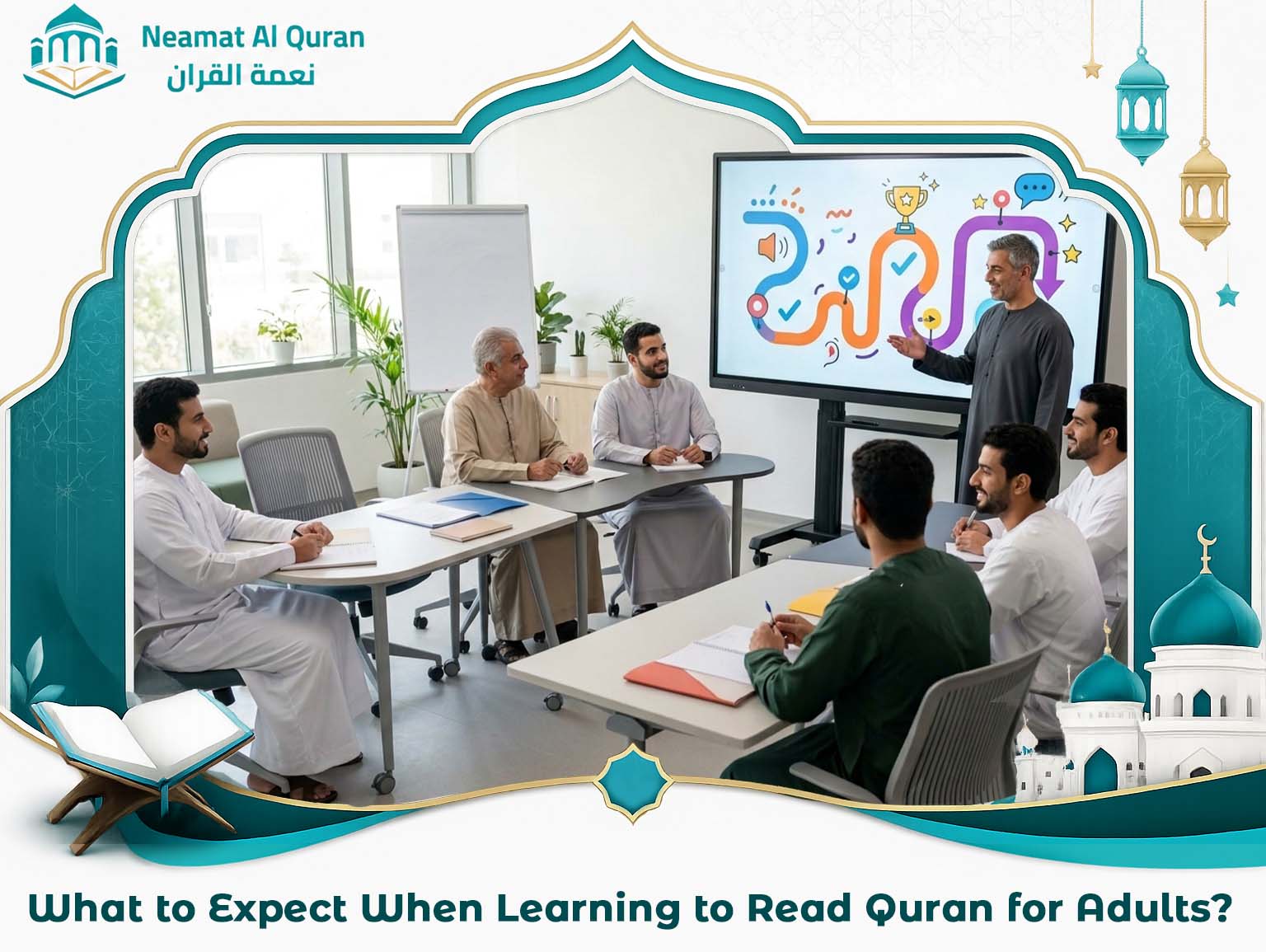
The first month should focus on building a strong routine rather than trying to finish a large portion of the Quran. For someone beginning to learn to read the Quran for Adults, establishing consistent study habits is an important early achievement.
During the first week, the teacher can identify your level and introduce the appropriate material. This prevents beginners from spending time on concepts they are not yet ready to understand.
In the second week, you can reinforce the basic reading patterns introduced during the initial lessons. Repetition at this stage helps strengthen recognition and pronunciation.
By the third week, practice can become more independent while the teacher continues correcting pronunciation and reading errors. This is often when learners begin to feel that Learn to Read Quran for Adults is becoming less intimidating.
During the fourth week, the focus can shift toward reviewing everything learned so far and identifying the next skills to develop. The teacher can also determine whether the learner is ready for more complex words or Quranic passages.
Your exact progress will depend on your starting point and consistency. Nevertheless, a structured first month can remove much of the uncertainty that prevents adults from beginning. Most importantly, it gives you a practical foundation for continuing to learn to read the Quran for Adults with greater confidence and direction.
Frequently Asked Questions About Learning to Read the Quran for Adults
Can adults with dyslexia or reading difficulties learn to read the Quran?
Yes, adults with reading difficulties can learn, although they may benefit from a slower pace, repeated visual patterns, shorter practice sessions, and teaching methods adapted to how they process written information. A teacher should understand the learner’s difficulty before deciding how quickly to introduce new material.
Should I learn Arabic grammar before learning to read the Quran?
No. Arabic grammar is not a prerequisite for learning to decode and recite the Quran. Grammar becomes relevant if your goal later expands to understanding sentence structure and the detailed meanings of Quranic Arabic.
Is it better to learn from the printed Mushaf or a digital Quran?
Both can support learning, but beginners may benefit from using a consistent format during lessons so that the visual arrangement of the text remains familiar. Your teacher can also guide you on which format is most suitable for your stage of learning.
What should I do if I keep forgetting letters after learning them?
Repeated forgetting usually means that the material needs more active review rather than faster progression. Ask your teacher to identify which letters are causing difficulty, practice them in different word positions, and revisit them regularly until recognition becomes automatic.
In conclusion, choosing to learn to read the Quran for adults is not about being at the same level as someone who started as a child. It is about beginning from where you are and developing the skills you need one step at a time.
You may begin by learning the Arabic alphabet. Another learner may begin by correcting pronunciation. Someone else may simply need to rebuild confidence after years away from Quran study.
Whatever your starting point, the process becomes easier when the lessons are structured, the teacher provides direct feedback, and practice remains consistent.
Neamat Al Quran Academy can support adults who want to build their Quran reading ability through organized lessons and level-appropriate instruction. Rather than waiting for the perfect time, start with a realistic schedule, identify your current level, and take the next manageable step toward reading the Quran with greater accuracy and confidence.