
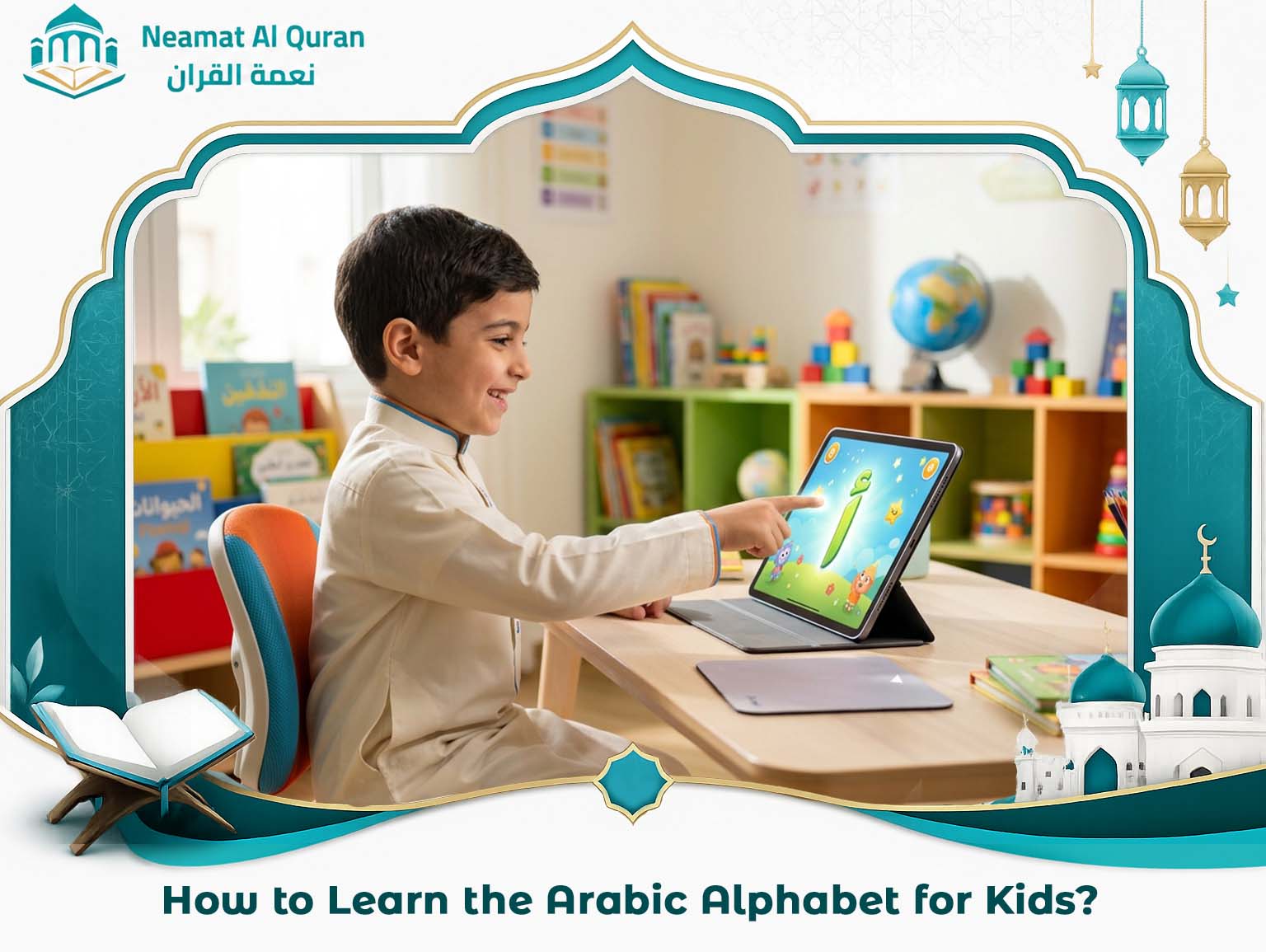
How to learn Arabic alphabet for kids is a common question for parents who want their children to build a strong foundation in Arabic reading. Learning the Arabic alphabet is not simply about memorizing 28 letters in order. Instead, children need to recognize each letter, connect its shape with the correct sound, notice the dots that distinguish similar letters, and gradually understand how letters appear inside words. For that reason, parents often look for a simple learning path that keeps children interested without making lessons feel difficult.
The good news is that learning can become much easier when the process follows a clear sequence. Rather than presenting every letter at once, parents can introduce sounds, shapes, writing movements, and short reading activities step by step. In addition, short and regular practice usually works better for young children than occasional long lessons.
For families looking for structured support, Neamat Al Quran Academy can provide an organized learning environment where children can develop their Arabic reading foundations progressively. However, the learning process also depends on what happens between lessons. Simple activities at home can reinforce recognition, pronunciation, and writing while helping children become more comfortable with Arabic letters.
How to Learn Arabic Alphabet for Kids Step by Step?
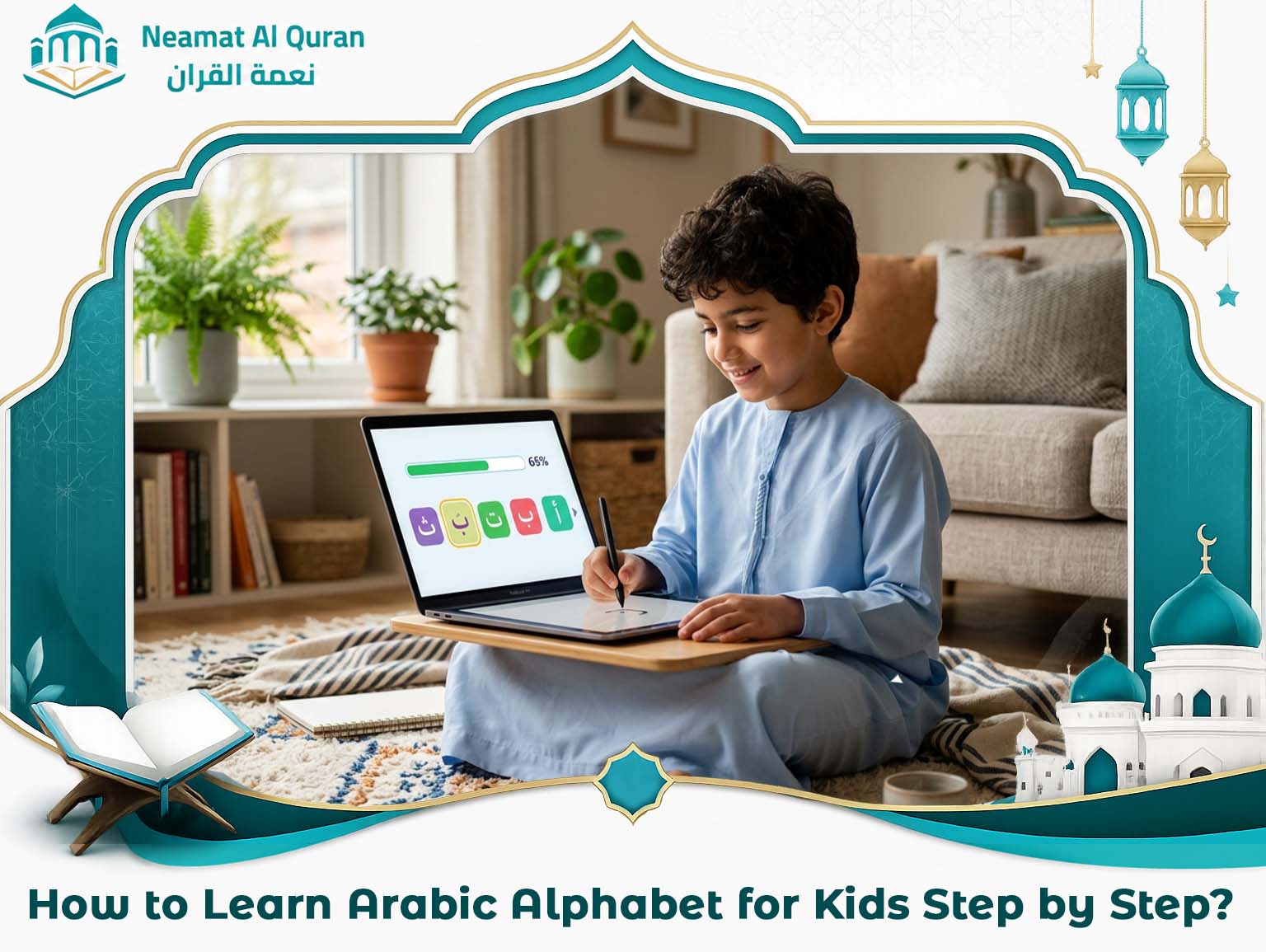
When parents ask how to learn the Arabic alphabet for kids, the first step should be understanding that children do not need to master everything at the same time. Letter recognition comes before fluent reading, while accurate pronunciation and writing can develop alongside recognition. A practical sequence can look like this:
- Introduce the letter visually.
- Teach its basic sound.
- Help the child notice its dots and shape.
- Ask the child to identify it among other letters.
- Practice saying the sound aloud.
- Trace the letter before expecting independent writing.
- Review previously learned letters regularly.
- Begin combining letters only after recognition becomes more secure.
This approach gives children manageable goals. Furthermore, every new lesson builds on an ability they have already developed.
Parents should also watch the child’s response. If a child repeatedly confuses two letters, adding more new letters may not solve the problem. Instead, spend additional time comparing the two shapes and sounds.
Discover the Wisdom of the Quran with Neamat Al Quran Academy
Are you ready to go beyond simple recitation and understand the true guidance of the Quran in your daily life? At Neamat Al Quran Academy, qualified teachers help students explore the meanings of the Quran clearly and practically, which strengthens their faith.
Through structured online lessons, learners improve their understanding and apply Quranic teachings in real situations. Each class encourages reflection, growth, and a deeper connection with Allah’s words. Start your journey today with Neamat Al Quran Academy and build a stronger relationship with the Quran.

How to Learn the Arabic Alphabet for Kids Through Letter Sounds?
One of the most useful principles in learning the Arabic alphabet for kids is to connect the written symbol with its sound from the beginning. Children should not only hear the name of a letter. They should also understand what sound it represents when they begin reading.
For example, when introducing ب, a parent can show the letter, pronounce its sound clearly, and ask the child to repeat it. Afterward, the child can identify ب among several different symbols.
This method becomes especially important with Arabic sounds that may be unfamiliar to children who primarily speak another language. Letters such as ع, ح, خ, and غ can require additional listening and pronunciation practice.
Therefore, parents should avoid rushing through difficult sounds. Repeating a sound in short sessions can be more productive than expecting a child to pronounce it perfectly after one lesson.
Why Sound Recognition Matters?
Knowing the visual appearance of a letter is only one part of early reading. A child eventually needs to connect the symbol with a sound and then use that connection while reading words. For that reason, each lesson can combine:
- Looking at the letter.
- Listening to its sound.
- Repeating the sound.
- Identifying the letter.
- Finding the same letter in simple examples.
This combination creates stronger connections than memorizing letter names alone.
How to Learn Arabic Alphabet for Kids by Grouping Similar Letters?
Another useful answer to how to learn the Arabic alphabet for kids is to teach related letters together. Arabic contains several groups of letters that share a similar basic shape but differ in the number or position of dots.
For example:
- ب، ت، ث share a basic structure.
- ج، ح، خ have a closely related form.
- د، ذ differ mainly through the additional dot.
- ر، ز have a similar visual pattern.
- س، ش are distinguished by dots.
- ص، ض have related structures.
- ط، ظ are visually connected.
- ع، غ share a basic shape.
- ف، ق can be compared through their general structure.
Grouping letters this way can help children recognize patterns instead of treating every symbol as completely unrelated.
However, similar letters should not be introduced so quickly that children confuse them. The purpose of grouping is to highlight differences as well as similarities.
How to Compare Similar Arabic Letters?
When two letters look alike, make the difference obvious. Parents can ask questions such as:
- How many dots does this letter have?
- Where are the dots?
- Which letter has no dots?
- Can you point to the letter I say?
- Can you find the matching letter?
Consequently, children begin paying attention to small visual details.
How to Learn Arabic Alphabet for Kids Without Memorizing All 28 Letters at Once?
A common problem in learning the Arabic alphabet for kids is presenting all 28 letters as one large memorization task. Young learners can become overwhelmed when every lesson introduces several unrelated symbols.
Instead, divide the alphabet into smaller learning units. The exact number of letters per lesson can change according to the child’s age and ability.
For instance, one lesson might focus on two or three letters that share a visual characteristic. Another lesson can review those letters while adding one new symbol. A simple progression might be:
- Learn two or three letters.
- Review them the next day.
- Add another small group.
- Mix old and new letters.
- Test recognition through games.
- Return to difficult letters during later reviews.
This structure gives children repeated exposure without making the lesson feel like a test.
Neamat Al Quran Academy can also be incorporated into a child’s broader learning routine when parents prefer structured instruction alongside home practice.
How to Learn Arabic Alphabet for Kids With Multisensory Activities?
Children often learn differently from adults. Therefore, how to learn the Arabic alphabet for kids should not depend entirely on worksheets or verbal explanations.
Multisensory activities can make the letters easier to remember because the child interacts with the symbol in several ways.
Visual Practice
Use large, clear letters and allow the child to observe their shape. Highlight dots when comparing similar letters. Picture cards can also help children identify letters in a playful setting.
Listening Practice
Pronounce the sound clearly and let the child repeat it. Listening becomes particularly important when a sound does not exist in the child’s first language.
Movement and Touch
Tracing can make letter formation more memorable. Children can trace letters with a finger, write them on a whiteboard, or form them using safe materials such as modeling dough.
Speaking Practice
Ask children to say the letter whenever they identify it. This adds an active element to recognition and helps parents notice pronunciation difficulties.
As a result, learning the Arabic alphabet for kids becomes a practical experience rather than a memorization exercise.
How to Learn Arabic Alphabet for Kids Through Tracing and Writing?
Writing should be introduced gradually. A child who cannot yet recognize a letter consistently may struggle to reproduce it correctly.
When considering how to learn the Arabic alphabet for kids, start with tracing before independent writing. The child can first follow a large model with a finger. Next, they can trace a dotted outline. Finally, they can attempt the letter without assistance.
A useful writing sequence is:
- Observe the letter.
- Trace its direction.
- Copy it beside a model.
- Write it independently.
- Compare the result with the original.
Parents should avoid correcting every small imperfection immediately. Instead, focus first on whether the child understands the general shape and writing direction.
Why Writing Should Not Come Too Early
Arabic letters can appear in different forms depending on their position in a word. Introducing every form at once can make the first stage unnecessarily complicated.
Therefore, isolated letters can be introduced first. Once the child recognizes them confidently, parents can gradually explain how letters change when they appear at the beginning, middle, or end of words.
How to Learn Arabic Alphabet for Kids and Understand Letter Shapes?
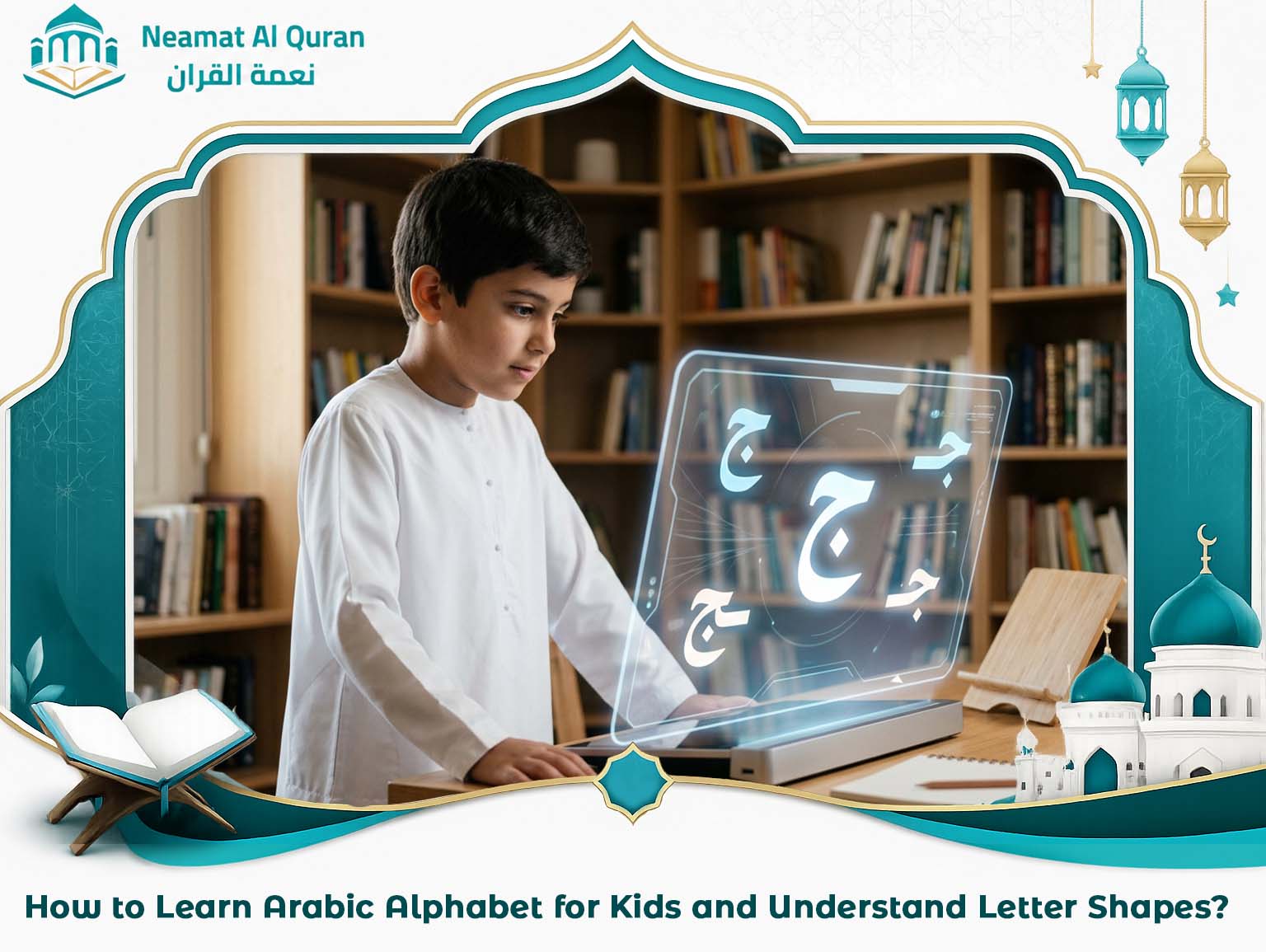
Arabic writing differs from English because many letters connect when they appear within words. As children progress, they need to understand that a familiar letter may look different depending on where it appears.
This is an important stage in learning the Arabic alphabet for kids because recognition must eventually move beyond isolated symbols.
For example, a child may first learn a letter in its isolated form. Later, the same letter can be shown within a simple word. The goal is to help the child recognize the underlying letter even when its appearance changes.
Parents can introduce this gradually rather than presenting all positional forms in one lesson.
A useful progression is:
- Isolated letter recognition.
- Recognition at the beginning of a word.
- Recognition at the end of a word.
- Recognition in connected writing.
- Reading short combinations.
This progression gives the child time to understand why the same letter may appear differently.
How to Learn Arabic Alphabet for Kids With Arabic Diacritics?
Once children have developed basic letter recognition, diacritics can be introduced. Arabic vowel marks, or tashkeel, help learners understand how letters are pronounced in written text. This foundation is also important when children begin to learn the Arabic alphabet for Quran reading.
The basic short-vowel marks include:
- Fatha: ـَ
- Damma: ـُ
- Kasra: ـِ
For example, children can gradually practice combinations such as بَ، بِ، بُ.
The goal is not to make the first alphabet lessons complicated. Instead, parents should introduce one concept at a time.
When asking how to learn the Arabic alphabet for kids, remember that reading development is progressive. Children first need to identify the letter. Then they can learn how a vowel mark changes its sound.
When Should Diacritics Be Introduced?
There is no single age that works for every child. Readiness is more useful than a fixed timetable.
A child may be ready when they can:
- Recognize most previously taught letters.
- Distinguish similar shapes.
- Repeat basic letter sounds.
- Follow short instructions.
- Stay engaged during a brief reading activity.
At that point, simple vowel combinations can become part of the learning routine.
How to Learn Arabic Alphabet for Kids Through Games?
Games can make repetition less tiring. Since children need repeated exposure to remember letters, playful activities can provide practice without making every session feel like formal study. This can be especially helpful before starting a Quran reading course for non-Arabic speakers.
For example, parents can place several Arabic letters on cards and ask the child to find a particular one. Another activity involves saying a sound and asking the child to select the matching letter.
Other ideas include:
- Letter matching cards.
- Find-the-letter challenges.
- Dot-counting games.
- Tracing races.
- Letter puzzles.
- Memory games.
- Sorting similar letters.
- Identifying letters in simple Arabic words.
These activities are especially useful when a child becomes bored with worksheets.
Moreover, games can reveal what the child actually remembers. A child who performs well during repetition may still struggle when letters are mixed together. That difference tells parents when additional review is needed.
How to Learn Arabic Alphabet for Kids With Short Daily Lessons?
Long lessons are not always necessary. In fact, learning the Arabic alphabet for kids often becomes easier when lessons are short, predictable, and repeated throughout the week. Later, children can build on this foundation through a Quranic Arabic course online.
A practical session could take around 10 to 15 minutes:
- 2–3 minutes: Review familiar letters.
- 4–5 minutes: Introduce or practice the current letters.
- 3 minutes: Use a game or recognition activity.
- 2–3 minutes: Practice tracing, speaking, or reading.
The exact timing can change according to the child’s age and attention span.
For younger children, ending the lesson before frustration begins can be more useful than extending it simply to complete a planned activity. Gradually, the child can develop greater stamina.
Neamat Al Quran Academy can complement this routine by giving children structured lessons while parents reinforce the same foundational skills at home.
How to Learn Arabic Alphabet for Kids When the Child Confuses Letters?
Confusing similar letters is normal during early learning. Arabic contains several symbols that share similar shapes, so children may initially mix them up.
Instead of repeatedly asking the child to memorize the correct answer, identify the specific difference confusing. When additional guidance is needed, a one-on-one Arabic tutor online can provide focused correction and practice.
For example, with ب، ت، ث, focus on the dots. Ask the child to identify whether there is one dot below, two dots above, or three dots above.
Similarly, when working with ج، ح، خ, draw attention to the position of the dot rather than treating each letter as an entirely separate shape.
A useful correction strategy is:
- Show the two confusing letters together.
- Explain the visual difference briefly.
- Say both sounds.
- Let the child repeat them.
- Mix them with familiar letters.
- Review them again later.
This approach turns mistakes into learning opportunities.
How to Learn Arabic Alphabet for Kids at Home?
A home environment can reinforce what children learn during formal lessons. Parents do not need to create a classroom. A small, consistent learning space is enough.
Keep Arabic books, letter cards, or a simple whiteboard available. You can also label selected objects with Arabic words once the child begins recognizing letters. As children grow older, the same foundation can support online Arabic classes for adults when they continue their own Arabic learning.
However, avoid turning the entire day into an Arabic lesson. Young learners benefit from natural exposure, songs, stories, conversation, and brief reading activities.
For parents who are not fluent in Arabic, pronunciation can be a particular concern. In that situation, structured instruction can provide a useful model while parents focus on encouragement and regular practice.
Neamat Al Quran Academy can be part of that structured approach, especially when families want children to learn within an organized program rather than relying entirely on independent home activities.
How to Learn Arabic Alphabet for Kids When Parents Do Not Speak Arabic?
Parents do not necessarily need to be fluent Arabic speakers to support alphabet learning. Their most important role can be creating consistency and encouraging the child to practice.
A parent can help by:
- Setting a regular learning time.
- Listening to the child’s reading.
- Reviewing familiar letters.
- Practicing simple recognition games.
- Celebrating progress.
- Keeping lessons positive.
- Communicating with the child’s teacher about difficulties.
At the same time, pronunciation should be modeled accurately. If a parent is uncertain about a particular Arabic sound, it is better to rely on a qualified teacher or reliable learning material than to repeatedly teach an incorrect pronunciation.
With this balance, learning the Arabic alphabet for kids becomes manageable even for families where Arabic is not spoken regularly at home.
How to Learn the Arabic Alphabet for Kids According to Learning Progress?
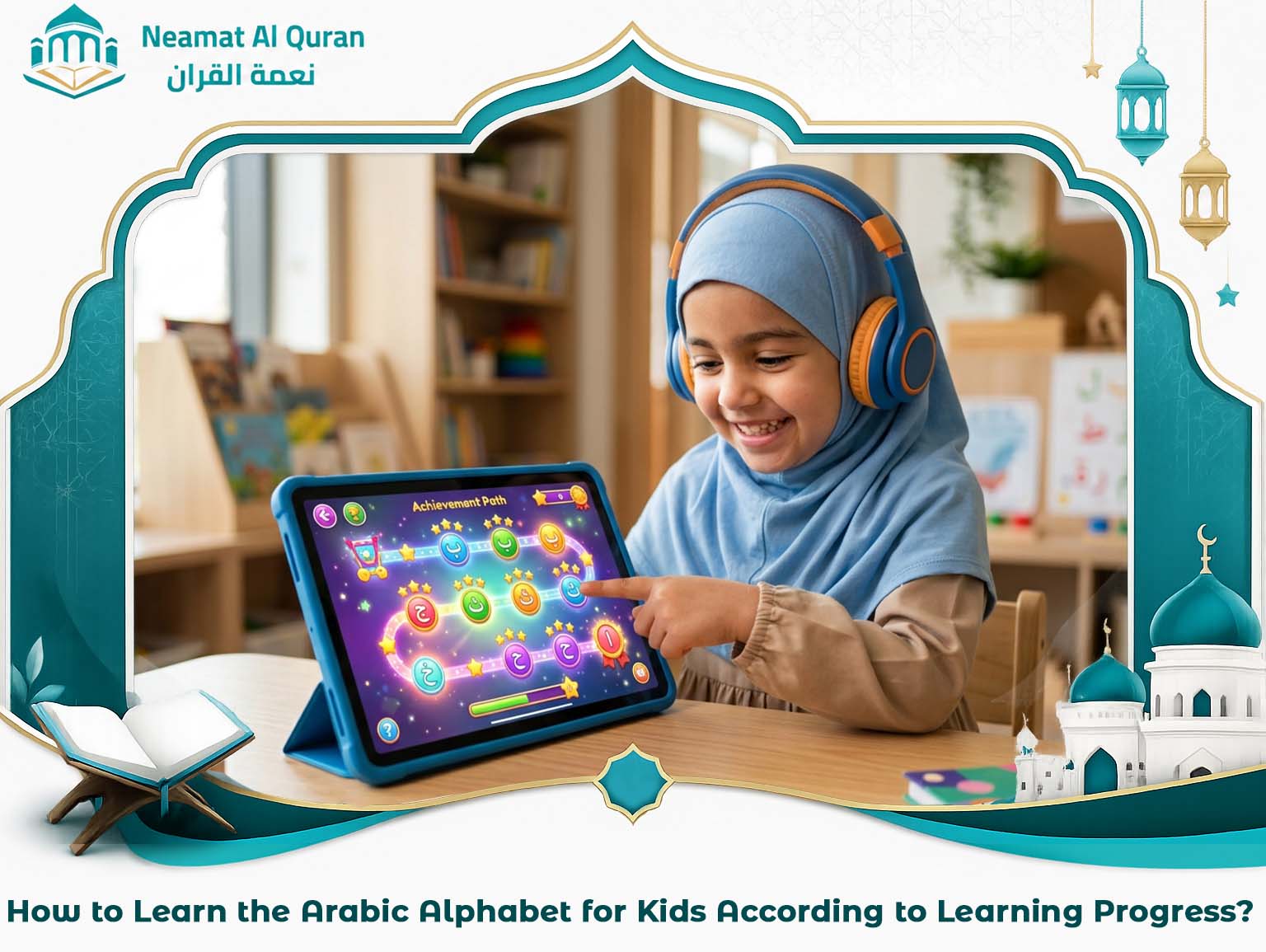
Every child develops at a different pace. Therefore, progress should be measured through skills rather than comparison with another child.
A child may be progressing well if they can:
- Recognize previously learned letters without prompts.
- Distinguish similar letters.
- Produce basic sounds accurately.
- Trace familiar shapes.
- Write some letters independently.
- Read simple combinations with support.
- Remember letters after a review period.
If one area develops more slowly, adjust the lesson rather than assuming the child is not ready to learn.
For example, a child might recognize letters visually but struggle with pronunciation. Another child may pronounce them correctly but have difficulty writing. Each situation requires a slightly different practice strategy.
Neamat Al Quran Academy can help provide structured progression, while parents can use these observable skills to understand where additional home practice may be useful.
Common Mistakes to Avoid When Learning the Arabic Alphabet
Knowing how to learn the Arabic alphabet for kids also means knowing what can make the process harder.
Teaching Too Many Letters at Once
A large number of new symbols can overwhelm young learners. Smaller groups make review easier.
Focusing Only on Letter Names
Names are useful, but children eventually need sound recognition for reading. Therefore, connect names with sounds rather than teaching names in isolation.
Ignoring Similar-Looking Letters
Children need explicit practice distinguishing letters such as ب، ت، ث. Simply repeating the alphabet may not solve the confusion.
Rushing Into Connected Words
Children need a stable foundation before dealing with changing letter forms and connected writing.
Making Every Lesson a Test
Constant testing can make children anxious or resistant. Use games and informal questions instead.
Practicing Only Once a Week
Frequent short exposure generally gives children more opportunities to remember what they have learned.
By avoiding these mistakes, parents can make learning the Arabic alphabet for kids a smoother and more enjoyable process.
A Simple Weekly Plan for How to Learn the Arabic Alphabet for Kids
- Day 1: Introduce one or two letters and their sounds.
- Day 2: Review the letters through recognition and speaking.
- Day 3: Practice tracing and identify the letters among similar symbols.
- Day 4: Add a simple game that requires the child to distinguish the letters.
- Day 5: Review all letters introduced during the week.
- Day 6: Use a short reading or matching activity.
- Day 7: Keep the session light or review only if the child is interested.
- The plan can be adjusted according to the child’s age, attention span, and previous Arabic exposure.
For younger children, repeating the same activities is not necessarily a problem. Repetition can strengthen recognition while keeping expectations realistic.
How to Learn Arabic Alphabet for Kids Before Moving to Reading?
Alphabet learning should eventually lead toward reading. However, the transition should happen gradually.
Once a child recognizes a reasonable number of letters, introduce very short combinations. Diacritics can make early reading easier because they provide information about vowel sounds.
Instead of presenting long words immediately, start with manageable combinations. Ask the child to identify each letter, notice the vowel mark, and blend the sounds. The process might look like this:
See the letter → identify the sound → notice the vowel mark → pronounce the combination → repeat it.
Over time, children can move from individual combinations to short words and then simple sentences.
This is one reason why learning the Arabic alphabet for kids should be viewed as the beginning of reading development rather than an isolated memorization task.
How to Learn Arabic Alphabet for Kids With Neamat Al Quran Academy?
Neamat Al Quran Academy can provide structured support for children who are beginning to learn Arabic letters. A guided lesson can help children recognize each letter, hear its correct sound, and practice writing it step by step. This structure makes the process of learning the Arabic alphabet for kids easier to follow because each skill is introduced at an appropriate pace.
Children can also benefit from regular correction during lessons. When a child confuses similar letters or produces an incorrect sound, timely feedback can prevent the mistake from becoming a habit. For this reason, how to learn the Arabic alphabet for kids should include both explanation and repeated practice.
How to Learn Arabic Alphabet for Kids With the Right Balance of Practice?
Effective practice does not mean asking children to repeat letters for long periods. Short, focused sessions are usually easier for young learners to manage. A child can review several letters, practice their sounds, and then finish with a simple activity. This approach keeps learning the Arabic alphabet for kids practical without making lessons feel overwhelming.
Parents can divide practice into small activities throughout the week. For example, one session can focus on recognition, another on pronunciation, and another on tracing. As a result, learning the Arabic alphabet for kids becomes a gradual process rather than a single memorization task.
Consistency also matters more than long study sessions. Practicing for a few minutes on most days gives children more opportunities to remember what they have learned. Therefore, parents should make learning the Arabic alphabet for kids part of a simple and manageable routine.
How to Know When Your Child Is Ready for the Next Stage?
A child may be ready to move forward when they can recognize familiar letters without constant help. They should also be able to produce the basic sounds with reasonable accuracy and distinguish between letters that look similar.
Writing provides another useful sign. If a child can trace and copy familiar letters with increasing control, they may be ready for more independent writing practice. These skills show that the child is building a solid foundation for how to learn arabic alphabet for kids.
However, children do not all progress at the same speed. Some may recognize letters quickly but need more time to pronounce them correctly. Others may pronounce the sounds well but struggle with writing. In these cases, how to learn the Arabic alphabet for kids should remain flexible enough to match the child’s actual progress.
How to Learn the Arabic Alphabet for Kids in a Positive Learning Environment?
A positive learning environment can make children more willing to participate. Instead of focusing only on mistakes, parents and teachers can recognize small improvements and encourage children to keep practicing. This attitude can make learning the Arabic alphabet for kids feel less stressful.
Children also learn better when lessons include familiar and enjoyable activities. Picture cards, tracing exercises, matching games, and short pronunciation activities can make practice more engaging. In this way, learning the Arabic alphabet for kids becomes connected with active participation rather than passive memorization.
Parents can also avoid comparing one child’s progress with another child’s progress. Each learner needs time to develop recognition, pronunciation, and writing skills. A calm approach can support learning the Arabic alphabet for kids without creating unnecessary pressure.
Final Tips for Parents
Before starting a new lesson, parents can use a simple checklist to keep learning the Arabic alphabet for kids organized:
- Introduce a small number of letters at a time.
- Teach the sound as well as the letter name.
- Review previously learned letters regularly.
- Use visual, listening, speaking, and writing activities.
- Practice similar-looking letters separately.
- Keep lessons short and focused.
- Give the child time to answer independently.
- Correct pronunciation gently and clearly.
- Use tracing before expecting independent writing.
- Introduce Arabic diacritics after the basic letters become familiar.
This checklist helps parents understand what effective ways to learn the Arabic alphabet for kids should include without making lessons unnecessarily complicated.
Frequently Asked Questions About How to Learn the Arabic Alphabet for Kids
Parents often have questions about the best age, learning pace, practice methods, and common challenges when teaching children the Arabic alphabet.
Can a child learn Arabic letters if Arabic is not spoken at home?
Yes. A child can develop Arabic letter recognition even when Arabic is not the main language used at home. What matters is consistent exposure, accurate pronunciation models, and regular opportunities to practice. Parents can support the process through short activities while a qualified teacher provides pronunciation guidance.
Should children learn handwriting and reading at exactly the same time?
Not necessarily. Reading recognition can begin before a child has developed strong handwriting control. Fine-motor skills also develop gradually, so parents can introduce tracing and writing alongside recognition without expecting both abilities to progress equally.
What should parents do when a child loses interest during an alphabet lesson?
Shorten the activity and change the type of practice. A recognition game, matching activity, or tracing exercise may feel easier than another worksheet. In addition, ending a session positively can make the child more willing to return for the next lesson.
How can parents tell whether their child is ready to start reading simple Arabic words?
Look for consistent letter recognition rather than relying only on age. If the child can identify many familiar letters, distinguish common look-alikes, and connect letters with their basic sounds, simple combinations can be introduced gradually. The transition should remain flexible and supported by regular review.
In conclusion, learning the Arabic alphabet for kids is best approached as a gradual learning journey rather than a single memorization exercise. Children need time to connect letter shapes with sounds, recognize differences between similar symbols, practice writing movements, and eventually understand how letters work together inside words.
With short lessons, regular review, multisensory activities, and age-appropriate progression, parents can create a learning routine that feels manageable and engaging. Furthermore, structured instruction from Neamat Al Quran Academy can complement practice at home and help children continue developing their Arabic reading foundation.
The objective is not simply to complete all 28 letters as quickly as possible. Instead, children should finish the first stage with confidence in what they have learned and enough understanding to move naturally toward reading, pronunciation, and Quran learning.