

Types of Madd in Tajweed were the last thing Adam expected to learn when he decided to improve his Quran recitation. Like many Muslims who grew up without speaking Arabic, he could recognize some Quranic words, but he often struggled to understand why certain sounds were stretched while others were pronounced quickly.
One evening, while listening to his favorite Quran reciter, Adam noticed something beautiful. Some letters seemed to flow gently, while others lasted much longer. He played the same verse several times, trying to understand what made the recitation sound so smooth.
The following morning, he visited his Quran teacher, Sheikh Ibrahim, hoping to find an answer.
“Sheikh, I have a question,” Adam said as he opened his Quran. “Why do some letters take longer to pronounce? Is it simply the reader’s choice?”
Sheikh Ibrahim smiled. “No, Adam. There is a beautiful system behind those sounds. It is called Madd, and learning its rules will help you understand how to recite the Quran correctly.”
He explained that Madd means elongation or stretching. In Tajweed, it refers to extending the sound of specific letters for a measured duration. These letters are Alif (ا), Waw (و), and Ya (ي).
Adam looked at the three letters written on the board.
“But how do I know when to stretch them?”
“That is exactly what we are going to discover,” replied the Sheikh.
The First Discovery: Why Some Quranic Sounds Are Naturally Longer
Sheikh Ibrahim began by writing three words on a small whiteboard: قَالَ (Qāla), يَقُولُ (Yaqūlu), and قِيلَ (Qīla).
“Read these words aloud,” he asked.
Adam carefully pronounced each one. The Sheikh then pointed to the elongated sounds.
“Notice something? The first word contains an Alif after a letter with Fathah. The second contains a Waw with Sukoon after Dammah, and the third contains a Ya with Sukoon after Kasrah.”
Adam repeated the words, paying attention to the differences.
“These are the three Madd letters,” the Sheikh explained. “When they appear under their correct conditions, they create what we call Madd Asli, also known as Madd Tabi’i.”
Adam asked whether this was the shortest type of elongation.
“Yes. Natural Madd is held for two Harakahs. A Harakah is a unit used to measure the duration of pronunciation. Think of it as a simple timing guide rather than an exact number of seconds.”
For the first time, Adam understood why some sounds in Quranic recitation seemed naturally longer. He had discovered Madd Asli, the foundation of the different types of Madd in Tajweed.
As he continued learning, he realized that guidance from an online Tajweed teacher could help him understand each rule and apply it correctly during Quran recitation.
The Unexpected Sound That Changed Everything

A few days later, Adam returned to his lesson with a recording of a famous Quran reciter.
“Sheikh, I understand the two-count elongation now, but listen to this word. It sounds much longer!”
The Sheikh listened carefully and wrote one word on the board:
جَاءَ (Jā’a).
“Look at this word,” he said. “Can you identify the Alif?”
Adam pointed to it.
“Good. Now look at what comes immediately after it. It is a Hamzah.”
He explained that when a Madd letter is followed by a Hamzah in the same word, the rule is called Madd Wajib Muttasil. The word Muttasil means connected because both letters occur within one word.
“In the common Hafs recitation, we stretch this Madd for four or five Harakahs.”
Adam was excited. He had just discovered that the position of a Hamzah could change the duration of a Madd.
The Sheikh then wrote another Quranic expression:
يَا أَيُّهَا
“Now, what do you notice here?”
Adam examined both words.
“The Madd letter is at the end of the first word, but the Hamzah starts the next one!”
“Exactly. This is Madd Ja’iz Munfasil. Unlike Muttasil, the Madd letter and Hamzah are separated into two words.”
Adam quickly wrote both rules in his notebook. Madd Wajib Muttasil occurred within one word, while Madd Ja’iz Munfasil occurred across two words. Both are commonly stretched for four or five counts in the Hafs reading method.
He smiled. “So, I should always check where the Hamzah appears before deciding how long to stretch the sound?”
“Precisely,” answered the Sheikh.
The Day Adam Discovered That Hamzah Could Come First
During his next lesson, the Sheikh presented Adam with three more Quranic words:
آمَنُوا، إِيمَانًا، أُوتُوا
Adam noticed that these words also contained a Hamzah and a Madd letter, but something was different.
“This time, the Hamzah comes before the Madd letter!” he said.
The Sheikh nodded.
“Very good. This is called Madd Badal. It occurs when a Hamzah is followed by a Madd letter in the same word.”
Adam learned that Madd Badal is normally extended for two Harakahs in the common Hafs recitation.
“That means I should not confuse it with Madd Wajib Muttasil,” he said.
“Correct. In Muttasil, the Madd letter comes before the Hamzah. In Badal, the Hamzah comes first.”
Adam began to understand that Tajweed was not about memorizing random sounds. Every rule had a reason, and even a small change in the order of letters could make a difference.
For beginners who want to understand these rules step by step, Tajweed classes online for beginners can provide structured guidance and help them apply Tajweed principles during Quran recitation.
Why Does One Word Need Six Counts?
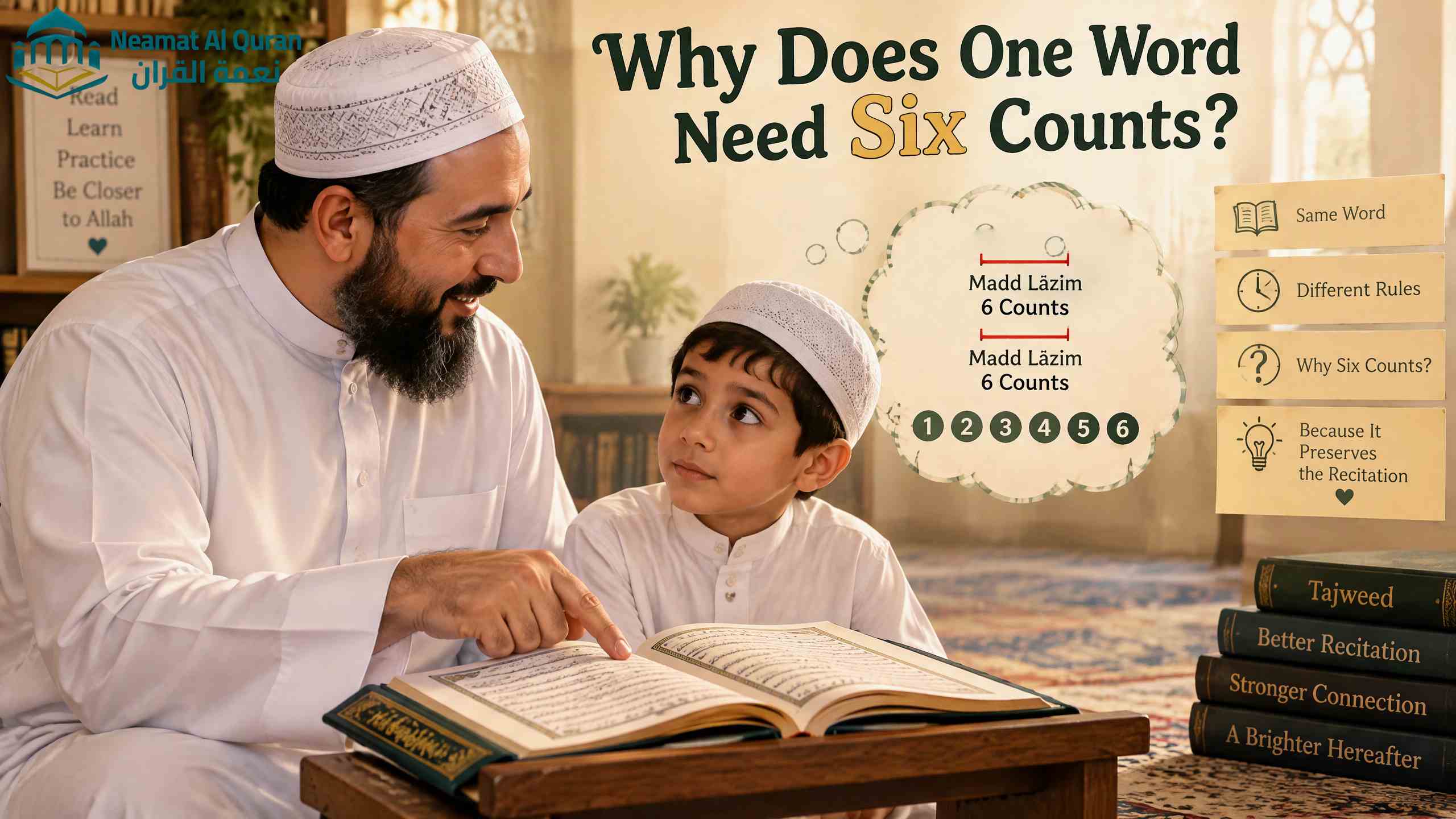
The following week, Adam arrived with another mystery.
“Sheikh, I heard a reciter hold one sound for a very long time. It seemed much longer than four counts. Is that possible?”
The Sheikh opened the Quran and pointed to a familiar word:
الضَّالِّينَ
“This is an example of Madd Lazim Kalimi Muthaqqal. It is one of the forms of Madd Lazim, which requires six Harakahs.”
Adam looked carefully at the word.
“Why six?”
“Because a Madd letter is followed by an original Sukoon. The Sukoon is a permanent part of the word, not something that appears only when we stop.”
The Sheikh explained that Madd Lazim has four subdivisions.
The first is Madd Lazim Kalimi Muthaqqal, where the Madd letter is followed by a letter with Shaddah in the same word, as in الضَّالِّينَ.
The second is Madd Lazim Kalimi Mukhaffaf, where the Madd letter is followed by an original Sukoon without a Shaddah. One of its rare Quranic examples is آلْآنَ.
The third is Madd Lazim Harfi Muthaqqal, which appears in certain disconnected letters at the beginning of Quranic chapters. In the opening letters الم, the letter-name Lām is an example.
The fourth is Madd Lazim Harfi Mukhaffaf, which also occurs in the disconnected opening letters of some Surahs, without the assimilation found in the Muthaqqal form. The letter صٓ is an example.
“Do all four types last six counts?” Adam asked.
“Yes, in the common Hafs reading. That is the important point to remember.”
Adam repeated the word الضَّالِّينَ slowly, trying to maintain the correct duration without rushing or exaggerating the sound.
He finally understood why some Quranic elongations were noticeably longer than others.
When Stopping Changes the Sound of a Word
One afternoon, Adam and his teacher were practicing the final verses of a Surah. Adam noticed that the Sheikh pronounced the ending of a word differently when he stopped.
“Why does the sound change when you stop reading?” he asked.
“Because stopping can create another type of Madd,” the Sheikh replied.
He showed Adam the word الْعَالَمِينَ.
“When we continue reading, the final letter is vowelled. But when we stop, it becomes temporarily silent. If a Madd letter comes before this temporary Sukoon, we have Madd ‘Arid Lis-Sukoon.”
Adam learned that this Madd can be extended for two, four, or six Harakahs.
“Does this mean the same word can have different elongation depending on whether I continue or stop?”
“Exactly. That is why understanding Waqf, or stopping, is important in Tajweed.”
The Sheikh then introduced another stopping rule.
He wrote the word عَلِيمًا.
“When a word ends with Tanween Fath and we stop on it, the Tanween is replaced with an Alif-like sound held for two counts. This is called Madd ‘Iwad.”
Adam tried pronouncing the word while continuing and then stopping. He immediately noticed the difference.
The Sheikh added an important exception: if a word ends with Ta Marbuta (ة), Madd ‘Iwad does not apply. Instead, the Ta Marbuta is pronounced as a silent Hā when stopping.
Adam was beginning to realize that the ending of a word could be just as important as its beginning. He also understood that learning Tajweed rules online could help beginners recognize these details and apply them correctly during Quran recitation. Those who want to study these principles step by step can explore learn Tajweed rules online.
The Soft Sound Hidden in Certain Quranic Words
As the lesson continued, the Sheikh wrote two words on the board:
خَوْفٍ and قُرَيْشٍ
“Listen carefully to these words,” he said.
Adam pronounced them slowly.
“Did you notice the soft sound of Waw and Ya?”
The Sheikh explained that these letters can produce Madd Leen when they have Sukoon and are preceded by Fathah. When the reader stops on the word, the final letter becomes silent, allowing the soft sound to be extended.
This is called Madd Leen.
Adam practiced the two examples and learned that Madd Leen can be stretched for two, four, or six Harakahs when stopping, according to the chosen recitation method.
“So it is different from Madd Asli because it depends on stopping?”
“Yes. The conditions are different, and recognizing them will help you avoid confusing the two.”
Adam repeated the words several times. He was starting to recognize Madd rules without needing his teacher to point them out.
The Small Letter That Adam Had Almost Ignored
During another lesson, the Sheikh asked Adam to read a verse containing the pronoun Hā (ه).
Adam read it without paying much attention to that letter.
“Stop for a moment,” said the Sheikh. “Sometimes, even a small letter can change the way we connect words.”
He explained that certain forms of Hā referring to a singular masculine absent person have a special rule called Madd Silah. It occurs when the pronoun Hā is between two vowelled letters, under its specific conditions.
“There are two types,” he continued.
“The first is Madd Silah Sughra. It occurs when the pronoun Hā is followed by a letter other than Hamzah. It is normally stretched for two Harakahs.”
He gave Adam an example:
إِنَّهُ كَانَ
“The second is Madd Silah Kubra. It occurs when the pronoun Hā is followed by a Hamzah. In the common Hafs reading, it is generally extended for four or five Harakahs.”
Adam practiced identifying the difference.
“Does this rule also apply when I stop on the Hā?”
“No. The Silah elongation is generally dropped when stopping on the pronoun itself.”
Adam smiled. He had discovered another subtle rule that he would never have noticed without learning Tajweed. He also realized that Tajweed classes for adults can help adult learners understand these rules and apply them more confidently during Quran recitation.
Adam’s Final Test: Can He Recognize the Types of Madd in Tajweed?
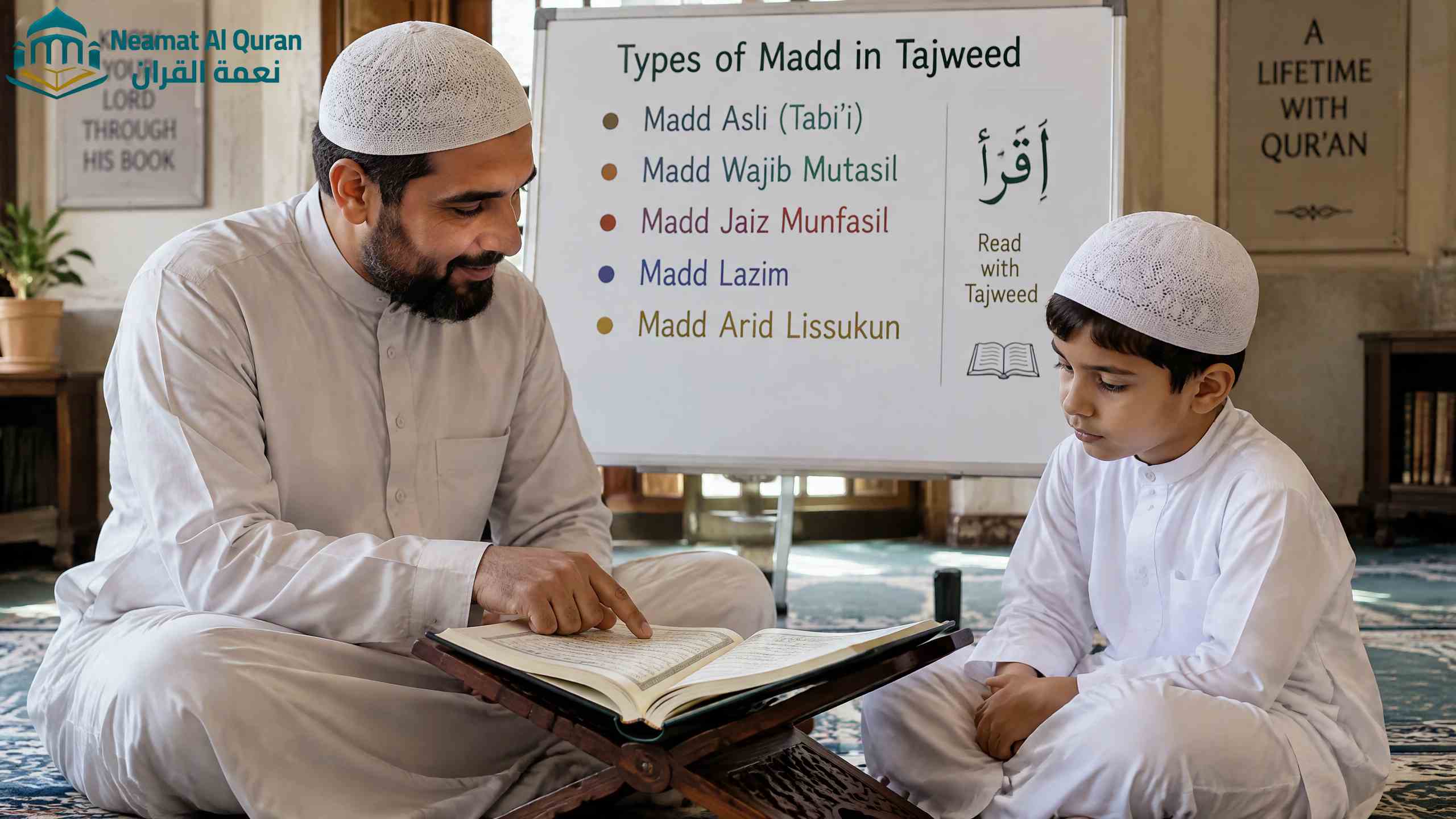
After several weeks of practice, Sheikh Ibrahim decided that Adam was ready for a small challenge.
“Today, I will not explain the rules first. I want you to read and identify the Madd types yourself.”
Adam felt slightly nervous, but he opened his Quran and began reading.
When he reached قَالَ, he recognized Madd Asli.
When he saw جَاءَ, he remembered Madd Wajib Muttasil.
At يَا أَيُّهَا, he identified Madd Ja’iz Munfasil.
He recognized the long elongation in الضَّالِّينَ as Madd Lazim Kalimi Muthaqqal. When stopping at الْعَالَمِينَ, he remembered Madd ‘Arid Lis-Sukoon.
He was not perfect. He confused a few rules and needed his teacher’s help. But something important had changed: he was no longer reading without understanding.
After the lesson, Adam asked, “Sheikh, how long will it take me to master all these rules?”
The teacher replied, “There is no need to learn everything in one day. Start with the natural Madd, then learn the secondary forms. Listen to qualified reciters, practice with a teacher, and give yourself time.”
He also advised Adam to record his recitation and compare it with a qualified teacher’s reading. This would help him identify mistakes in pronunciation and timing.
Adam left the lesson feeling encouraged. What once seemed like a complicated collection of Arabic terms had become a meaningful system he could understand and practice. For learners who want to develop their Tajweed knowledge through structured study, a Tajweed course with certificate may offer an opportunity to strengthen their understanding and demonstrate their learning progress.
Frequently Asked Questions About the Types of Madd in Tajweed
Here are answers to common questions about the types of Madd in Tajweed, their durations, rules, and practical examples.
1. How many types of Madd are there in Tajweed?
Madd is divided into two main categories: Madd Asli (Natural Madd) and Madd Far’i (Secondary Madd). Each category contains several types and subdivisions. The total number depends on how the rules are classified in a particular Tajweed curriculum.
2. What is the easiest type of Madd for beginners?
Madd Asli, also called Madd Tabi’i, is generally the easiest starting point. It requires stretching one of the three Madd letters for two Harakahs under the correct conditions.
3. Which type of Madd requires six Harakahs?
Madd Lazim requires six Harakahs in the common Hafs recitation. Its four subdivisions are Madd Lazim Kalimi Muthaqqal, Kalimi Mukhaffaf, Harfi Muthaqqal, and Harfi Mukhaffaf.
4. What is the difference between Madd Wajib Muttasil and Madd Ja’iz Munfasil?
Madd Wajib Muttasil occurs when a Madd letter is followed by a Hamzah in the same word. Madd Ja’iz Munfasil occurs when the Madd letter is at the end of one word, and the Hamzah begins the next word.
5. Can non-Arabic speakers learn the types of Madd in Tajweed?
Absolutely. Non-Arabic speakers can learn Tajweed by studying the Arabic alphabet, understanding vowel sounds, listening to qualified Quran teachers, and practicing regularly. Speaking Arabic fluently is not a requirement for learning correct Quranic recitation.
Conclusion: Every Sound Has a Beautiful Purpose
As Adam continued his Quran learning journey, he discovered that Madd was much more than simply stretching a sound. Each rule had its own conditions, duration, and purpose.
From the natural two-count elongation of Madd Asli to the six-count extension of Madd Lazim, the different types of Madd in Tajweed helped him understand the structure and beauty of Quranic recitation.
For anyone learning Quranic recitation without knowing Arabic, Adam’s experience offers an important lesson: you do not have to master everything immediately. Learn one rule at a time, listen carefully, and practice with a qualified teacher.
With patience and consistent practice, what once sounded complicated can gradually become familiar and natural.
Your journey toward beautiful Quran recitation begins with understanding one letter, one sound, and one Madd at a time.