
When children should start learning Quran is one of the most common questions parents ask when they want to build a strong Islamic foundation for their children. There is no single age that works perfectly for every child. Some children show interest in Arabic letters and Quran recitation at a very young age, while others need more time before they can focus, repeat sounds, or participate comfortably in structured lessons.
The better approach is to consider the child’s development, personality, attention span, curiosity, and emotional readiness. Quran learning should feel like a positive part of childhood rather than a demanding task that creates anxiety. Parents can introduce the Quran gradually through listening, short conversations, simple Surahs, stories, and family reading time.
At Neamat Al Quran Academy, children can receive age-appropriate Quran education in a supportive environment where teachers can adapt lessons to the learner’s level. The goal is not simply to make a child memorize quickly. It is to help them develop a lasting relationship with the Quran based on love, understanding, good manners, and regular practice.
When Should Children Start Learning Quran?
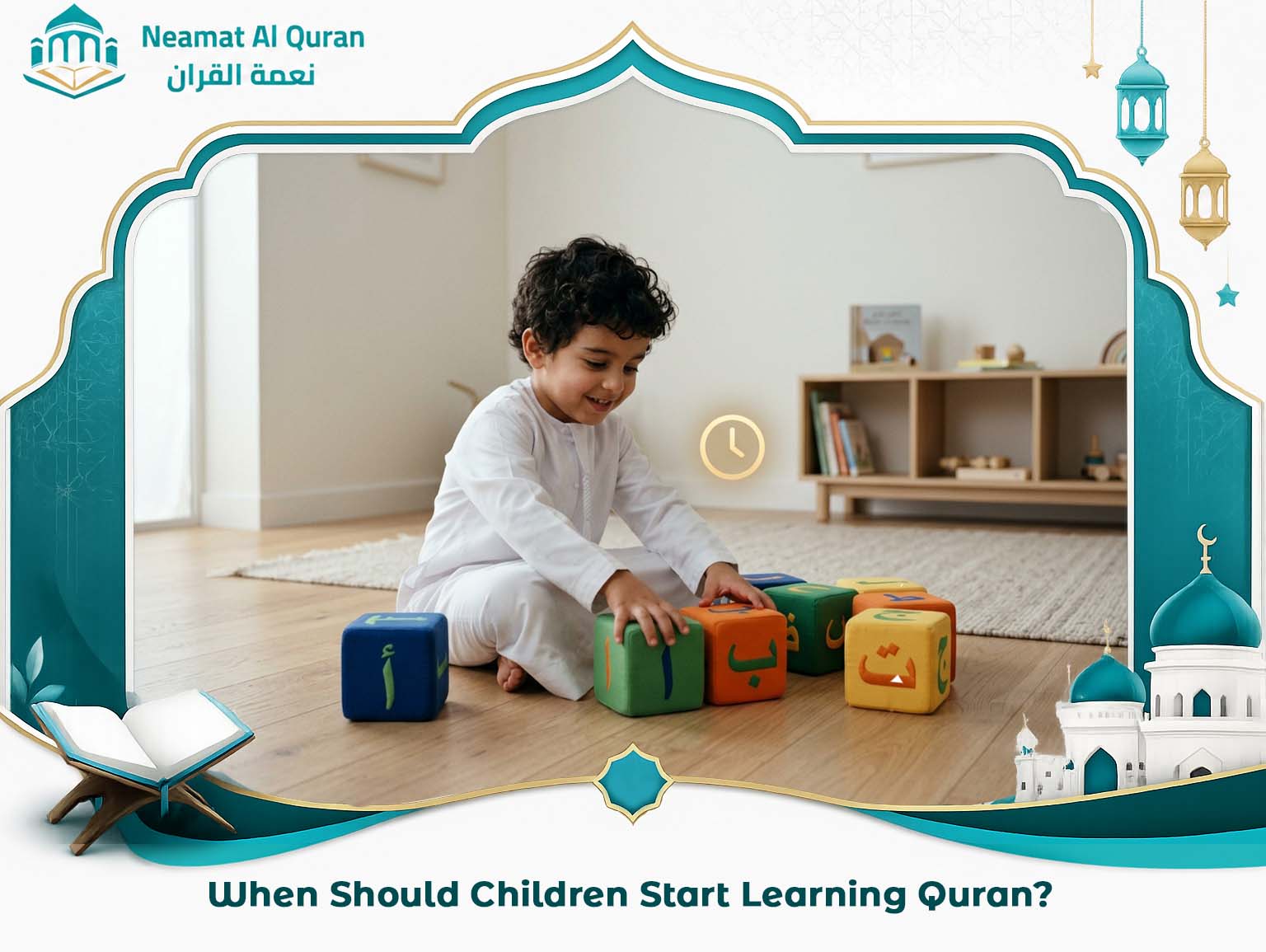
So, when should children start learning quran? In general, parents can introduce children to the Quran from an early age through simple and enjoyable activities. However, formal lessons should match the child’s ability to concentrate and participate without becoming overwhelmed.
There is a major difference between introducing a child to the Quran and expecting that child to complete a structured curriculum. A toddler may enjoy listening to recitation or repeating a short phrase. A preschool child may begin recognizing Arabic letters. A school-age child may be ready for regular reading, Tajweed, memorization, and Islamic studies.
Instead of focusing only on a specific birthday, parents should look for practical signs of readiness:
- The child enjoys listening to Quran recitation.
- They can follow simple instructions.
- They show curiosity about Arabic letters.
- They can remain engaged for a short lesson.
- They enjoy repeating sounds or words.
- They respond positively to praise and encouragement.
- They are willing to participate without constant pressure.
This approach makes the learning experience more personal and sustainable.
Discover the Wisdom of the Quran with Neamat Al Quran Academy
Are you ready to go beyond simple recitation and understand the true guidance of the Quran in your daily life? At Neamat Al Quran Academy, qualified teachers help students explore the meanings of the Quran clearly and practically, which strengthens their faith.
Through structured online lessons, learners improve their understanding and apply Quranic teachings in real situations. Each class encourages reflection, growth, and a deeper connection with Allah’s words. Start your journey today with Neamat Al Quran Academy and build a stronger relationship with the Quran.

What Is the Best Age to Introduce the Quran?
When parents ask when children should start learning quran, they often expect one exact age. In reality, Quran education can begin in stages.
During the toddler years, exposure can be informal. Parents may play gentle recitations, recite short Surahs at home, and allow children to hear Quran regularly. At this stage, the purpose is familiarity rather than academic achievement.
During the preschool years, many children become more interested in letters, sounds, and repetition. This can be a suitable period to introduce Arabic letters and basic Quran reading skills. Lessons should remain short because young children naturally have limited attention spans.
By the early school years, many children can handle a more organized routine. They may begin learning Quran reading, basic Tajweed rules, short Surahs, and selected Islamic teachings.
However, these age ranges are not strict rules. One child may be ready earlier, while another may benefit from waiting. The parent’s responsibility is to recognize the child’s needs rather than compare them with other children.
When Should Children Start Learning Quran in a Formal Class?
The question of when children should start learning quran becomes especially important when parents are considering an academy or private teacher. Formal lessons can begin once a child can participate willingly and benefit from structured instruction. Parents who want to improve their own Arabic skills alongside supporting their children can also explore online Arabic classes for adults.
A formal Quran class does not necessarily need to be long. For younger learners, a short and focused session may produce better results than an extended lesson. The teacher can gradually increase the amount of material as the child’s confidence and concentration improve.
Before enrolling a child, parents should consider:
- Attention span: Can the child focus for the expected lesson period?
- Communication: Can the child understand basic instructions?
- Interest: Does the child show some curiosity about learning?
- Emotional readiness: Can the child accept correction without becoming distressed?
- Routine: Can the family maintain regular attendance?
- Teacher compatibility: Does the teaching style suit the child’s personality?
A suitable class should meet the child where they are. It should not force a young learner into a program designed for older students.
When Should Children Start Learning Quran Without Pressure?
Parents sometimes believe that starting as early as possible automatically produces better Quran learners. Earlier exposure can certainly be valuable, but pressure can undermine that benefit.
When considering when children should start learning quran, parents should also ask how the child will experience those lessons. A child who associates the Quran with shouting, punishment, or constant criticism may become reluctant to study. Conversely, a child who experiences encouragement and warmth may develop a natural desire to continue.
This does not mean parents should remove discipline or structure. Children need clear expectations. The difference is between healthy consistency and excessive pressure.
A positive learning environment can include:
- Praising effort rather than perfection.
- Correcting mistakes calmly.
- Giving children achievable targets.
- Allowing short breaks when necessary.
- Celebrating progress.
- Avoiding comparisons with siblings or classmates.
- Connecting Quran lessons with everyday life.
The early years are about building a foundation. Strong foundations usually require patience.
Why Early Quran Exposure Can Benefit Children?
Early exposure gives children an opportunity to become familiar with Quranic sounds, Arabic pronunciation, and Islamic vocabulary. Hearing the Quran repeatedly can also make recitation feel natural as children grow.
However, early exposure does not mean demanding memorization from a very young child. Parents can introduce the Quran through ordinary family routines while also considering whether is online quran learning safe for kids when choosing a suitable learning environment.
For example, a family might:
- Listen to a short Surah during a quiet part of the day.
- Recite together before bedtime.
- Encourage children to repeat familiar verses.
- Explain simple Islamic concepts.
- Read age-appropriate stories related to the Prophets.
- Let children observe parents reading the Quran.
These experiences can make the Quran part of everyday family life.
The most important benefit may be emotional rather than academic. Children learn that the Quran is something their family values, reads, respects, and enjoys.
When Should Children Start Learning Quran Reading Skills?
For many families, when should children start learning quran also means asking when they should begin learning how to read Arabic.
There is no universal starting point. A child’s ability to recognize shapes, distinguish sounds, remember symbols, and follow instructions can influence the timing.
A gradual reading pathway may look like this:
Stage 1: Recognizing Arabic Letters
The child becomes familiar with individual letters and their basic sounds. Visual games and repetition can make this stage easier.
Stage 2: Connecting Letters With Sounds
The learner begins combining letters and recognizing simple vowel patterns. Repetition is useful, but sessions should remain manageable.
Stage 3: Reading Simple Words
Once the child understands the basic system, they can gradually read connected Arabic letters and short words.
Stage 4: Reading Quranic Text
The child can begin applying those skills to Quranic verses while receiving correction from a qualified teacher.
This gradual process helps children develop accuracy before they are expected to read quickly. As their reading develops, parents can also explore how to read quran with tajweed for beginners to understand the fundamentals of proper Quranic recitation better.
When Should Children Start Learning Quran Memorization?
Memorization is another area where parents often wonder when children should start learning quran. Young children can have impressive memory abilities, but memorization should still be adapted to their development.
Instead of setting an ambitious target, begin with manageable portions. A child might learn a short Surah over several sessions, with frequent review between new verses. Parents can also consider how long it takes to memorize the quran when setting realistic expectations for the child’s progress.
A balanced memorization routine can include:
- Listening to the selected passage.
- Reading or following along with the teacher.
- Repeating small sections.
- Connecting each verse to the previous one.
- Reciting from memory.
- Reviewing older material regularly.
- Taking breaks when concentration decreases.
Review is particularly important. Memorizing new material without revisiting older passages can lead to weak retention.
Parents should also remember that memorization speed is not the only measure of success. Accurate recitation, understanding, confidence, and consistency matter just as much.
How Long Should a Child Study Quran Each Day?
Once parents know when children should start learning quran, the next question is often how long each lesson should last.
The ideal duration depends on age, learning level, personality, and the type of lesson. Younger children generally benefit from shorter sessions, while older learners may gradually handle longer periods.
A useful routine should be realistic enough to maintain throughout the week.
For younger children, parents can focus on:
- 5–15 minutes of focused practice.
- One small learning objective.
- A short review.
- Positive feedback.
Older children may gradually move toward longer structured sessions when their concentration allows it.
The important principle is consistency. A short routine that happens regularly can be more useful than a long session followed by several days without practice.
When Should Children Start Learning Quran With Tajweed?
Parents who ask when children should start learning quran may also wonder when Tajweed should be introduced. Tajweed should not necessarily begin as a collection of complicated technical rules.
Children can first develop correct pronunciation by listening carefully and receiving gentle correction. As they become more comfortable with reading, teachers can introduce relevant Tajweed concepts gradually.
For example, a teacher may focus on:
- Correct pronunciation of Arabic letters.
- Proper articulation points.
- Clear vowel sounds.
- Basic elongation.
- Simple stopping and starting principles.
- Rules appropriate to the child’s reading level.
Teaching every rule at once can overwhelm a beginner. A progressive approach allows children to apply one skill before adding another.
At Neamat Al Quran Academy, a structured approach can help children build Quran reading skills progressively while keeping lessons suitable for their individual level.
What If a Child Is Not Interested in the Quran?
Not every child immediately becomes enthusiastic about formal Quran lessons. This does not necessarily mean the child is incapable of learning.
When considering when children should start learning quran, parents should recognize that motivation can develop gradually. A child may dislike repetitive exercises but enjoy stories, listening, games, or interactive activities connected to the Quran.
Parents can discover what motivates the child by changing the learning experience rather than abandoning Quran education completely. Before choosing an online program, parents can also review how to choose an online quran teacher for your child and consider the teacher’s experience, communication style, and ability to engage young learners.
Try:
- Shorter lessons.
- More interactive activities.
- Different teaching materials.
- Story-based explanations.
- Listening before reading.
- Letting the child choose between two suitable activities.
- Praising improvement rather than demanding perfection.
The teacher also plays an important role. Some children respond better to energetic instruction, while others prefer a calm and patient teacher.
How Can Parents Make Quran Learning Enjoyable?
The answer to when children should start learning quran is only part of the picture. The way parents introduce learning can have a lasting influence.
Children often remember emotions associated with learning. Therefore, parents should try to create a calm environment.
Simple habits can make Quran time more enjoyable:
- Choose a consistent time when the child is not tired.
- Keep learning materials organized.
- Use age-appropriate explanations.
- Celebrate small achievements.
- Give specific praise such as “Your pronunciation improved.”
- Avoid turning every family interaction into a correction session.
- Give the child opportunities to recite without fear of embarrassment.
Parents can also establish a family Quran routine. Even when a child has a formal lesson, seeing parents read and listen to the Quran reinforces the importance of the habit.
When Should Children Start Learning Quran With Parents?
Family participation can begin from the earliest stages. A parent does not need to be an expert Quran teacher to create a positive learning environment.
If you are still asking when children should start learning quran, consider starting family exposure before formal education. Parents can recite short Surahs, listen with their children, explain simple meanings, and encourage respectful behavior around the Quran.
A parent can also support the child’s formal education by reviewing assigned material without becoming overly strict.
For example, after a lesson, ask:
- “What did you learn today?”
- “Which verse did you enjoy?”
- “Would you like to recite it for me?”
- “Was anything difficult?”
These questions turn practice into conversation rather than an examination.
When Should Children Start Learning Quran Based on Readiness?
A readiness-based approach is often more useful than an age-only approach. When deciding when children should start learning quran, parents can evaluate several developmental areas.
Emotional Readiness
The child should feel reasonably comfortable participating in lessons. Occasional resistance is normal, but persistent distress may indicate that the approach needs adjustment.
Cognitive Readiness
The learner should be able to remember simple instructions, recognize patterns, and participate in short learning activities.
Communication Readiness
The child should be able to communicate basic needs and understand the teacher well enough to follow the lesson.
Physical Readiness
If the child is consistently exhausted or hungry during lesson times, even an excellent program may become difficult.
Behavioral Readiness
The child does not need perfect behavior. However, some ability to sit, listen, respond, and return attention to the lesson is helpful.
These factors provide a better picture than age alone.
Common Mistakes Parents Should Avoid
Knowing when children should start learning quran is helpful, but avoiding common mistakes is equally important.
Starting With Unrealistic Targets
Expecting a young child to memorize large portions immediately can create unnecessary frustration. Begin with achievable goals.
Comparing Children
Children develop at different speeds. Comparing one learner with another can damage confidence and motivation.
Focusing Only on Memorization
Memorization is valuable, but Quran education should also include reading accuracy, pronunciation, understanding, manners, and practical Islamic values.
Using Constant Punishment
Fear may produce short-term compliance, but it does not necessarily create a positive lifelong relationship with the Quran.
Ignoring Revision
New memorization can disappear quickly if older material is not reviewed.
Choosing a Teacher Based Only on Qualifications
Qualifications matter, but teaching personality matters too. A teacher who understands children can make a major difference in the learning experience.
How to Choose the Right Quran Teacher for a Child?
The right teacher can answer many practical challenges surrounding when children should start learning quran because they can assess the child’s current level and recommend an appropriate learning path.
Parents should look for several qualities:
- Experience teaching children.
- Strong Quran reading and Tajweed skills.
- Patience with beginners.
- Clear communication.
- Ability to adapt lesson difficulty.
- Respectful correction.
- Understanding of child development.
- A positive approach to mistakes.
- Consistent progress feedback.
Parents should also ask how the teacher handles a child who becomes distracted. A good teacher should have strategies for regaining attention without humiliating the learner.
At Neamat Al Quran Academy, parents can seek an organized learning experience designed around children’s Quran education, allowing lessons to progress according to the student’s needs.
Online Quran Learning for Children
Online education can be useful for families who need flexible scheduling or prefer home-based learning. It can also allow parents to select teachers according to their child’s level and learning needs.
However, online Quran learning works best when the family creates a suitable environment.
Parents can improve online lessons by:
- Choosing a quiet room.
- Checking the internet connection beforehand.
- Using a suitable device.
- Keeping distractions away.
- Preparing the Quran or learning materials before class.
- Staying nearby when younger children need assistance.
- Maintaining a consistent schedule.
The convenience of online learning should not replace quality. Parents should still evaluate the teacher, curriculum, communication, lesson structure, and progress monitoring.
When Should Children Start Learning Quran at Home?
For families who prefer home education, when children should start learning quran can be answered through gradual exposure.
Home learning can begin with listening and family recitation before moving into structured reading practice. Parents can divide learning into small activities instead of attempting a long lesson.
A simple home routine could include:
- First: Listen to a short passage.
- Next: Review a previously learned verse.
- Then: Practise one new reading skill.
- After that: Recite together.
- Finally: Finish with encouragement and a short dua.
The routine does not have to be complicated. What matters most is that the child experiences regular contact with the Quran in a calm environment.
How Does Understanding the Quran Change the Learning Experience?
Children should not be expected to understand complex Tafsir. However, age-appropriate meaning can make their learning more meaningful.
If a child memorizes a verse about kindness, parents can connect that idea to helping siblings. If a verse teaches gratitude, parents can discuss everyday blessings. If a Surah mentions Allah’s mercy, they can explain the concept using language the child understands.
This approach helps children see that Quran learning is not separate from daily life.
The child gradually learns that the Quran teaches values that influence behavior, relationships, decisions, and character.
When Should Children Start Learning Quran for Lifelong Benefits?
Parents who ask when children should start learning quran are often thinking beyond childhood. They want their children to maintain a connection with the Quran as teenagers and adults.
A lifelong relationship is more likely to develop when Quran education includes both knowledge and positive emotional experiences.
Children should gradually learn that the Quran is:
- A source of guidance.
- Something to recite regularly.
- A book to approach with respect.
- A source of reflection.
- Connected to Islamic character.
- Part of Muslim family life.
This broader perspective prevents Quran education from becoming nothing more than a race to complete a certain number of pages.
Creating a Sustainable Quran Routine
A successful Quran routine should fit the family’s actual schedule. Parents do not need to design an exhausting timetable.
A sustainable routine can include a few fixed habits:
- A regular class during the week.
- Short daily revision.
- Family recitation.
- Weekend review.
- Monthly progress discussions.
The routine can change as the child grows. School schedules, holidays, family commitments, and developmental changes may require adjustments.
Flexibility does not mean inconsistency. It means creating a routine that can survive real life.
Signs That Your Child Is Making Good Progress
Parents should measure progress using more than the number of Surahs memorized. Positive signs include:
- Improved pronunciation.
- Greater confidence while reciting.
- Better recognition of Arabic letters.
- Ability to remember previously learned passages.
- Willingness to practise independently.
- Understanding simple Quranic concepts.
- Improved manners connected to Islamic teachings.
- Reduced dependence on prompts during familiar recitation.
Progress may sometimes appear slowly. That is normal. A child can make meaningful improvements even when memorization numbers do not increase rapidly.
When Should Children Start Learning Quran? A Practical Age Guide
There is no universal schedule, but parents may use the following framework as a general guide rather than a strict rule.
Ages 2–4: Familiarity and Exposure
The focus can be listening, repeating simple words, hearing short Surahs, and becoming comfortable with the sound of Quranic Arabic.
Ages 4–6: Early Foundations
Many children can begin exploring Arabic letters, simple sounds, short Surahs, and basic Islamic concepts through engaging activities.
Ages 6–8: Structured Learning
Children may become ready for regular Quran reading, basic Tajweed, memorization, and more organized lessons.
Ages 8 and Above: Developing Independence
Older children can gradually take greater responsibility for revision, reading practice, memorization targets, and understanding.
Again, these are flexible ranges. The individual child matters more than the number on the calendar.
How Can Neamat Al Quran Academy Support Young Learners?
Choosing a Quran program is an important decision, especially when parents want learning to remain consistent without making children feel overwhelmed. Neamat Al Quran Academy is worth considering for families seeking structured online Quran education for children.
A suitable program should help parents understand the child’s current level and identify realistic learning objectives. Instead of giving every student the same workload, lessons should progress according to ability.
Parents can also discuss important questions before beginning:
- What level is suitable for my child?
- How long will each lesson last?
- How is progress evaluated?
- How are mistakes corrected?
- What happens if my child struggles with concentration?
- How much home practice is recommended?
These questions help families choose an approach based on educational quality rather than marketing claims.
How Can Parents Keep Children Motivated Over Time?
Understanding when children should start learning quran is only the beginning. Parents also need to know how to maintain motivation after lessons begin. A child who enjoys Quran lessons one month may become distracted the next. This does not necessarily mean the program has failed. In many cases, motivation naturally changes as children grow.
When parents understand when children should start learning quran, they can set expectations that match the child’s developmental stage. Instead of demanding constant progress, focus on creating positive experiences and recognizing genuine effort.
Try setting small milestones such as:
- Reading a new group of letters.
- Completing a short Surah.
- Improving a specific pronunciation.
- Reviewing previously memorized verses.
- Learning the meaning of a short passage.
For families considering when children should start learning quran, these small goals can make the journey feel achievable. Celebrate progress without turning every achievement into a competition.
Children should understand that Quran learning is a journey. They do not need to master everything immediately. A patient approach to when children should start learning quran can help protect their confidence and willingness to continue.
A Balanced Approach to Quran Education
A balanced Quran education considers more than memorization. Parents asking when children should start learning quran should also consider what the child will learn after beginning.
The strongest approach combines several elements rather than focusing on one outcome:
- Reading — learning to read Quranic Arabic accurately.
- Tajweed — improving pronunciation and recitation.
- Memorization — retaining selected Surahs and passages.
- Understanding — learning age-appropriate meanings.
- Character — applying Quranic values in daily life.
- Consistency — developing a sustainable relationship with the Quran.
When these elements work together, children can develop both practical skills and a meaningful connection with the Book of Allah. This shows that when children should start learning quran more meaningful because the quality of education matters as much as its starting point.
Parents should therefore avoid treating when children should start learning quran as a race. The objective is to establish a foundation that can continue throughout childhood and beyond.
What If a Child Starts Learning Later?
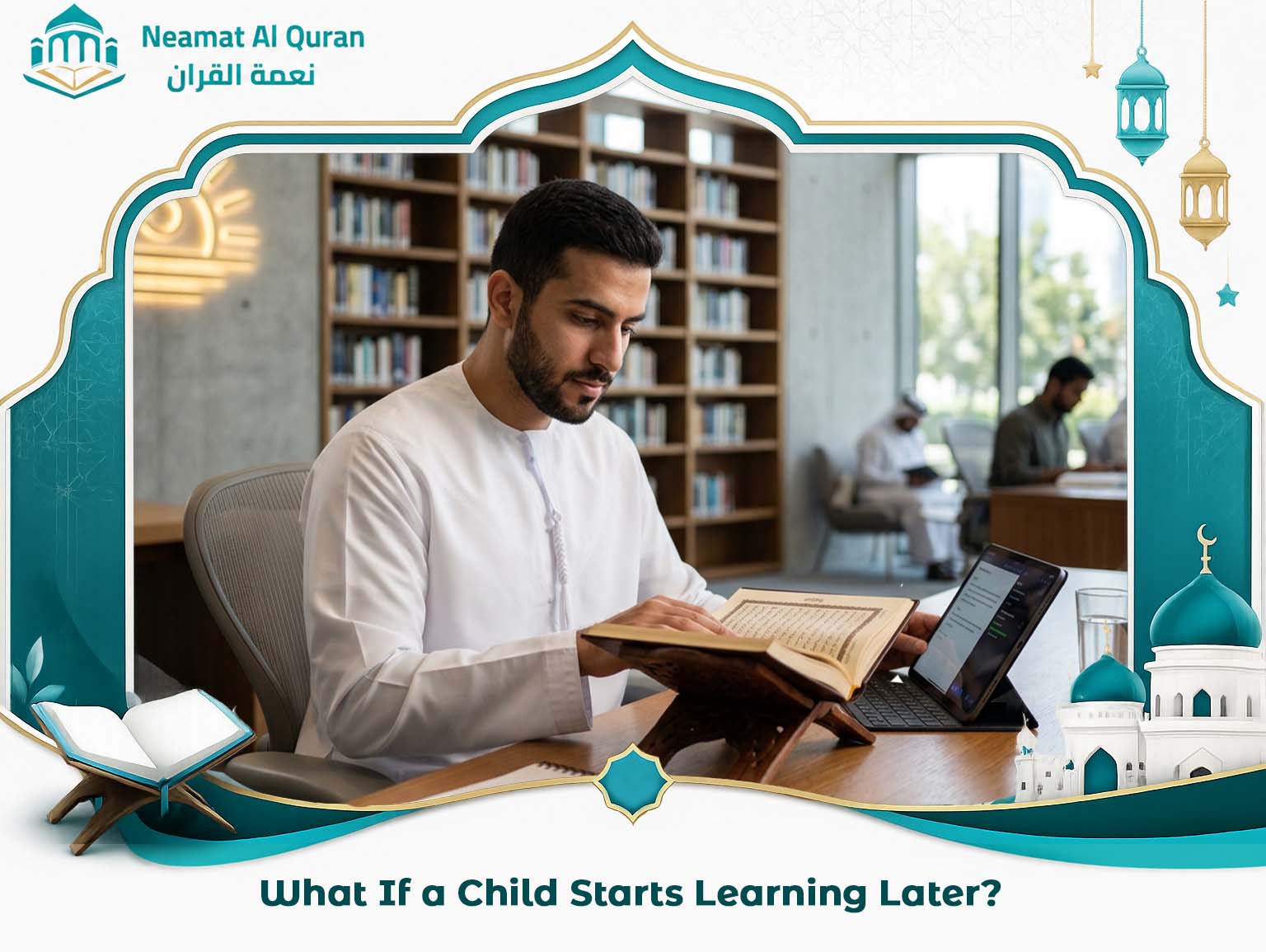
Parents should not feel guilty if their child did not begin at an early age. When children should start learning quran can vary significantly from one family and learner to another. Children can begin Quran education at many stages of life.
An older beginner may have advantages, including stronger concentration, greater independence, and the ability to understand explanations more deeply. Therefore, parents should not assume that starting later means a child has missed their opportunity.
If you are still deciding when children should start learning quran, focus on the child’s current abilities rather than comparing them with other children. A suitable teacher can help identify the appropriate starting level and create realistic goals.
The question of when children should start learning quran should never become a source of guilt or anxiety. If your child is older and has not started yet, the most useful step is simply to begin with an appropriate level.
Ultimately, when children should start learning quran is less important than creating a learning experience that the child can maintain. With patience, encouragement, and consistency, a late start can still become a valuable and rewarding Quran journey.
Frequently Asked Questions: When Should Children Start Learning Quran?
Parents often have questions about the best age, readiness signs, lesson duration, and suitable learning methods when deciding when children should start learning Quran.
1. Can a child learn the Quran if they do not speak Arabic?
Yes. Children who do not speak Arabic can learn Quran reading and memorization through structured instruction. A suitable teacher can explain pronunciation and meanings using the child’s familiar language. This allows children to develop their Quran skills even when Arabic is not their first language.
2. Should parents teach Quran at home before hiring a teacher?
Parents can introduce basic Quran exposure at home, but a qualified teacher can provide more systematic guidance for pronunciation, reading, Tajweed, and memorization. Combining both approaches can be helpful, especially when parents want to reinforce lessons between classes.
3. What should parents do if their child keeps forgetting memorized Surahs?
Forgetting is common during memorization. Parents can reduce the amount of new material and increase revision. Frequent short reviews can help strengthen previously memorized passages. A teacher can also adjust the memorization schedule when necessary.
4. Can Quran lessons improve a child’s Arabic pronunciation?
Regular Quran instruction can help children become more familiar with Arabic sounds and pronunciation. Consistent correction from a knowledgeable teacher is especially useful for developing accurate recitation. Over time, repeated listening and guided practice can improve the child’s confidence and accuracy.
In conclusion, when children should start learning quran depends on each child’s age, personality, attention span, and emotional readiness. Early exposure can begin through listening to recitation, family reading, short Surahs, and simple Islamic conversations. As children grow, their learning can gradually become more structured.
Parents should not focus only on starting early or memorizing quickly. Instead, when children should start learning quran should be approached as a question of readiness and long-term development. A calm learning environment, realistic goals, regular practice, and positive encouragement can help children build confidence and enjoy their Quran journey.
For families seeking structured support, Neamat Al Quran Academy can provide an organized learning environment where children can develop Quran reading, Tajweed, memorization, and understanding according to their level. Therefore, parents considering when children should start learning quran should choose an approach that supports both educational progress and a lasting love for the Quran.
Ultimately, there is no single perfect age for every child. The ideal time is when learning can be introduced naturally and consistently without unnecessary pressure. By understanding when children should start learning quran and respecting each child’s individual pace, parents can help their children develop a meaningful and lifelong connection with the Quran.