
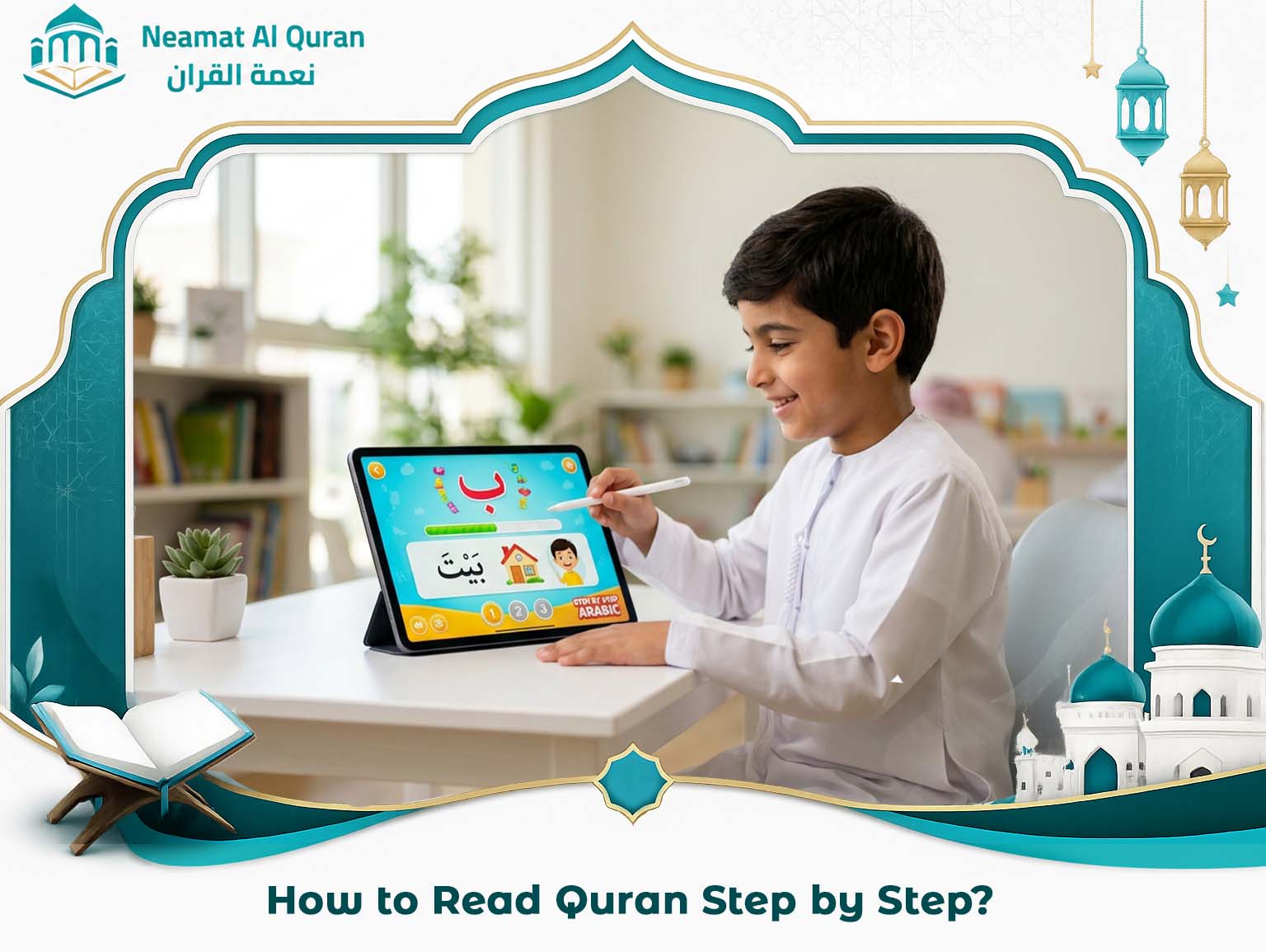
How to read quran step by step is a practical question for anyone who wants to begin reading the Quran with confidence, correct pronunciation, and a stronger connection with its verses. For beginners, the Arabic script, unfamiliar sounds, vowel signs, and Tajweed rules can seem difficult at first. However, learning becomes much easier when each skill is introduced gradually.
The right approach does not require you to master everything in one day. Instead, you can build your ability through small lessons, regular practice, careful listening, and guidance from a qualified Quran teacher. This method is especially useful for children, adults, and Muslims who do not speak Arabic as their first language.
Learning how to read quran step by step also means understanding where to begin and what to study next. A beginner can start with Arabic letters, move to vowel marks, practice joining letters, study Noorani Qaida, and then apply basic Tajweed while reading short Surahs.
With a structured learning plan, Neamat Al Quran Academy can support learners as they develop their Quran reading skills through organized lessons and individual guidance.
Why Learn How to Read Quran Step by Step?
Trying to read the Quran without a clear learning path can make the process confusing. Beginners may recognize some Arabic letters but struggle when those letters appear together. Similarly, knowing the alphabet does not automatically mean that a learner can pronounce Quranic words correctly.
That is why learning how to read quran step by step should begin with the simplest skills before moving toward longer verses.
A gradual method allows learners to:
- Recognize Arabic letters accurately.
- Connect letters to form words.
- Understand short and long vowel sounds.
- Improve pronunciation.
- Practice basic Tajweed.
- Read short Surahs with greater confidence.
- Identify and correct recurring mistakes.
- Develop a consistent Quran reading routine.
Most importantly, a structured approach reduces frustration. Instead of attempting difficult passages immediately, students can focus on one skill at a time.
For beginners, progress is more valuable than speed. Therefore, learning how to read quran step by step should always prioritize accuracy, repetition, and understanding of the reading process.
Discover the Wisdom of the Quran with Neamat Al Quran Academy
Are you ready to go beyond simple recitation and understand the true guidance of the Quran in your daily life? At Neamat Al Quran Academy, qualified teachers help students explore the meanings of the Quran clearly and practically, which strengthens their faith.
Through structured online lessons, learners improve their understanding and apply Quranic teachings in real situations. Each class encourages reflection, growth, and a deeper connection with Allah’s words. Start your journey today with Neamat Al Quran Academy and build a stronger relationship with the Quran.

How to Read Quran Step by Step Starting With Arabic Letters?
The Arabic alphabet is the foundation of Quran reading. Before reading complete words, beginners need to recognize each letter and understand its basic sound.
Arabic letters can look different depending on their position within a word. A letter may appear differently when it stands alone, at the beginning, in the middle, or at the end. Consequently, learners should become comfortable recognizing these forms.
A useful starting routine includes:
- Learning a small group of Arabic letters.
- Repeating each letter aloud.
- Listening to a correct pronunciation.
- Comparing similar letters.
- Reviewing previously learned letters.
- Practicing until recognition becomes automatic.
For example, some Arabic letters have sounds that may be unfamiliar to English speakers. The learner should not rely entirely on English approximations because they can lead to incorrect pronunciation.
Instead, a teacher can demonstrate the correct articulation and explain how the mouth, tongue, throat, or lips are positioned.
Once the alphabet becomes familiar, the learner can move to the next stage of how to read quran step by step without feeling overwhelmed.
How to Read Quran Step by Step With Harakat?
After learning the letters, beginners need to understand Harakat, or Arabic vowel signs. These small marks play an important role because they help determine how letters are pronounced.
The three basic short vowels include:
- Fathah: usually producing a short “a” sound.
- Kasrah: usually producing a short “i” sound.
- Dammah: usually producing a short “u” sound.
Learners also encounter Sukoon, which indicates the absence of a short vowel, and Shaddah, which indicates a doubled consonant sound.
Understanding these marks makes learning how to read quran step by step much clearer because learners begin to see how individual letters become readable sounds.
At this stage, repetition is essential. A student can practice one letter with different vowel marks before combining several letters. Short exercises are often more effective than attempting long passages too early.
Moreover, listening while reading can reinforce the relationship between the written symbol and the spoken sound.
How to Read Quran Step by Step With Noorani Qaida?
Noorani Qaida is widely used as a foundational resource for Quran reading. It introduces learners to Arabic letters, vowel signs, combinations, and gradually more advanced reading patterns.
Rather than immediately opening a long Surah, beginners can use structured exercises that isolate individual skills.
A typical learning sequence may include:
- Individual Arabic letters.
- Letters with Harakat.
- Two-letter combinations.
- Joined letters.
- Sukoon exercises.
- Shaddah exercises.
- Madd and elongation.
- More complex word patterns.
- Quranic reading practice.
This progression makes how to read quran step by step easier to follow because every lesson builds on the previous one.
The important point is not simply completing the pages. Students should be able to read the exercises accurately before moving forward. If a particular sound remains difficult, repeating the lesson is completely normal.
With consistent instruction, learners can gradually transfer these skills from Qaida exercises to actual Quranic verses.
How to Read Quran Step by Step With Correct Pronunciation?
Correct pronunciation is one of the most important parts of Quran reading. A beginner may recognize every letter visually yet still pronounce some sounds incorrectly.
This happens because Arabic contains sounds that do not exist in many other languages. Therefore, learners need practical pronunciation training rather than relying only on written explanations.
A qualified teacher can help students identify the articulation points of Arabic letters, known as Makharij al-Huruf.
For example, pronunciation may involve:
- The throat.
- The tongue.
- The lips.
- The nasal passage.
- Specific positions inside the mouth.
Learning how to read quran step by step therefore involves both seeing the word and hearing how it should sound.
A helpful technique is to listen to a qualified reciter, repeat a short phrase, and then receive correction. Recording your own recitation can also help you notice differences between your pronunciation and a reliable model.
However, self-correction has limitations. Some mistakes are difficult to detect without trained feedback. For that reason, teacher supervision can accelerate improvement.
How to Read Quran Step by Step With Tajweed?
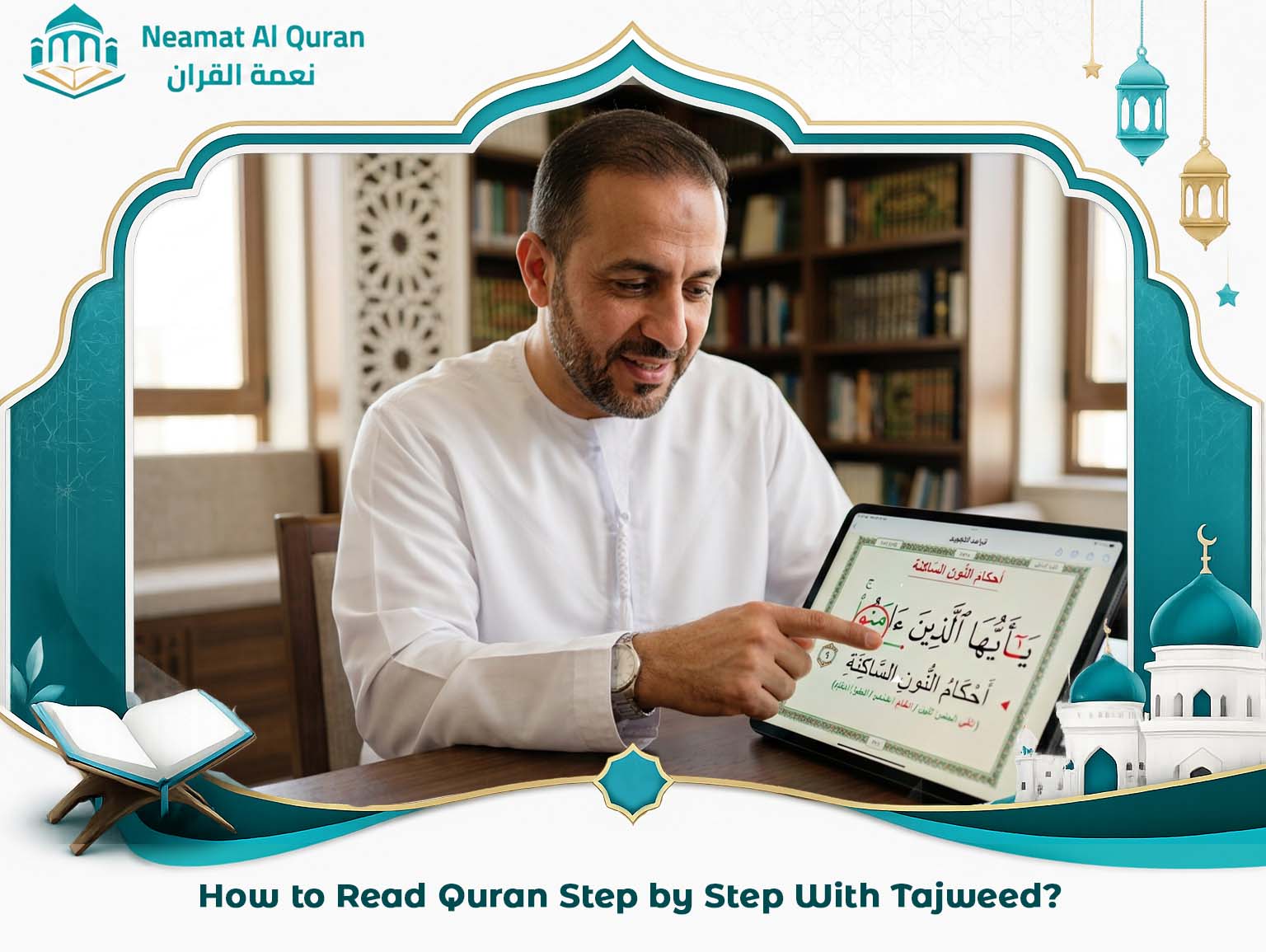
Tajweed refers to the rules that guide proper Quranic pronunciation and recitation. Beginners do not need to memorize every advanced rule immediately. Instead, they can learn the most relevant principles gradually.
At the beginning, students can focus on:
- Correct articulation of letters.
- Basic elongation.
- Sukoon.
- Shaddah.
- Noon Sakinah and Tanween.
- Meem Sakinah.
- Common stopping and starting rules.
Learning how to read quran step by step with Tajweed means introducing each rule when the student is ready to apply it.
Reading slowly is especially useful during this stage. Speed can come later. Accuracy should remain the primary objective because rushing may reinforce incorrect pronunciation.
Furthermore, Tajweed is not simply about making the recitation sound beautiful. Correct application protects the pronunciation of Quranic words and helps learners develop disciplined reading habits.
How to Read Quran Step by Step From Short Surahs?
Once beginners understand basic letters, vowel signs, and introductory Tajweed, they can begin reading short Surahs.
Starting with shorter passages provides several advantages. The learner can practice complete verses without becoming mentally exhausted. Additionally, repeated reading makes familiar words easier to recognize.
Al-Fatihah is naturally important because Muslims recite it regularly in prayer. Short Surahs from the end of the Quran can also provide manageable reading practice.
When practicing a Surah:
- Listen to the verse carefully.
- Read it slowly.
- Identify unfamiliar words.
- Check pronunciation.
- Apply the Tajweed rules you have learned.
- Repeat the verse several times.
- Review it again on another day.
This routine makes how to read quran step by step more practical because the learner moves from isolated exercises into authentic Quranic text.
How to Read Quran Step by Step Without Rushing?
Many beginners believe that faster reading means faster learning. In reality, speed can hide pronunciation problems and make correction more difficult.
A slower reading pace gives you enough time to:
- Recognize each word.
- Observe vowel marks.
- Apply Tajweed.
- Pronounce difficult letters.
- Stop at appropriate points.
- Notice mistakes.
Therefore, anyone learning how to read quran step by step should focus on controlled reading rather than competing with a faster reciter.
As accuracy improves, natural fluency will gradually develop. You will begin recognizing common words and patterns without consciously analyzing every letter.
Patience is especially important during the first few weeks. Some lessons may feel repetitive, but repetition creates the foundation needed for confident Quran reading.
How to Read Quran Step by Step With Daily Practice?
Consistency can make a significant difference. A short daily session is often more productive than a long lesson followed by several days without practice.
A beginner can create a simple routine such as:
- 5 minutes: Review Arabic letters and difficult sounds.
- 5 minutes: Practice Qaida exercises.
- 10 minutes: Read a short Quran passage.
- 5 minutes: Listen to a correct recitation and repeat.
- 5 minutes: Review mistakes from the previous session.
- This 30-minute structure can be adjusted according to age, ability, and available time.
When practicing how to read quran step by step, consistency should be realistic. A learner who can practice for only 15 minutes should not feel discouraged. Regular short sessions can still produce meaningful progress.
In addition, reviewing yesterday’s material before introducing something new helps strengthen long-term retention.
How to Read Quran Step by Step for Children?
Children often benefit from short lessons, repetition, encouragement, and age-appropriate activities. A long lesson can make a young learner lose concentration, especially when every new concept requires significant mental effort.
For children, learning how to read quran step by step can be organized around small achievements.
A child might first learn several letters, then practice their sounds, and later read simple combinations. Once those skills become familiar, the teacher can introduce short Quranic words.
Parents can also support the process by creating a positive home environment. Instead of turning Quran practice into a source of pressure, they can celebrate improvement and encourage regular attendance.
Visual materials, listening exercises, repetition, and teacher feedback can make lessons more engaging.
Most importantly, children need time. Some learners progress quickly, while others require additional repetition. Comparing one child with another can create unnecessary pressure.
How to Read Quran Step by Step for Adults?
Adults sometimes hesitate to begin because they believe they are too old to learn. However, age does not prevent someone from developing Quran reading skills.
Adult learners may actually bring useful advantages, including stronger motivation, clearer goals, and the ability to organize their practice schedule.
For adults learning how to read quran step by step, the most effective approach is usually structured and practical. Instead of trying to memorize large amounts of information, learners can focus on one skill at a time.
An adult beginner may study letters during one stage, vowel signs during another, and pronunciation and Tajweed afterward.
Busy learners can also schedule short sessions around their existing responsibilities. Morning practice, an evening lesson, or a few minutes after daily prayers can create a sustainable routine.
The key is to avoid postponing learning because the schedule is not perfect. A manageable routine is better than waiting for an ideal opportunity.
How to Read Quran Step by Step for Non-Arabic Speakers?
Non-Arabic speakers can learn Quran reading successfully even if they cannot hold a conversation in Arabic. Quran reading and Arabic language fluency are related, but they are not the same skill.
The first objective is to recognize the Arabic script and pronounce Quranic words accurately. Later, students can expand their vocabulary and study Quranic Arabic if they want to understand the meanings more deeply.
For learners from non-Arabic-speaking backgrounds, how to read quran step by step should include plenty of listening and pronunciation practice.
Audio support is particularly valuable because learners can hear sounds that are difficult to understand from written instructions alone.
A teacher can also explain unfamiliar pronunciation using comparisons, demonstrations, and repeated correction.
With patient instruction, non-Arabic speakers can gradually become comfortable with Arabic letters and Quranic recitation.
How to Read Quran Step by Step With an Online Teacher?
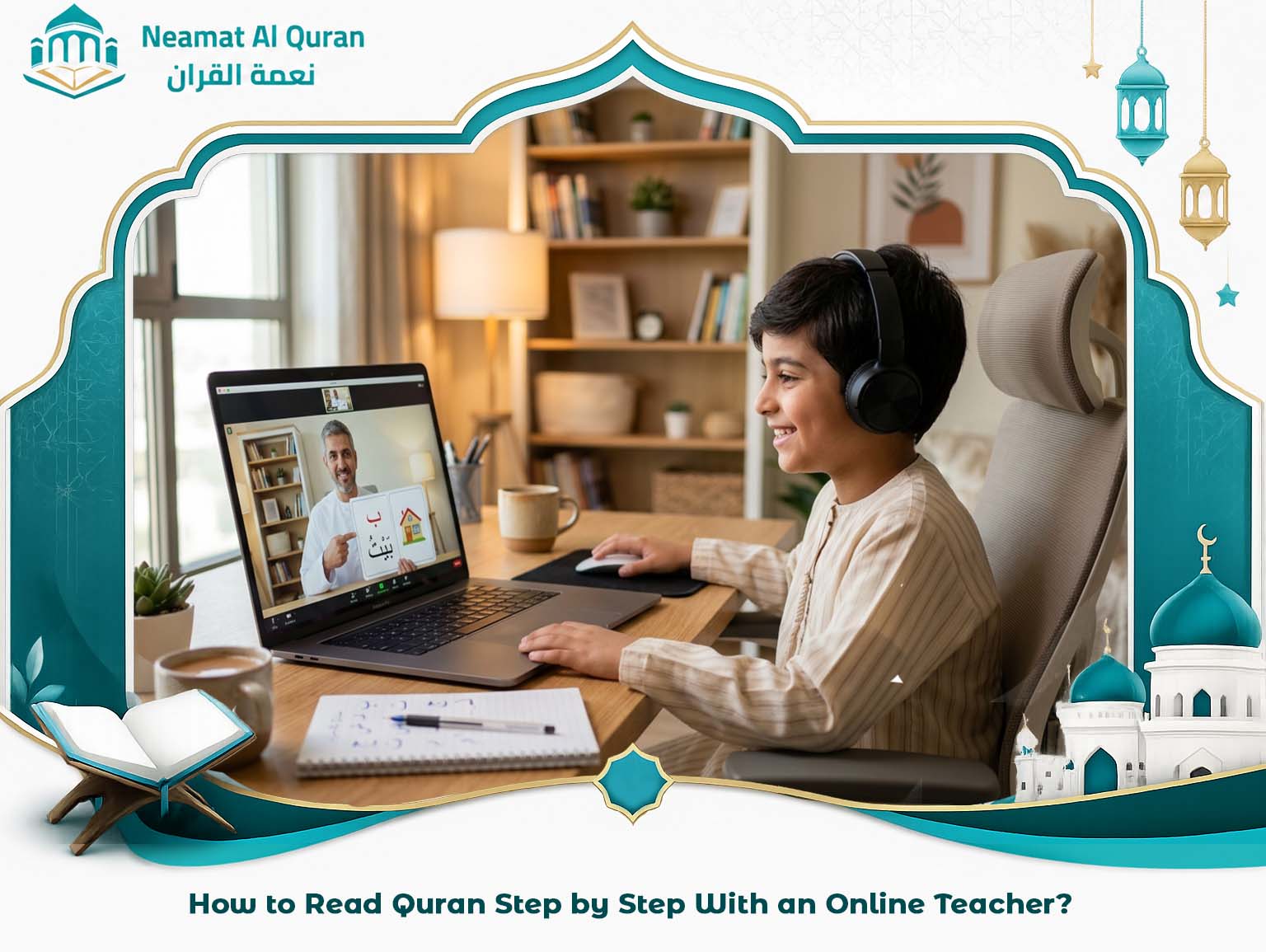
Online learning has made Quran education accessible to students in many countries. A learner can study from home while receiving direct instruction from a qualified teacher.
However, not every online course follows the same structure. Beginners should look for a program that offers clear lessons, teacher feedback, flexible scheduling, and gradual progression.
When choosing a program for how to read quran step by step, consider:
- Teacher qualifications.
- Individual attention.
- Lesson structure.
- Pronunciation correction.
- Tajweed instruction.
- Flexible class times.
- Progress tracking.
- Trial lesson availability.
- Communication with parents when teaching children.
Neamat Al Quran Academy can be considered by learners looking for structured online Quran education with guidance suited to different learning levels.
The greatest advantage of one-to-one or small-group learning is immediate feedback. Instead of practicing an incorrect sound repeatedly, students can receive correction during the lesson.
How to Read Quran Step by Step With Neamat Al Quran Academy?
For beginners who want organized support, Neamat Al Quran Academy can provide a structured environment for developing Quran reading skills.
A guided learning program can help students understand what to study first, what to review, and when to move to the next stage.
The value of learning how to read quran step by step becomes clearer when the learner follows a sequence instead of jumping between unrelated materials.
With Neamat Al Quran Academy, learners can focus on foundational reading skills before progressing toward stronger recitation. Teacher guidance can also help identify pronunciation problems that may otherwise remain unnoticed.
For children, structured lessons can provide consistency and encouragement. Adults can benefit from flexible learning arrangements that fit their daily routines.
Most importantly, learners should approach their classes with realistic expectations. The objective is not to finish a course as quickly as possible. Instead, the goal is to develop accurate and lasting Quran reading skills.
How to Read Quran Step by Step and Correct Common Mistakes?
Beginners commonly make mistakes because they try to progress before mastering the basics. Recognizing these problems early can save considerable time.
Common issues include:
- Confusing similar Arabic letters.
- Ignoring vowel signs.
- Reading too quickly.
- Skipping pronunciation practice.
- Neglecting revision.
- Applying Tajweed inconsistently.
- Depending entirely on transliteration.
- Practicing irregularly.
Transliteration can sometimes help a complete beginner understand a word, but it should not become a permanent substitute for learning Arabic letters. A structured Quran Qaida course for beginners can help students develop these foundational skills in an organized way.
When studying how to read the Quran step by step, learners should gradually become independent of transliteration and read directly from the Arabic Quran. Before reaching this stage, it is helpful to learn the Arabic alphabet for Quran reading and practice each letter carefully.
Another common issue is practicing without feedback. If a learner repeatedly makes the same pronunciation mistake, correction from a qualified teacher can be extremely valuable.
How to Read Quran Step by Step Using Audio Practice?
Listening is one of the easiest ways to strengthen Quran reading. A beginner can listen to a short verse and then repeat it several times.
This technique helps connect written Arabic with correct pronunciation. A useful listening routine involves:
- Listen to one verse.
- Follow the Arabic text with your eyes.
- Pause the recording.
- Repeat the verse slowly.
- Listen again.
- Compare your pronunciation.
- Repeat difficult sections.
Audio practice is particularly helpful when learning how to read the Quran step by step because it gives learners a reliable pronunciation model. Students who need additional guided practice can also explore Noorani Qaida online classes to strengthen their reading foundation.
Nevertheless, audio should complement—not completely replace—teacher feedback. A recitation recording cannot always explain why a learner is making a specific error.
How to Read Quran Step by Step and Build Confidence?
Confidence develops when learners see measurable progress. Instead of asking whether you can read the entire Quran, focus on smaller achievements.
For example, you might aim to recognize all Arabic letters, then read words with Harakat, then complete a Qaida lesson, and eventually read a short Surah. These milestones make learning how to read quran step by step feel achievable.
Keep a simple record of what you have learned. Mark difficult letters, Tajweed rules that need revision, and Surahs that require additional practice.
Furthermore, do not be embarrassed by mistakes. Every beginner makes them. Correction is part of learning, not evidence of failure.
With regular practice, the same words that once seemed unfamiliar will gradually become recognizable.
How to Read Quran Step by Step With a Realistic Learning Plan?
Learning how to read quran step by step is easier when you follow a simple plan that matches your level. Instead of rushing, focus on one skill at a time and practice regularly.
Week 1–2: Arabic Foundations
Learn the Arabic letters and their correct sounds. Pay attention to similar letters and practice reading them aloud every day.
Week 3–4: Harakat and Letter Combinations
Practice Fathah, Kasrah, Dammah, Sukoon, and Shaddah. Then start joining letters together to read simple combinations.
Week 5–6: Noorani Qaida
Use Noorani Qaida to strengthen your reading skills. Repeat difficult exercises until you can pronounce them correctly and confidently.
Week 7–8: Basic Tajweed
Begin learning essential Tajweed rules while practicing short Quranic words and verses. Read slowly so you can focus on correct pronunciation.
After the Foundation
Start reading short Surahs and continue reviewing previous lessons. Remember that progress differs from one learner to another, so focus on accuracy and consistency rather than speed.
The timeline is only an example. Some learners may need more time at one stage, while others may progress faster. For those who are not native Arabic speakers, a Quran reading course for non-Arabic speakers can provide targeted support for pronunciation and reading development.
The most important principle behind how to read quran step by step is progression based on ability rather than a fixed deadline.
How to Read Quran Step by Step and Maintain Your Progress?
Learning to read the Quran is not complete when a learner finishes the first course. Maintaining the skill requires continued reading.
Even after becoming comfortable with basic recitation, continue reviewing pronunciation and Tajweed.
A simple maintenance routine can include:
- Reading a few verses every day.
- Reviewing difficult words.
- Listening to reliable reciters.
- Practicing Tajweed.
- Revisiting previously studied rules.
- Reading different Surahs.
- Asking a teacher to check your recitation periodically.
These habits prevent skills from becoming weak through lack of use.
For students following how to read quran step by step, consistency after the beginner stage is just as important as consistency during the first lessons. Once reading skills become stronger, studying a Quranic Arabic course online can also help learners move beyond basic recitation toward a deeper understanding of Quranic vocabulary and language.
How to Read Quran Step by Step for Beginners?
Before considering your foundation complete, check whether you can:
- Recognize Arabic letters without hesitation.
- Distinguish similar letters.
- Read basic Harakat correctly.
- Join letters into words.
- Understand common Quranic reading signs.
- Read with basic Tajweed.
- Pronounce difficult letters correctly.
- Read short Surahs slowly.
- Identify common pronunciation mistakes.
- Maintain a regular practice routine.
If one area remains difficult, return to that skill rather than rushing forward.
This checklist makes how to read quran step by step more measurable and gives beginners a clear way to evaluate their progress.
Frequently Asked Questions About How to Read Quran Step by Step
This FAQ section answers common questions about how to read Quran step by step and helps beginners understand the right learning approach.
1. Can someone learn Quran reading without knowing Arabic?
Yes. Quran reading can be learned without being fluent in spoken Arabic. The learner first focuses on recognizing Arabic letters, reading their sounds, and applying the basic rules needed for Quranic recitation.
2. How can I stay motivated when Quran reading feels difficult?
Set small goals and celebrate steady progress. Reading a few lines accurately is more valuable than forcing yourself through several pages while making repeated mistakes.
3. Should I learn Quran reading or Arabic conversation first?
If your immediate goal is Quran recitation, you can begin with Quran reading skills directly. Spoken Arabic can be studied separately when you want to understand conversations or communicate in Arabic.
4. How can I know when I am ready to read independently?
You are ready to practice independently when you can recognize most letters and vowel signs, read basic words, and maintain reasonably accurate pronunciation. However, occasional teacher feedback remains useful.
In conclusion, learning how to read quran step by step is a gradual journey that combines Arabic letters, vowel signs, pronunciation, Noorani Qaida, Tajweed, listening, and regular practice. Beginners do not need to master everything immediately. Instead, each stage should prepare them for the next one.
Start with the alphabet, learn the basic vowel marks, practice joining letters, and then progress toward Quranic words and short Surahs. After that, continue developing pronunciation and Tajweed through guided practice.
Most importantly, do not measure success by speed. Accurate reading, steady improvement, and consistency are much more valuable. A learner who practices a little every day can build strong skills over time.
Neamat Al Quran Academy can support learners who want organized online Quran education and guidance throughout their learning journey.
Whether you are an adult starting from zero, a parent searching for Quran lessons for a child, or a non-Arabic speaker looking for a clear learning path, beginning with the right method can make the experience easier and more rewarding.
The best time to begin is simply when you are ready to take the first step. With patience, qualified guidance, regular revision, and sincere effort, reading the Quran can become a natural and meaningful part of your daily life.