
What Is Tafseer? It is the scholarly explanation of the meanings of the Quran, including its vocabulary, context, guidance, and relationship to other Quranic verses. For Muslims who want to understand the message of the Quran beyond recitation, studying tafseer provides a structured way to explore what Allah reveals and how qualified scholars explain it.
Understanding What Is Tafseer involves more than reading a translation. A translation communicates the general meaning of Arabic words in another language, while tafseer examines the wording, relevant prophetic teachings, circumstances of revelation, and explanations transmitted by recognized scholars. These elements help readers approach Quranic meanings with greater care.
For beginners, learning What Is Tafseer also means recognizing the limits of personal interpretation. Some verses communicate clear guidance, while other passages require detailed linguistic knowledge or specialist scholarship. Reliable references and qualified guidance are therefore essential when questions become complex.
This guide explains What Is Tafseer, why it matters, how it differs from other Quranic disciplines, which books beginners can consider, and how to develop a practical study routine. It also discusses how Neamat Al Quran Academy may fit into a learner’s search for structured Quranic education.
Understanding Tafseer and Its Role in Explaining the Quran
The Arabic term tafsir, also commonly spelled tafseer in English, refers to explaining or clarifying something. In Islamic scholarship, it describes the discipline concerned with explaining the meanings of the Quran. A scholar who specializes in this field is known as a mufassir.
When learners ask What Is Tafseer, they are asking how the Quran is explained through evidence, language, context, and established scholarship. A mufassir does not simply assign a personal meaning to a verse. Instead, the scholar considers its wording, relevant verses, authentic prophetic teachings, and other sources appropriate to the question.
For example, a translation may communicate the general meaning of a Quranic expression without explaining why a particular word was used or how scholars understand it in context. Tafseer can explore those details and identify interpretations supported by relevant evidence.
The main purposes of tafseer include:
- Explaining unfamiliar Quranic words and expressions.
- Clarifying the context of verses when reliable information is available.
- Connecting related passages to develop a fuller understanding.
- Explaining guidance concerning faith, worship, character, and conduct.
- Distinguishing established scholarly explanations from unsupported claims.
Understanding What Is Tafseer therefore begins with recognizing its purpose: to clarify the Quran’s meanings responsibly rather than invent interpretations. The discipline combines careful reading with the knowledge needed to assess different explanations.
Discover the Wisdom of the Quran With Neamat Al Quran Academy
Studying Quranic meanings can help learners develop a deeper understanding of the guidance they encounter during recitation. Neamat Al Quran Academy offers an option for learners researching structured online Quran education. Before choosing a course, consider your reading level, learning goals, and the kind of teacher guidance you need.
A suitable learning plan should explain Quranic passages clearly, use reliable references, and give students opportunities to ask questions. Explore the available options and determine whether they match your goals for Quranic learning.

Why Is Tafseer Important for Understanding the Quran?
Reciting a verse and understanding its message are related but distinct activities. A person may recite a surah accurately while remaining unfamiliar with its vocabulary, context, or practical guidance. Tafseer helps readers investigate these meanings through reliable explanations.
When considering What Is Tafseer in everyday Quranic study, it is useful to recognize the Quran’s invitation to reflection. Surah Muhammad, verse 24, asks whether people contemplate the Quran or whether their hearts are locked. The verse emphasizes reflection rather than treating reading as an activity without consideration of meaning.
Surah An-Nahl, verse 44, also describes the Prophet Muhammad ﷺ as explaining to people what had been revealed to them. This provides an important basis for understanding the role of prophetic explanation in Quranic interpretation. Studying tafseer can help learners:
- Understand passages they recite regularly.
- Recognize how context affects the interpretation of a verse.
- Appreciate the relationship between the Quran and the Sunnah.
- Reflect on ethical responsibilities and spiritual development.
- Avoid drawing broad conclusions from isolated phrases.
Learning What Is Tafseer can therefore support a more informed approach to Quranic study. It helps readers move from a general understanding toward a careful examination of the message while respecting the limits of their knowledge.
What Is Tafseer Compared With Translation, Tajweed, and Hifz?
Tafseer, translation, tajweed, and hifz all contribute to Quranic education, but they have different objectives. Understanding these distinctions helps learners decide which skills they need to develop.
Tafseer and Quran Translation
A Quran translation presents the meaning of Arabic expressions in another language. Translators must choose words that communicate the original meaning as clearly as possible, although some nuances of Arabic cannot be reproduced fully in translation.
Tafseer examines a passage in greater detail. It may explain vocabulary, grammar, context, relevant prophetic teachings, and differences between scholarly interpretations. When asking What Is Tafseer in relation to translation, the key distinction is that translation communicates meaning across languages, whereas tafseer investigates and explains that meaning through scholarly methods.
Both resources can complement each other. Beginners can start with a reputable translation and then consult a recognized commentary for additional explanation.
Tafseer and Tajweed
Tajweed concerns the correct recitation of the Quran. It includes the pronunciation of Arabic letters, their characteristics, and the rules that guide accurate reading.
Tafseer focuses on the meanings of the verses. A learner may pronounce the Quran accurately while needing further study to understand its message. Students who want to improve their recitation can explore how to read quran with tajweed for beginners.
Tafseer and Hifz
Hifz means memorizing the Quran. Students who study hifz work on retaining verses, maintaining accuracy, and reviewing what they have learned.
Tafseer can enrich memorization by helping learners understand the passages they memorize. However, memorizing a verse does not automatically mean that someone can interpret it independently. A balanced learning plan can include recitation, memorization, and the study of meanings according to the learner’s needs.
What Is Tafseer in Classical Islamic Scholarship?
Tafseer developed through the preservation, transmission, and analysis of explanations of the Quran. The Prophet Muhammad ﷺ explained aspects of the revelation, and subsequent generations transmitted knowledge through reports, linguistic analysis, and scholarly study.
Different commentators developed methods suited to particular questions. Some focused extensively on transmitted explanations, while others gave greater attention to language, legal rulings, theology, or practical guidance.
Understanding What Is Tafseer in this scholarly context means recognizing that interpretation involves methods and evidence. A commentary should be considered in light of its author’s approach, the sources it uses, and the questions it addresses.
Important sources and disciplines include:
- The Quran itself: Related verses may clarify a passage or provide additional context.
- The Sunnah: Authentic prophetic explanations are essential when relevant to interpretation.
- Reports from early Muslim authorities: Reliable transmitted explanations can provide important context.
- Arabic language: Vocabulary, grammar, morphology, and rhetoric help clarify the original wording.
- Circumstances of revelation: Reliable historical reports may explain the context in which a verse was revealed.
- Principles of Islamic jurisprudence: These help qualified scholars examine verses concerning religious rulings.
Each source requires an appropriate method of evaluation. For instance, a report about the circumstances of revelation should be assessed for reliability before it is used to establish a historical claim.
For beginners, the practical lesson is to study recognized explanations, consult reliable translations, and seek qualified guidance when interpretations differ significantly. Learning What Is Tafseer should build appreciation for scholarly methods, not encourage unsupported conclusions.
The Four Categories of Tafseer Explained
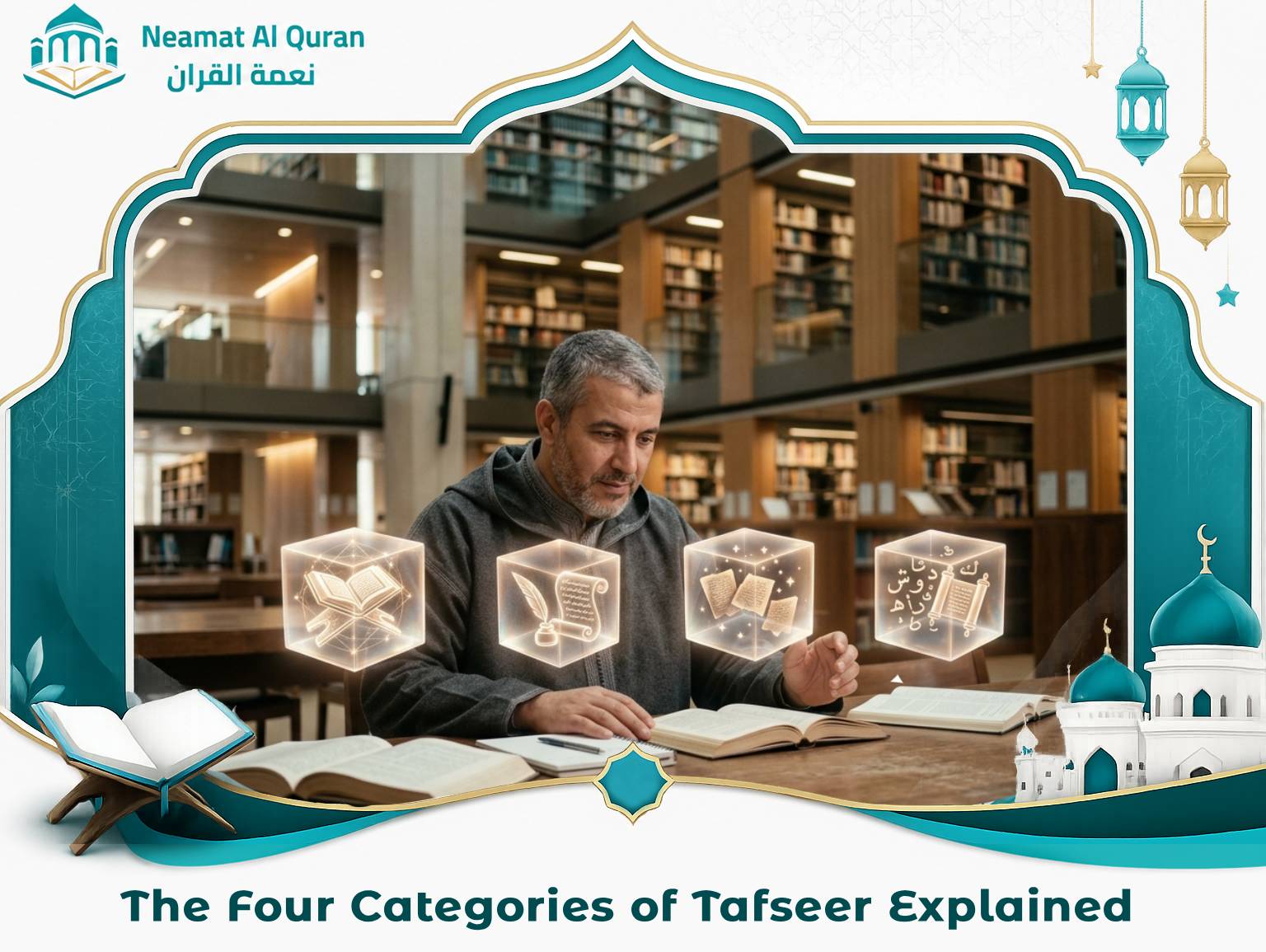
Classical tafseer literature includes a classification attributed to Ibn Abbas that describes four broad categories of understanding. The classification is commonly presented as distinguishing between meanings essential to religious understanding, meanings accessible through Arabic, matters requiring scholarly knowledge, and matters whose full reality is known only to Allah.
The categories help illustrate why not every question about the Quran requires the same level of expertise.
| Category | What it involves | Appropriate approach |
|---|---|---|
| Essential religious meanings | Fundamental teachings and obligations | Learn through reliable Islamic instruction |
| Linguistic meanings | Vocabulary, grammar, idiom, and expression | Study Arabic and consult recognized explanations |
| Questions requiring scholarly knowledge | Context, hadith, legal principles, and relationships between verses | Consult trained scholars and established commentaries |
| Matters known only to Allah | Realities of the unseen whose full knowledge has not been disclosed | Recognize the limits of human knowledge |
This classification does not mean that everyone can interpret any verse independently. Rather, it highlights differences in the knowledge needed to address particular questions.
A Muslim can learn the general meaning of a verse encouraging honesty without becoming a specialist. However, deriving a complex legal ruling may require knowledge of Arabic, hadith, jurisprudence, and related scholarly discussions.
Understanding What Is Tafseer also means knowing when a question exceeds one’s current knowledge. Reflection is valuable, but conclusions should remain connected to reliable evidence.
What Is Tafseer of Clear and Ambiguous Quranic Verses?
The Quran distinguishes between verses described as muhkam, often understood as clear or firmly established in meaning, and mutashabih, which may involve ambiguity or require further examination. Surah Al-Imran, verse 7, discusses these categories and warns against pursuing ambiguous passages with the intention of creating discord.
Scholars have offered different explanations of these terms. In some interpretations, muhkam refers to verses whose meanings are clear, while mutashabih describes passages that require additional explanation or concern matters whose full reality is known only to Allah.
When studying What Is Tafseer in relation to these categories, readers should not assume that every difficult passage is impossible to understand. Some become clearer through linguistic study, relevant prophetic teachings, or comparison with other verses.
At the same time, sincere inquiry should not become an excuse for claiming certainty without evidence. A responsible student distinguishes between a question that scholarship can address and one that concerns knowledge unavailable to human beings.
The discussion of Quran 3:7 in Sahih al-Bukhari is also associated with a warning against blameworthy pursuit of ambiguous verses. The concern is not sincere questioning. Rather, it is the misuse of difficult passages to promote unsupported interpretations or create confusion.
Understanding What Is Tafseer includes learning to approach difficult verses patiently, consult recognized explanations, and acknowledge uncertainty where appropriate.
What Does Tafseer by Personal Opinion Mean?
Islamic scholarship distinguishes between reasoned interpretation supported by knowledge and blameworthy interpretation based on unsupported personal opinion. The expression tafsir bi’l-ra’y broadly refers to interpretation involving personal reasoning, but its evaluation depends on how that reasoning is used.
Qualified scholars may use reasoned judgment within established principles. This differs from presenting an unsupported opinion as the definitive meaning of a Quranic verse.
Blameworthy interpretation may occur when someone ignores relevant evidence, overlooks the Arabic wording, or chooses a meaning simply because it supports a personal preference. Such an approach can distort the message and lead to conclusions that the available evidence does not justify.
When considering What Is Tafseer, readers should remember that interpretation is not an unrestricted license to assign any meaning to a verse. A responsible approach involves several steps:
- Read the verse within its surrounding passage.
- Consult a recognized tafseer rather than relying on an isolated quotation.
- Check whether authentic prophetic explanations are relevant.
- Compare interpretations when qualified scholars differ.
- Ask a knowledgeable teacher when a question involves complex theology or religious rulings.
Hadith reports also require careful evaluation. Their sources, wording, and scholarly assessments matter, particularly when a religious conclusion depends on them.
A careful approach to What Is Tafseer therefore combines curiosity with intellectual humility. Readers can investigate meanings while recognizing that specialist questions require specialist knowledge.
What Knowledge Does a Tafseer Scholar Need?
A qualified mufassir needs more than a general familiarity with Quran translations. Tafseer draws upon several fields of Islamic scholarship, and each may influence how a passage is understood.
Classical Arabic is particularly important because grammatical structures and word forms can affect meaning. Rhetoric also helps explain how an expression communicates emphasis or conveys a particular nuance.
Other areas of knowledge include:
- Hadith studies: Understanding prophetic reports and assessing their relevance and reliability.
- Asbab al-nuzul: Examining reliable reports about the circumstances of revelation.
- Nasikh and mansukh: Studying questions of abrogation through established scholarly principles.
- Quranic readings: Understanding recognized readings and their implications where relevant.
- Usul al-fiqh: Applying principles used to derive and evaluate legal rulings.
- The wider Quran: Comparing related passages instead of interpreting a verse in isolation.
Not every introductory lesson requires detailed knowledge of all these subjects. However, they explain why advanced interpretation differs from general reading and reflection.
Understanding What Is Tafseer helps beginners appreciate the scholarship behind recognized commentaries. It also helps them identify when a question is suitable for independent reading and when specialist guidance is necessary.
Families planning age-appropriate Quranic education can also explore when should children start learning quran when deciding how to introduce Quranic learning and understanding.
Major Tafseer Books and How to Choose One
Tafseer books differ in length, methodology, language, and intended audience. The most suitable choice depends on the reader’s Arabic ability, previous knowledge, and learning goals. Beginners do not necessarily benefit from starting with the longest or most technically demanding commentary.
The following works illustrate the range of approaches within tafseer literature.
| Tafseer book | Author | Main characteristics |
|---|---|---|
| Jami’ al-Bayan | Al-Tabari | A major early commentary that collects transmitted explanations and discusses differing views |
| Tafsir al-Quran al-Azim | Ibn Kathir | Draws extensively on Quranic verses, prophetic reports, and explanations transmitted from early authorities |
| Al-Jami’ li-Ahkam al-Quran | Al-Qurtubi | Gives substantial attention to legal questions and scholarly positions |
| Tafsir al-Jalalayn | Al-Mahalli and Al-Suyuti | A concise commentary that clarifies wording and implied meanings |
| Taysir al-Karim al-Rahman | Al-Sa’di | Presents explanations in an accessible style, with attention to guidance and practical benefit |
| Al-Tafsir al-Wasit | Muhammad Sayyid Tantawi | Offers a modern scholarly treatment of language, context, and interpretation |
These descriptions are introductory rather than exhaustive. Each work follows its own methodology, so readers should consult suitable editions and qualified teachers when detailed questions arise.
Which Tafseer Is Best for Beginners?
A concise, reliable commentary is often a practical starting point for someone learning Quranic meanings. Tafsir al-Jalalayn may suit readers who want brief explanations, while Al-Sa’di’s commentary can help learners explore the guidance of Quranic passages in an accessible style.
Ibn Kathir is another widely studied option, including through abridged English editions. However, readers should remember that translated editions may differ from the full Arabic work in wording, detail, and presentation.
More extensive commentaries, such as those of Al-Tabari and Al-Qurtubi, are valuable references but may be demanding for readers without the necessary background.
When deciding which resource best suits your needs, consider the following:
- Is the language understandable at your current level?
- Does the commentary identify its sources?
- Can you follow the explanation without advanced technical knowledge?
- Can you ask a qualified teacher about difficult passages?
- Does the edition provide enough context for your learning goals?
Choosing one suitable book and studying it consistently is often more useful than collecting numerous references without a clear plan.
How to Start Learning Tafseer as a Beginner?
Learning tafseer does not require immediate specialization. Beginners can develop a manageable routine that combines Quranic reading, a reliable translation, concise commentary, and regular review.
1. Choose a Reliable Translation
Start with a reputable translation in a language you understand comfortably. Read the passage carefully to identify its general message before comparing different explanations.
Next, consult a recognized tafseer to explore details that a translation may not communicate fully. This approach helps you distinguish the general meaning from the deeper explanation.
2. Begin With Short Surahs
Short surahs can provide manageable starting points because learners can examine complete passages without immediately facing lengthy discussions.
Read a surah, identify its central theme, and then study the commentary verse by verse. As your understanding improves, you can progress to longer passages.
3. Use One Concise Commentary
Choose a suitable commentary and work through it consistently. Switching between numerous sources before understanding the basic explanation may create unnecessary confusion.
If a question remains unresolved, record it and discuss it with a qualified teacher rather than forcing a conclusion.
4. Learn Common Quranic Vocabulary
Learning frequently occurring Arabic words can gradually improve your understanding of Quranic passages. Pay attention to how a word functions in different contexts rather than assuming it always carries exactly the same meaning.
Basic Arabic grammar can also help you recognize sentence relationships and understand why translators sometimes choose different expressions. Children who need a foundation in Arabic reading can explore how to learn Arabic alphabet for kids as a related starting point.
5. Keep a Question Notebook
Write down questions about unfamiliar expressions, historical references, and differences between scholarly explanations. Use reliable commentaries or teacher guidance to investigate them.
This habit encourages careful study and prevents uncertain ideas from becoming established beliefs simply through repetition.
6. Continue Reading the Quran Regularly
Tafseer should complement Quranic recitation rather than replace it. A consistent routine can include recitation, a short passage of explanation, and reflection on lessons supported by the text.
For younger learners who need a structured Quranic learning environment, Quran Classes for Kids in the USA may be relevant when comparing age-appropriate options.
The most important principle is to establish a realistic routine rather than trying to master every aspect of tafseer at once.
How to Study Tafseer Without Knowing Arabic?
Arabic knowledge is valuable for studying tafseer, but beginners who do not read Arabic fluently can still benefit from reliable translations and translated commentaries. These resources introduce Quranic meanings in a language the learner understands.
The important distinction is between learning an established scholarly explanation and independently interpreting the Arabic text. English-language resources can explain general meanings, introduce relevant context, and help learners identify questions that require further study.
A translated commentary also involves translation choices. The English wording reflects the translator’s decisions, just as a Quran translation reflects choices about how to communicate the Arabic revelation.
To study effectively without advanced Arabic:
- Choose a reputable Quran translation.
- Use a recognized translated tafseer.
- Check the references provided for important claims.
- Keep a list of unfamiliar Islamic terms and Quranic expressions.
- Ask a qualified teacher to explain difficult or disputed passages.
- Consider learning basic Quranic Arabic alongside your tafseer studies.
Adults beginning with reading fundamentals may find Learn to read quran for adults useful for developing their reading skills.
A lack of Arabic fluency does not have to prevent someone from beginning to study Quranic meanings. However, readers should distinguish translated explanations from direct analysis of the original Arabic and seek guidance when the wording or evidence is disputed.
What Is Tafseer in Online Quran and Islamic Studies Classes?
Online tafseer classes offer a structured way to study Quranic meanings with a teacher, regular explanations, and opportunities to ask questions. Unlike lessons focused mainly on pronunciation, tafseer sessions examine the meanings of verses, scholarly interpretations, and relevant context.
The quality of instruction matters more than the delivery format. A useful course should provide a clear curriculum, reliable sources, and a teacher who can explain scholarly differences responsibly.
Before joining an online course, consider whether it offers:
- A structured curriculum: Lessons should follow a clear sequence rather than consist entirely of disconnected topics.
- Recognized references: The teacher should identify the tafseer works and other sources being used.
- Contextual explanations: Historical background should be included when it helps clarify a passage.
- Responsible treatment of evidence: Relevant hadith reports should be handled with attention to their sources and reliability.
- Opportunities for questions: Students should be able to ask about unfamiliar words and difficult interpretations.
- Appropriate learning goals: Beginners should not be expected to perform advanced scholarly interpretation independently.
Learners considering Neamat Al Quran Academy can first identify their current reading ability and learning objectives. Some may need foundational Quran reading before studying detailed explanations, while others may be ready for introductory Islamic Studies lessons that include tafseer.
Ask about available courses, teachers’ qualifications, the references used, and how lessons address differences between scholarly interpretations. These details can help you determine whether a learning option matches your needs.
Studying Tafseer With Neamat Al Quran Academy
Neamat Al Quran Academy is an option for learners researching structured online Quran education. Before choosing a learning path, consider your Quran reading ability, familiarity with Arabic, and the questions you want to explore.
Beginners may benefit from strengthening their reading skills before studying detailed interpretations. More experienced readers may prefer lessons that examine verse meanings, linguistic details, and connections between passages.
When contacting Neamat Al Quran Academy, ask about the available study options, teaching methods, curriculum, and references used to explain Quranic verses. These questions help you assess whether the available instruction aligns with your goals.
A thoughtful learning plan should reflect your current ability rather than assume that every student needs the same starting point. Consistent study, reliable sources, and appropriate teacher guidance can make Quranic learning more organized and meaningful.
How to Study Tafseer Step by Step?

Once you understand the basics, a simple study plan can turn occasional reading into a consistent learning habit. The schedule should remain realistic, allowing time to understand each passage instead of rushing through large amounts of material.
A weekly plan might include these activities:
- Day one: Read a short Quranic passage with a reliable translation.
- Day two: Study the same passage in a concise tafseer.
- Day three: Review unfamiliar vocabulary and identify the main theme.
- Day four: Examine relevant references mentioned in the commentary.
- Day five: Write down questions that remain unresolved.
- Day six: Discuss difficult questions with a qualified teacher or consult a trusted scholarly source.
- Day seven: Review the passage and summarize what you have learned.
This schedule is flexible. Some learners may prefer shorter daily sessions, while others need more time for Arabic study or foundational recitation.
Measure progress by asking whether you can explain the passage’s general message, identify the sources supporting the explanation, and recognize questions that remain beyond your current knowledge.
The aim is to develop consistency, not to finish a fixed number of pages regardless of understanding. As your knowledge grows, you can explore more detailed commentaries and learn how scholars evaluate different interpretations.
Frequently Asked Questions About What Is Tafseer
These answers address common questions about Quranic interpretation, beginner study methods, and the use of reliable scholarly sources.
1. Is it necessary to study the entire Quran to understand tafseer?
No. Beginners can study individual surahs or passages while considering their wider Quranic context. However, a single verse should not be treated as the complete basis for a conclusion when related passages or prophetic teachings may affect its interpretation.
2. How can I check whether an online tafseer quotation is authentic?
Look for the original source, the full context, and references to the scholars or commentaries being quoted. If a quotation includes a hadith, check its collection and scholarly grading through reliable references. If its attribution remains uncertain, avoid sharing it as an established statement.
3. Should children study tafseer while memorizing the Quran?
The answer depends on the child’s age, reading ability, and readiness to understand abstract concepts. Simple explanations of vocabulary and the main lessons of short surahs can accompany memorization, while detailed scholarly discussions can be introduced gradually.
4. What should I do when two recognized scholars explain a verse differently?
First, establish whether the difference concerns wording, context, a legal implication, or a matter of the unseen. Compare the evidence and methodology behind each explanation, and consult a qualified scholar if the distinction affects your understanding or religious practice.
Conclusion
Tafseer helps readers move beyond the surface meaning of a translation and explore the Quran through language, context, prophetic explanations, and the work of qualified scholars. It also teaches an important principle: sincere reflection is valuable, but interpretation should remain connected to reliable evidence and appropriate scholarly methods.
Beginners can start with a trusted translation, a concise commentary, short surahs, and a notebook for questions. As their knowledge develops, they can explore more advanced works and seek guidance when a passage requires specialized understanding.
For learners who prefer structured instruction, Neamat Al Quran Academy is an option to investigate by asking about its available courses, teaching methods, and tafseer curriculum. Choose a learning path that suits your current ability and supports steady, informed progress.
With patience, reliable references, and intellectual humility, readers can build a clearer understanding of the Quran while respecting the depth of scholarship devoted to its interpretation.