

Learn Arabic for non-Arabic speakers online is now easier than ever when you follow a structured learning path instead of jumping randomly between apps, videos, and lessons. Arabic has a unique alphabet, distinctive sounds, several language varieties, and a grammar system that can initially feel unfamiliar. However, these challenges become much more manageable when each skill is introduced at the right time.
For many learners, the biggest problem is not a lack of resources. It is not knowing what to learn first, what to practice next, and how to measure progress. A clear online plan solves this problem by turning Arabic into a series of achievable stages.
Whether your goal is to communicate with Arabic speakers, understand Islamic texts, travel, study, work, or develop a new language skill, you can build your ability gradually. The key is to combine instruction with regular practice and meaningful exposure.
In this guide, you will discover how to learn Arabic for non-Arabic speakers online from the foundation level to practical communication. You will also learn how to choose lessons, practice independently, avoid common mistakes, and create a sustainable daily routine.
Why Learn Arabic for Non-Arabic Speakers Online?

Choosing to learn Arabic for non-Arabic speakers online gives students access to lessons without requiring them to relocate or attend a physical classroom. This flexibility is especially useful for adults, university students, parents, professionals, and busy learners.
Online learning also allows you to repeat difficult lessons and organize your schedule around your responsibilities. Instead of spending time traveling to a classroom, you can use that time for actual practice.
Another advantage is personalized learning. A suitable online program can help you work on the skills you need most, whether that means pronunciation, reading, vocabulary, conversation, or grammar.
For example, a beginner who struggles with Arabic pronunciation may need more speaking practice, while another learner may already speak confidently but struggle with reading.
A well-designed online learning plan should therefore provide:
- Structured lessons.
- Progressive difficulty.
- Regular speaking opportunities.
- Pronunciation correction.
- Vocabulary development.
- Grammar instruction.
- Reading and writing activities.
- Feedback from a qualified teacher.
This approach makes learning Arabic for non-Arabic speakers online a practical option rather than simply a convenient one.
Discover the Wisdom of the Quran with Neamat Al Quran Academy
Are you ready to go beyond simple recitation and understand the true guidance of the Quran in your daily life? At Neamat Al Quran Academy, qualified teachers help students explore the meanings of the Quran clearly and practically, which strengthens their faith.
Through structured online lessons, learners improve their understanding and apply Quranic teachings in real situations. Each class encourages reflection, growth, and a deeper connection with Allah’s words. Start your journey today with Neamat Al Quran Academy and build a stronger relationship with the Quran.

Set Clear Goals Before You Learn Arabic for Non-Arabic Speakers Online
Before beginning to learn Arabic for non-Arabic speakers online, identify exactly what you want to achieve. Your goal will determine the vocabulary, materials, and learning speed that make sense for you.
Someone learning Arabic for travel does not need the same study plan as someone who wants to understand classical Islamic texts. Similarly, a professional may prioritize workplace conversations, while a beginner may simply want to introduce themselves and understand common expressions.
Start with one primary goal and a few smaller milestones.
For example:
- Learn the Arabic alphabet during the first stage.
- Understand basic greetings and introductions.
- Build a core vocabulary.
- Construct simple sentences.
- Hold short conversations.
- Read beginner-level texts.
- Write short messages.
- Understand increasingly natural speech.
Your goals should also be measurable. Instead of saying, “I want to become fluent,” choose a target such as, “I want to introduce myself and ask basic questions in Arabic.”
This makes your progress easier to recognize and keeps your motivation realistic.
Learn Arabic for Non-Arabic Speakers Online by Mastering the Alphabet
The Arabic alphabet should be one of your first priorities when you learn Arabic for non-Arabic speakers online. Arabic contains 28 basic letters, and many letters change their written form depending on where they appear in a word.
Beginners should learn more than the visual shape of each letter. You also need to connect every letter with its correct sound.
A useful progression is:
- Learn the name of each letter.
- Recognize its isolated shape.
- Practice its pronunciation.
- Learn how it connects to other letters.
- Read simple combinations.
- Practice short words.
- Move gradually toward complete sentences.
Do not rush through pronunciation. Arabic contains sounds that may not exist in your native language. Letters such as ع, ح, خ, غ, ص, ض, ط, and ظ can require repeated practice.
Use audio whenever possible. Listen carefully, repeat the sound, and compare your pronunciation with a qualified teacher or reliable recording.
The objective is not simply to memorize the alphabet. You want to recognize letters automatically so that reading becomes increasingly natural.
Understand Arabic Vowels and Pronunciation
After learning the letters, learning Arabic for non-Arabic speakers online becomes much easier when you understand short and long vowel sounds.
Arabic uses vowel marks to indicate short vowels. Beginners commonly encounter:
- Fatha: a short “a” sound.
- Damma: a short “u” sound.
- Kasra: a short “i” sound.
- Sukoon: indicates the absence of a short vowel.
- Shadda: indicates consonant doubling.
Long vowels also play an important role in pronunciation and meaning. Therefore, students should practice hearing the difference between short and extended sounds.
One effective exercise is to listen to a word several times before repeating it. Then pronounce it slowly, syllable by syllable, before attempting a natural speed.
Avoid relying entirely on English transliteration. Transliteration can provide temporary assistance, but depending on it for too long may prevent you from developing direct recognition of Arabic letters.
The sooner you become comfortable reading Arabic itself, the stronger your foundation will be.
Build Essential Vocabulary for Daily Communication
Vocabulary becomes the bridge between understanding individual words and communicating complete ideas. When you learn Arabic for non-Arabic speakers online, begin with words that have immediate practical value.
Instead of memorizing hundreds of unrelated words, organize vocabulary into useful categories.
Start with themes such as:
- Greetings and introductions.
- Family.
- Food and drinks.
- Numbers.
- Time and dates.
- Places.
- Common objects.
- Daily activities.
- Transportation.
- Work and study.
- Frequently used verbs.
- Question words.
Learning vocabulary in groups makes it easier to connect related words.
However, memorization alone is not enough. Put new words into short sentences as soon as possible. If you learn the word for “book,” for instance, practice using it in a sentence rather than simply repeating the translation.
Spaced repetition can also help you review vocabulary before you forget it. Flashcards are useful when they include examples, audio, or images rather than isolated translations.
The goal is to make familiar vocabulary available when you need to speak, not merely recognize it during a quiz.
Learn Arabic for Non-Arabic Speakers Online Through Simple Sentences
One of the most useful transitions in learning Arabic for non-Arabic speakers online is moving from individual vocabulary items to complete sentences.
Beginners often spend too much time memorizing nouns and too little time learning how words function together. Sentence practice solves this problem.
Start with simple structures such as:
- My name is…
- I am from…
- I live in…
- I want…
- I have…
- Where is…?
- What is this?
- I understand.
- I do not understand.
- Can you repeat that?
Then gradually replace individual words within the same structure.
For example, once you understand a basic sentence pattern, change the person, place, object, or verb. This allows you to practice grammar without studying abstract rules for hours.
Sentence patterns are especially useful for beginners because they create an immediate connection between vocabulary and communication.
As your confidence grows, increase sentence length and introduce connectors such as “because,” “but,” “and,” and “then.”
Learn Arabic for Non-Arabic Speakers Online With Basic Grammar
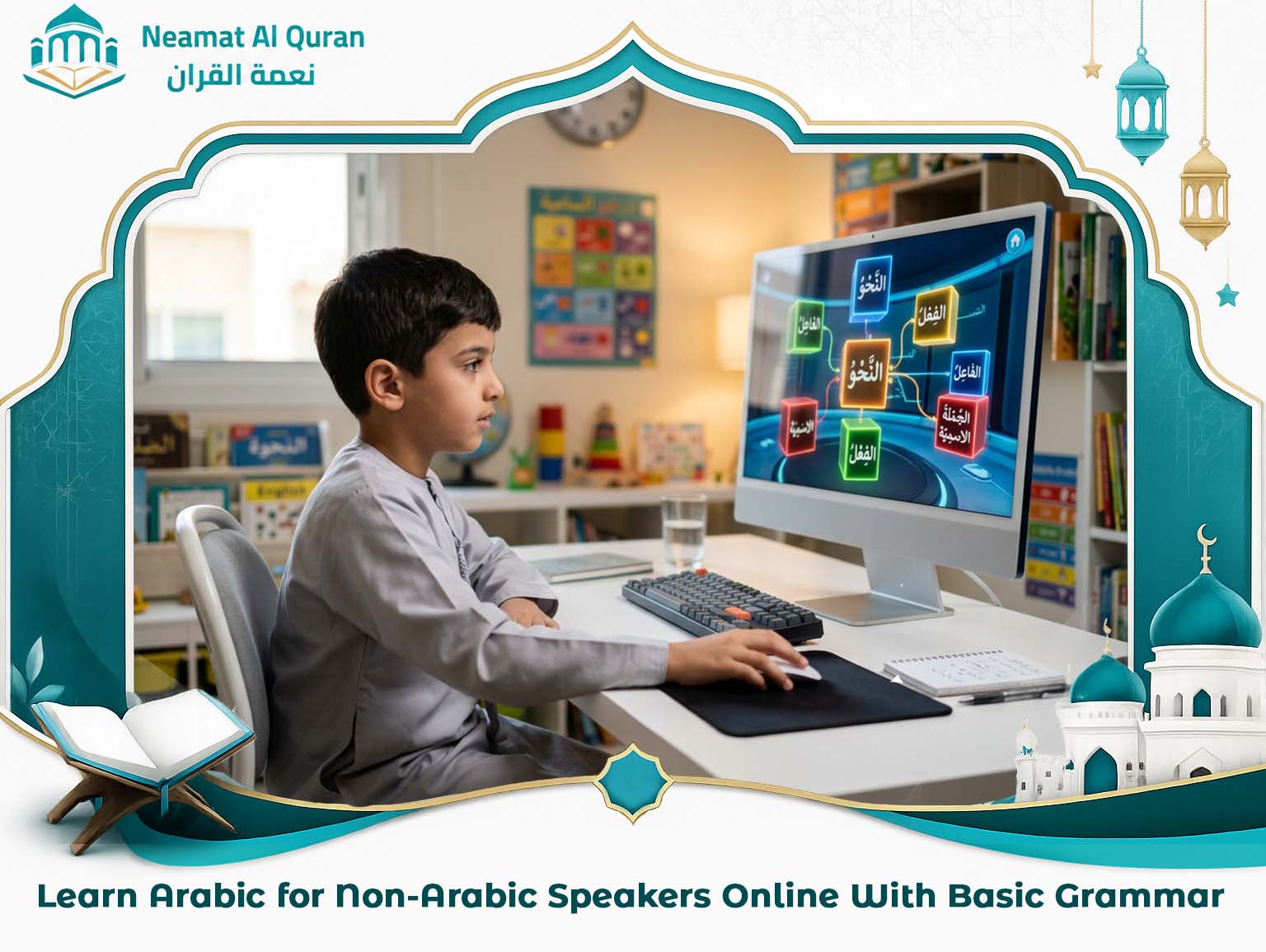
Grammar is an important part of learning Arabic for non-Arabic speakers online, but beginners do not need to study every grammatical rule immediately. Start with the structures that help you communicate. These may include:
- Masculine and feminine forms.
- Singular and plural concepts.
- Pronouns.
- Basic noun sentences.
- Common verb patterns.
- Present-tense verbs.
- Question formation.
- Negation.
- Demonstrative words.
- Basic prepositions.
- Adjective agreement.
The best way to study grammar is through examples. Learn a rule, observe several sentences using it, and then create your own examples.
Avoid trying to memorize long grammatical explanations without applying them. A grammar rule becomes useful when you can recognize and produce it naturally.
As your level develops, you can study more advanced structures and understand why Arabic sentences are formed in particular ways.
This gradual approach reduces frustration and allows grammar to support communication rather than become an obstacle.
Practice Listening Every Day
Listening is one of the most important skills when you learn Arabic for non-Arabic speakers online because spoken Arabic can sound very different from textbook examples.
Start with slow, clearly pronounced material designed for learners. Once you understand the general meaning, gradually introduce more natural conversations.
A useful listening routine includes three stages:
- First listening: Listen without stopping to understand the general topic.
- Second listening: Listen again and identify familiar words.
- Third listening: Replay difficult sections and repeat selected sentences aloud.
Do not expect to understand every word immediately. Instead, focus on recognizing the overall meaning and noticing recurring expressions.
You can also listen while performing simple daily activities, provided the material is appropriate for your level. Over time, your brain becomes more familiar with Arabic rhythm, pronunciation, word boundaries, and common sentence patterns.
Consistent exposure is more valuable than listening to a long lesson once and then stopping for several days.
Learn Arabic for Non-Arabic Speakers Online Through Speaking Practice
Speaking requires active use, so learning Arabic for non-Arabic speakers online should never be limited to watching lessons.
You need opportunities to produce Arabic yourself.
Start with controlled speaking exercises. Introduce yourself, describe your room, talk about your routine, or answer basic questions. Record yourself occasionally and listen to the recording afterward.
Another effective method is shadowing. Listen to a short sentence and repeat it immediately, trying to imitate the speaker’s pronunciation, rhythm, and pauses.
As your confidence improves, practice live conversations with a qualified teacher.
During speaking sessions, do not worry about making every sentence perfect. Mistakes are part of language development. What matters is identifying recurring errors and correcting them gradually.
Try to prioritize communication first and accuracy second during early conversations. You can refine grammar and pronunciation as you gain more experience.
The objective is to make Arabic an active skill rather than something you only recognize on a screen.
Improve Your Arabic Reading Step by Step
Reading should develop alongside speaking. When you learn Arabic for non-Arabic speakers online, reading helps reinforce vocabulary, spelling, grammar, and sentence recognition.
Begin with short texts that match your level. Avoid starting with advanced newspapers, complicated literature, or lengthy academic texts.
A useful progression is:
- Individual words.
- Short phrases.
- Simple sentences.
- Beginner dialogues.
- Short stories.
- Graded reading passages.
- More advanced articles and books.
When reading, resist the temptation to translate every word immediately. First try to understand the sentence from context.
If a word appears repeatedly, its meaning may become clear naturally. After reading, review only the vocabulary that is important for understanding or that you expect to encounter again.
Reading aloud can also combine reading and pronunciation practice. This is particularly helpful during the beginner and intermediate stages.
Learn Arabic for Non-Arabic Speakers Online Through Writing
Writing gives you another way to reinforce what you learn. As you learn Arabic for non-Arabic speakers online, begin writing simple sentences instead of waiting until you feel fluent.
You can write about:
- Your daily routine.
- Your family.
- Your hobbies.
- Your studies.
- Your work.
- Your weekend.
- Your plans.
- A simple picture.
- A short story.
At first, five sentences per day can be enough. The important thing is consistency. Review your writing for basic issues such as spelling, word order, verb forms, and agreement. If possible, ask a qualified teacher to identify patterns in your mistakes.
Do not attempt to produce complex essays immediately. Simple and accurate writing creates a stronger foundation than complicated writing filled with errors.
You can gradually increase the length and complexity of your writing as your vocabulary and grammar improve.
Common Mistakes to Avoid When You Learn Arabic for Non-Arabic Speakers Online
Many beginners face unnecessary challenges when they learn Arabic for non-Arabic speakers online because they may not have a clear study strategy. Understanding the most common mistakes can help you save time, stay motivated, and make steady progress.
1. Studying Without a Clear Plan
When you learn Arabic for non-Arabic speakers online, avoid jumping between unrelated lessons. Moving randomly from grammar to vocabulary and then to advanced conversations can create gaps in your knowledge.
Instead, follow a simple progression:
- Learn the alphabet and pronunciation.
- Build basic vocabulary.
- Study simple sentence structures.
- Practice listening and speaking.
- Develop reading and writing skills.
A clear plan makes each lesson more useful.
2. Memorizing Vocabulary Without Practice
Learning vocabulary lists is not enough. When you learn Arabic for non-Arabic speakers online, try to use every new word in a sentence.
For example, after learning a new verb, create several simple sentences with it. This helps move vocabulary from passive recognition to active communication.
Grouping words by topics such as family, food, work, travel, and daily activities can also make them easier to remember.
3. Ignoring Pronunciation
Pronunciation should be practiced from the beginning. Some Arabic sounds may be unfamiliar, so relying on similar sounds from your native language can create incorrect habits.
When you learn Arabic for non-Arabic speakers online, listen carefully to native or qualified speakers and repeat difficult sounds regularly. Recording yourself can also help you identify areas that need improvement.
4. Focusing Only on Grammar
Grammar is important, but it should not become the entire learning process. Students who learn Arabic online as non-Arabic speakers need opportunities to listen, speak, read, and write.
After studying a grammar rule, immediately apply it by creating sentences or having a short conversation. Practical use makes grammar easier to understand and remember.
5. Studying Irregularly
Long breaks can make it harder to remember vocabulary and sentence patterns. Therefore, consistency is essential.
A short daily routine can be more effective than studying for several hours once a week. Even 30 minutes of focused practice can include vocabulary review, listening, speaking, and reading.
When you learn Arabic online as a non-Arabic speaker, choose a schedule that fits your lifestyle so you can maintain it long term.
6. Using Too Many Resources
Online learners have access to countless courses, apps, videos, and websites. However, using too many resources can create confusion.
Choose a reliable structured program and a few supporting tools. Give yourself enough time to use them before searching for alternatives.
The goal is to spend more time practicing Arabic and less time looking for new materials.
7. Avoiding Speaking Because of Mistakes
Many beginners understand some Arabic but hesitate to speak because they fear making mistakes. This can slow progress considerably.
When you learn Arabic for non-Arabic speakers online, remember that mistakes are part of the learning process. Start with simple conversations about your name, family, work, hobbies, or daily routine.
Regular speaking practice gradually improves confidence, pronunciation, and sentence formation.
8. Expecting Immediate Fluency
Another common mistake is expecting fluency after a short period. Arabic requires regular exposure, practice, and patience.
Instead of focusing only on fluency, measure smaller achievements. You may first recognize the alphabet, then understand simple sentences, and later hold short conversations.
When you learn Arabic for non-Arabic speakers online, steady improvement is more important than fast results.
9. Skipping Revision
Always make time to review previous lessons. Without revision, newly learned vocabulary and grammar can quickly become difficult to recall.
Review important words, repeat difficult pronunciation, and reuse old sentence patterns in new conversations. Regular revision strengthens long-term memory.
10. Learning Without Feedback
Independent study is valuable, but teacher feedback can identify mistakes that you may not notice yourself.
A qualified teacher can correct pronunciation, explain confusing grammar, and help you choose appropriate materials. Combining guided instruction with independent practice creates a more balanced learning experience.
Avoiding these mistakes makes learning Arabic for non-Arabic speakers online more organized, practical, and sustainable. With a clear plan, consistent practice, and regular feedback, beginners can gradually build confidence and develop useful Arabic skills.
Choose the Right Arabic Variety
An important consideration when you learn Arabic for non-Arabic speakers online is deciding which type of Arabic you need.
Modern Standard Arabic is widely used in formal writing, education, news, literature, and many formal settings. Regional spoken varieties, however, are commonly used in everyday conversations.
Your goal should guide your choice.
For example:
- Choose Modern Standard Arabic if your priority is formal reading or written Arabic.
- Consider a spoken dialect if your primary goal is daily conversation with people from a particular region.
- Combine both approaches if you need formal literacy and practical communication.
You do not necessarily need to make a permanent decision on your first day. Your learning plan can evolve as your goals become clearer.
The most important thing is to avoid studying several unrelated varieties simultaneously as a complete beginner. Doing so can create unnecessary confusion.
Start with one clear direction, establish your foundation, and expand later.
Learn Arabic for Non-Arabic Speakers Online With Neamat Al Quran Academy

For learners who prefer guided instruction, Neamat Al Quran Academy can be incorporated into a structured online Arabic learning journey.
A guided program can help students avoid the common problem of studying disconnected lessons without a clear progression. Instead, learners can work through skills in an organized sequence and receive guidance as they advance.
When evaluating an online Arabic program, consider whether it provides:
- Lessons appropriate for your current level.
- Qualified instructors.
- Clear learning objectives.
- Regular speaking opportunities.
- Pronunciation feedback.
- Progress tracking.
- Flexible scheduling.
- Lessons that match your personal goals.
The right program should make learning easier to organize, not simply provide a large collection of lessons.
For students choosing to learn Arabic for non-Arabic speakers online, structured guidance can be particularly useful during the early stages when it is difficult to know whether you are practicing correctly.
Create a Daily Routine to Learn Arabic for Non-Arabic Speakers Online
Consistency matters more than studying for many hours once a week. A realistic daily routine makes learning Arabic for non-Arabic speakers online easier to maintain.
A beginner might organize a 45-minute session like this:
- 10 minutes: Review previous vocabulary.
- 10 minutes: Study a new grammar or sentence pattern.
- 10 minutes: Listen to Arabic.
- 10 minutes: Practice speaking.
- 5 minutes: Read or write a short passage.
If you have more time, extend each activity rather than abandoning the structure.
You can also divide practice throughout the day. For instance, review vocabulary in the morning, listen during a break, and complete speaking practice in the evening.
The best schedule is one that you can maintain for months.
A complicated routine may look impressive but become difficult to sustain. A simple routine performed consistently will usually produce better long-term results.
Use Technology Without Becoming Dependent on It
Technology can support your decision to learn Arabic for non-Arabic speakers online, but apps should serve your learning goals rather than replace them.
Digital tools can help with:
- Vocabulary review.
- Pronunciation practice.
- Listening.
- Flashcards.
- Dictionaries.
- Reading.
- Scheduling.
- Progress tracking.
However, collecting too many apps can become counterproductive. Beginners sometimes spend more time searching for new resources than actually studying.
Choose a small set of tools that each has a clear purpose.
For example, you might use one resource for structured lessons, another for vocabulary review, and a third for listening practice. Then spend the majority of your study time actively using Arabic. Technology is most effective when it makes practice easier and more consistent.
Learn Arabic for Non-Arabic Speakers Online by Using Context
Context makes Arabic vocabulary easier to understand and remember. Instead of learning a word through an isolated translation, encounter it in a sentence, dialogue, story, or real-life situation.
For example, if you learn vocabulary related to shopping, practice a complete shopping conversation. If you study transportation, learn how to ask for directions and understand common answers.
Context provides several benefits:
- It shows how words are naturally used.
- It reinforces sentence structure.
- It improves recall.
- It exposes you to common expressions.
- It connects vocabulary with real situations.
This is particularly valuable for learners who want to communicate rather than simply pass language tests. When you learn Arabic for non-Arabic speakers online, try to make every new word part of a meaningful situation.
Use Repetition Strategically
Repetition is essential, but repeating the same lesson endlessly is not the most efficient approach. Instead, review information at increasing intervals.
For example, you might review new vocabulary:
- Later the same day.
- The following day.
- Several days later.
- One week later.
- Again after a longer interval.
This helps move information from short-term recognition toward long-term memory. You should also vary the way you practice. Read a word, hear it, say it, write it, and use it in a sentence.
Multisensory practice creates more connections around the information. When you learn Arabic for non-Arabic speakers online, strategic repetition is especially important because independent learners do not always have a teacher reminding them what needs review.
Learn Arabic for Non-Arabic Speakers Online Without Translating Everything
Translation can help beginners, but constant translation can slow down your ability to process Arabic directly.
At the beginning, it is natural to translate unfamiliar words. However, gradually try to understand familiar expressions without passing through your native language.
For example, when you see a common greeting, aim to recognize its meaning immediately rather than translating each word mentally.
Pictures, gestures, context, definitions, and simple Arabic explanations can eventually reduce your dependence on translation.
This transition takes time. You do not need to eliminate translation completely. Instead, use it strategically when a word or expression is genuinely unclear. The long-term goal is to create a direct connection between Arabic words and their meanings.
Stay Motivated While Learning Arabic Online
Motivation naturally changes during a long language-learning journey. Some weeks may feel exciting, while others may feel slow.
When you learn Arabic for non-Arabic speakers online, avoid measuring success only by fluency. Look for smaller signs of improvement.
You may notice that:
- You recognize more words.
- You understand a sentence without translating it.
- You can pronounce a difficult sound more accurately.
- You can read a paragraph faster.
- You can introduce yourself more confidently.
- You understand part of a natural conversation.
These are meaningful achievements.
Keep a simple progress record and periodically return to material that once seemed difficult. Seeing how much easier it has become can strengthen your motivation.
It also helps to connect learning with subjects you genuinely enjoy. If you like stories, read stories. If you enjoy conversations, prioritize speaking. If your interest is religious or academic, choose appropriate Arabic materials related to that purpose.
Personal relevance makes consistent study easier.
Learn Arabic for Non-Arabic Speakers Online at Your Own Pace
There is no universal timeline for learning Arabic for non-Arabic speakers online. Progress depends on your native language, previous language-learning experience, study frequency, goals, exposure, and opportunities to practice.
A learner who studies consistently for an hour every day may progress differently from someone who studies for two hours only on weekends.
Instead of comparing yourself with another student, compare your current ability with your previous performance.
Set realistic milestones for each stage.
For example, your first milestone may be reading the alphabet. The next could be producing basic sentences. Later, you might aim to understand a short conversation or write a paragraph independently.
Progress becomes easier to maintain when every stage has a clear purpose.
Build an Arabic-Rich Learning Environment
The environment around you can reinforce your formal lessons. If you want to learn Arabic for non-Arabic speakers online, introduce small amounts of Arabic into your everyday routine.
You can:
- Label common objects in Arabic.
- Set aside time for Arabic listening.
- Follow suitable Arabic content.
- Read short Arabic posts.
- Keep a vocabulary notebook.
- Use Arabic greetings during practice.
- Describe simple activities in Arabic.
- Listen to Arabic while commuting or exercising.
You do not need to transform your entire life overnight.
Start with one or two habits and expand gradually.
The purpose of immersion is to increase meaningful exposure without making the language feel overwhelming.
How Can Neamat Al Quran Academy Support Your Learning Journey?
Neamat Al Quran Academy can support learners who want a structured path for developing their Arabic skills online. Beginners can start with the basics and gradually improve reading, pronunciation, vocabulary, grammar, and communication. Starting with the fundamentals is especially important for students who have never studied Arabic before.
A structured program is often more effective than moving randomly between videos and digital resources. Each lesson should connect naturally with the previous one, allowing learners to develop their skills without feeling overwhelmed. Students interested in Quran reading can begin by learning how to learn the Arabic alphabet for Quran reading and then gradually move toward longer texts.
When choosing lessons through Neamat Al Quran Academy, consider your personal objectives and current ability. A learner focused on conversation may need more speaking practice, while someone interested in Quranic texts may need stronger reading and vocabulary skills.
The value of guided instruction comes from having a clear learning path and receiving useful feedback. Teachers can identify pronunciation mistakes, explain difficult concepts, and help students develop better study habits.
For anyone trying to learn Arabic for non-Arabic speakers online, combining guided lessons with independent daily practice can create a balanced learning system. Students who want to improve their Quran reading can also benefit from a structured Quran reading course for non-Arabic speakers that matches their level.
The teacher provides direction and correction, while the learner develops independence through regular practice. This combination allows students to take greater responsibility for their progress while still receiving professional guidance when needed.
A Practical 12-Week Plan to Learn Arabic for Non-Arabic Speakers Online
A structured timeline can make learning Arabic for non-Arabic speakers online easier to manage. The following 12-week plan provides a practical starting point for beginners and can be adjusted according to individual goals.
Weeks 1–2: Build the Foundation
Focus on:
- Arabic letters.
- Letter shapes.
- Basic vowel marks.
- Correct pronunciation.
- Simple reading exercises.
At this stage, focus on recognizing letters accurately rather than trying to memorize large amounts of vocabulary.
Weeks 3–4: Develop Basic Vocabulary
Study useful words and expressions related to:
- Greetings.
- Numbers.
- Family.
- Common objects.
- Daily activities.
- Basic verbs.
- Simple questions.
Begin using new vocabulary in short sentences instead of memorizing isolated words. Learners interested in understanding Quranic vocabulary can later explore a Quranic Arabic course online as their skills develop.
Weeks 5–6: Introduce Grammar
Focus on:
- Pronouns.
- Masculine and feminine forms.
- Basic sentence patterns.
- Present-tense verbs.
- Negation.
- Common prepositions.
Apply each grammar point through simple examples so you can understand how it works in real communication.
Weeks 7–8: Strengthen Listening and Speaking
Practice short dialogues and shadowing exercises. Listen to simple Arabic conversations and repeat useful expressions aloud. Try to speak about familiar subjects without reading from a prepared script.
Weeks 9–10: Expand Reading and Writing
Read short passages that match your level and write simple paragraphs about familiar subjects. Review your mistakes and focus on patterns that appear repeatedly.
Weeks 11–12: Combine All Four Skills
Use activities that require you to listen, speak, read, and write. At this stage, focus on applying Arabic in practical situations rather than only studying grammatical rules.
This plan can be adjusted according to your level and available time. Learners who need more individualized support can consider a one-on-one Arabic tutor online when they reach areas that require personalized feedback.
Measure Your Progress Correctly
When you learn Arabic for non-Arabic speakers online, progress should be measured through practical abilities rather than the number of lessons completed.
Ask yourself:
- Can I read unfamiliar words more confidently?
- Can I understand the main idea of a short recording?
- Can I introduce myself without memorizing a script?
- Can I create sentences using new vocabulary?
- Can I understand basic questions?
- Can I write a short paragraph?
- Can I recognize common grammatical patterns?
These questions provide a clearer picture of your development than simply counting study hours.
You can also record yourself speaking every few weeks. Comparing older recordings with newer ones can reveal improvements that may not be obvious from day to day.
Learn Arabic for Non-Arabic Speakers Online With Consistency
The most important principle behind learning Arabic for non-Arabic speakers online is consistency. You do not need to study for several hours every day. You need a realistic routine that allows you to return to Arabic regularly.
Even a short session can be productive when it includes active practice. A useful weekly routine can combine structured lessons, vocabulary review, listening, speaking, reading, writing, and revision.
Adults with busy schedules may find flexible online Arabic classes for adults useful when they need to balance Arabic study with work and other responsibilities.
Do not treat missed days as failure. Simply return to your routine and continue. Language learning is cumulative, and every new word, sentence, conversation, and reading passage contributes to your overall ability.
With a clear plan and realistic expectations, online Arabic learning can become a sustainable part of your daily routine.
Why Choose Neamat Al Quran Academy for Online Arabic Learning?

Neamat Al Quran Academy can serve learners who prefer organized online instruction and teacher-guided practice. A structured learning environment can be particularly helpful for beginners because it reduces uncertainty about what to study next.
Instead of moving randomly between unrelated materials, learners can follow a progression that develops foundational skills before introducing more advanced concepts. This approach also makes it easier to identify areas that require additional practice.
For students who learn Arabic as non-Arabic speakers online, teacher interaction can provide valuable feedback. A teacher can identify pronunciation problems, explain difficult grammar, correct sentence construction, and recommend appropriate practice activities.
At the same time, successful learning still requires personal effort. Online classes become more effective when students review lessons, complete exercises, and practice Arabic between sessions.
Therefore, Neamat Al Quran Academy can be viewed as part of a complete learning system rather than a replacement for independent practice. Combining structured instruction with consistent personal study can help learners develop stronger and more practical Arabic skills over time.
Frequently Asked Questions: Learn Arabic for non-Arabic speakers online
Answers common questions about how to learn Arabic for non-Arabic speakers online, including how to start as a beginner, build vocabulary, improve pronunciation, practice speaking, develop reading and writing skills, and make steady progress through consistent online learning.
Can I learn Arabic online if I cannot read Arabic at all?
Yes. You can learn Arabic for non-Arabic speakers online even if you are starting from zero. Begin with the Arabic alphabet, letter sounds, vowel marks, and simple words. A structured program can help you learn Arabic for non-Arabic speakers online step by step without feeling overwhelmed.
Is Arabic difficult for someone who has never studied another language?
Arabic can seem challenging because of its writing system, pronunciation, and grammar. However, beginners can learn Arabic for non-Arabic speakers online by studying one skill at a time. When you learn Arabic for non-Arabic speakers online, regular practice makes unfamiliar sounds and structures easier to understand.
Should I study Arabic every day or several times a week?
Daily practice is recommended because it keeps vocabulary and sentence patterns fresh. Even a short session can help you learn Arabic for non-Arabic speakers online more effectively. If daily study is not possible, several consistent sessions each week can still support progress as you learn Arabic for non-Arabic speakers online.
How can I know when I am ready to speak with Arabic speakers?
You do not need to wait until you become fluent. Start speaking when you can introduce yourself, ask basic questions, understand simple responses, and form short sentences. As you learn Arabic for non-Arabic speakers online, regular conversations will gradually improve your confidence and communication skills.
In conclusion, learning Arabic for non-Arabic speakers online becomes a realistic and rewarding goal when learning is organized around clear stages instead of random study. Beginners should first establish a strong foundation in the alphabet and pronunciation, then develop practical vocabulary and sentence patterns before gradually expanding grammar, listening, speaking, reading, and writing.
The most effective approach combines structured instruction with regular independent practice. Technology can make learning more accessible, but consistency, meaningful communication, and feedback remain essential.
Choosing Neamat Al Quran Academy can provide learners with guided instruction as they progress through their Arabic journey. However, the strongest results come when lessons are supported by daily vocabulary review, listening, speaking, reading, and writing.
Most importantly, do not expect yourself to master Arabic immediately. Set realistic milestones, celebrate measurable progress, and continue practicing even when improvement feels slow.
With patience, a clear routine, and the right learning structure, you can steadily learn Arabic for non-Arabic speakers online and turn your first lessons into practical Arabic skills that continue developing over time.