

The best way to learn Arabic online starts with choosing a structured learning approach that combines clear lessons, regular practice, useful learning resources, and opportunities to communicate in Arabic. Although Arabic may initially seem challenging because of its alphabet, pronunciation, and grammatical structure, beginners can make steady progress when they follow a realistic study plan.
Learning Arabic through the internet gives students access to educational materials, virtual lessons, audio resources, and opportunities to practice from different locations. Furthermore, online learning allows students to organize their schedules around work, school, family responsibilities, and other commitments. As a result, learners can develop their language skills without needing to attend a physical classroom.
However, finding the best way to learn Arabic online involves more than downloading an application or watching occasional videos. Students need to understand which skills to develop first, how to practice consistently, and how to choose resources that match their current level. For example, a complete beginner should focus on recognizing Arabic letters and producing their sounds before moving toward longer conversations or advanced grammar.
This guide explains practical strategies for learning Arabic online, from understanding the alphabet to improving speaking, listening, reading, and writing. It also explores how Neamat Al Quran Academy can fit into a learner’s educational journey when seeking online Arabic instruction.
Why Is Learning Arabic Online an Effective Choice?

Online education has changed how people approach language learning. Instead of depending entirely on local classes or printed textbooks, students can now access lessons and educational resources through computers, tablets, and smartphones.
For many beginners, the best way to learn Arabic online is to combine organized instruction with independent practice. This approach allows learners to receive guidance while developing the habit of studying outside scheduled lessons.
Flexible Learning Schedules
One important advantage of online Arabic education is scheduling flexibility. Students can arrange their study sessions according to their daily responsibilities rather than following a fixed classroom timetable.
For instance, a working adult might study for 30 minutes in the evening, while a school student could practice after completing homework. Parents can also organize shorter sessions around their children’s routines.
Consequently, the best way to learn Arabic online is not necessarily the method that requires the most study hours. Instead, an effective approach should fit naturally into everyday life and provide enough time for regular practice.
Access to Different Learning Resources
Online learning makes it possible to use several types of educational materials. These may include:
- Recorded lessons explaining Arabic grammar.
- Audio recordings for pronunciation practice.
- Digital exercises covering vocabulary.
- Reading materials for different proficiency levels.
- Interactive activities that reinforce previous lessons.
- Live online instruction when available.
Each resource serves a different purpose. Therefore, choosing the best way to learn Arabic online means selecting materials that support specific learning objectives rather than collecting large numbers of unrelated resources.
Learning at an Appropriate Pace
Beginners do not always understand new concepts at the same speed. Some students recognize letters quickly but need more time to understand sentence structure. Others can memorize vocabulary but struggle with pronunciation.
Online study gives learners opportunities to revisit explanations, repeat exercises, and review difficult topics. In addition, students can spend extra time on areas that require attention.
This flexibility makes the best way to learn Arabic online a personalized process rather than a fixed sequence that every learner must complete at the same speed.
Start Your Quran Learning Journey with Confidence
Are you ready to improve your Quran reading and recite the words of Allah with greater confidence? Take the first step with Neamat Al Quran Academy and discover a learning experience designed around your individual needs.
Whether you are a complete beginner, an adult to Quran study, or a parent looking for suitable lessons for your child, guided instruction can help you strengthen your Arabic reading, master essential Tajweed rules, and improve your pronunciation.
Don’t let uncertainty or a busy schedule delay your progress. Contact Neamat Al Quran Academy today, explore the available Quran learning programs, and begin your journey towards accurate and confident Quran recitation.

How to Choose the Best Way to Learn Arabic Online?
Before selecting a course, application, or educational website, beginners should identify their learning objectives. Arabic is studied for different reasons, and each purpose may require a slightly different educational approach.
For example, someone interested in everyday communication needs vocabulary and speaking practice. Meanwhile, a student who wants to understand written Arabic may need additional reading and grammar instruction.
Identify Your Main Learning Goal
Start by answering a simple question: Why do you want to learn Arabic?
Your answer will help determine which subjects deserve priority.
| Learning goal | Important skills |
|---|---|
| Everyday communication | Speaking, listening, and common expressions |
| Reading Arabic texts | Alphabet recognition, vocabulary, and comprehension |
| Understanding grammar | Sentence structure, word forms, and grammatical rules |
| Academic learning | Reading, writing, and formal Arabic |
| Understanding Quranic Arabic | Arabic reading, vocabulary, and relevant language foundations |
Once you identify your objective, the best way to learn Arabic online becomes easier to define. You can concentrate on relevant lessons instead of following an unnecessarily broad study plan.
Check the course structure.
A useful online Arabic course should present information in an understandable sequence. Beginners generally benefit from starting with foundational concepts before moving toward more complicated material. Look for a learning program that explains:
- Arabic letters and their sounds.
- Short vowels and basic reading rules.
- Common vocabulary and expressions.
- Basic sentence construction.
- Essential grammar concepts.
- Reading and listening exercises.
- Opportunities to apply previously learned material.
Additionally, check whether lessons include explanations and practical activities. The best way to learn Arabic online should involve active learning rather than asking students to memorize information without understanding how to use it.
Consider Your Current Language Level
A beginner should not automatically enrol in an advanced Arabic course. Similarly, an intermediate learner may need more challenging materials than introductory alphabet lessons. Before choosing a program, consider whether you can:
- Recognise Arabic letters.
- Read simple words.
- Understand basic expressions.
- Construct short sentences.
- Follow simple spoken conversations.
These abilities can help you identify a suitable starting point. Ultimately, the best way to learn Arabic online is one that challenges you without introducing so many unfamiliar concepts that learning becomes confusing.
Start with the Arabic Alphabet and Pronunciation
The Arabic alphabet is the foundation of reading and writing. It contains 28 basic letters, and each letter has a distinctive written form and pronunciation.
For someone who has never studied Arabic, learning these letters should be an early priority. Trying to read complete sentences before understanding the alphabet can make the experience unnecessarily difficult.
Learn the 28 Arabic letters.
Begin by studying a small group of letters at a time. Instead of memorizing the entire alphabet in one session, divide it into manageable lessons.
For example, you could learn the Arabic alphabet for Quran reading four or five letters daily. During each session:
- Look carefully at the written form.
- Listen to the correct pronunciation.
- Repeat each sound several times.
- Identify the letter in different words.
- Write it independently.
- Review previously studied letters.
This gradual process supports recognition and recall. Moreover, it gives beginners enough time to distinguish between letters that have similar shapes.
A practical best way to learn Arabic online combines visual recognition, listening, speaking, and writing instead of relying on memorization alone.
Understand How Arabic Letters Change Shape
Arabic letters can have different forms depending on their position within a word. A letter may appear differently at the beginning, middle, or end of a word, while some letters connect only to the preceding letter. Therefore, learners should study the four common positions:
- Isolated form.
- Initial form.
- Medial form.
- Final form.
Recognizing these variations helps students understand connected Arabic writing. It also makes reading unfamiliar words easier over time.
For beginners, the best way to learn Arabic online includes exercises that show letters inside actual words rather than presenting every letter separately.
Practice Arabic Pronunciation
Correct pronunciation requires attention to the sounds of individual letters. Some Arabic sounds may be unfamiliar to learners whose first language does not contain similar sounds.
Listen to a reliable pronunciation example, repeat the sound, and compare your attempt with the original recording. When possible, receive feedback from a qualified instructor who can identify pronunciation difficulties.
In particular, avoid rushing through this stage. The best way to learn Arabic online is to help learners develop accurate pronunciation from the beginning instead of allowing repeated mistakes to become habits.
Build Basic Arabic Vocabulary and Grammar
After developing familiarity with the alphabet, learners can begin expanding their vocabulary and understanding how Arabic sentences work.
Vocabulary and grammar are closely connected. Knowing individual words is useful, but students also need to understand how those words communicate complete ideas.
Learn Common Arabic Words First
Start with words that appear frequently in everyday situations. These may include greetings, family terms, numbers, common objects, and basic actions.
You can organize vocabulary into categories:
| Category | Examples of what to study |
|---|---|
| Greetings | Common expressions used when meeting people |
| Family | Words describing family members |
| Numbers | Counting and basic quantities |
| Food | Names of meals, drinks, and ingredients |
| Daily activities | Words related to waking, studying, and working |
| Places | Names of common locations |
Use flashcards or a vocabulary notebook to record new words. Write the Arabic word, its meaning, and an example sentence whenever possible.
The best way to learn Arabic online involves reviewing vocabulary regularly rather than memorizing a long list once and forgetting it several days later.
Understand Basic Arabic Sentence Structure
Arabic sentence construction may differ from the structure of your native language. Therefore, beginners should learn how words are arranged to express meaning.
Start with short sentences and gradually introduce additional details. For example, practice identifying the subject, verb, and object where relevant.
You should also become familiar with:
- Masculine and feminine forms.
- Singular and plural nouns.
- Basic pronouns.
- Common verbs.
- Simple present and past expressions.
- Adjectives and their agreement with nouns.
Do not attempt to memorize every grammatical rule immediately. Instead, study one concept, understand its purpose, and apply it in several examples.
This makes the best way to learn Arabic online more practical because grammar becomes a tool for communication rather than a collection of isolated definitions.
Create a Daily Arabic Learning Routine
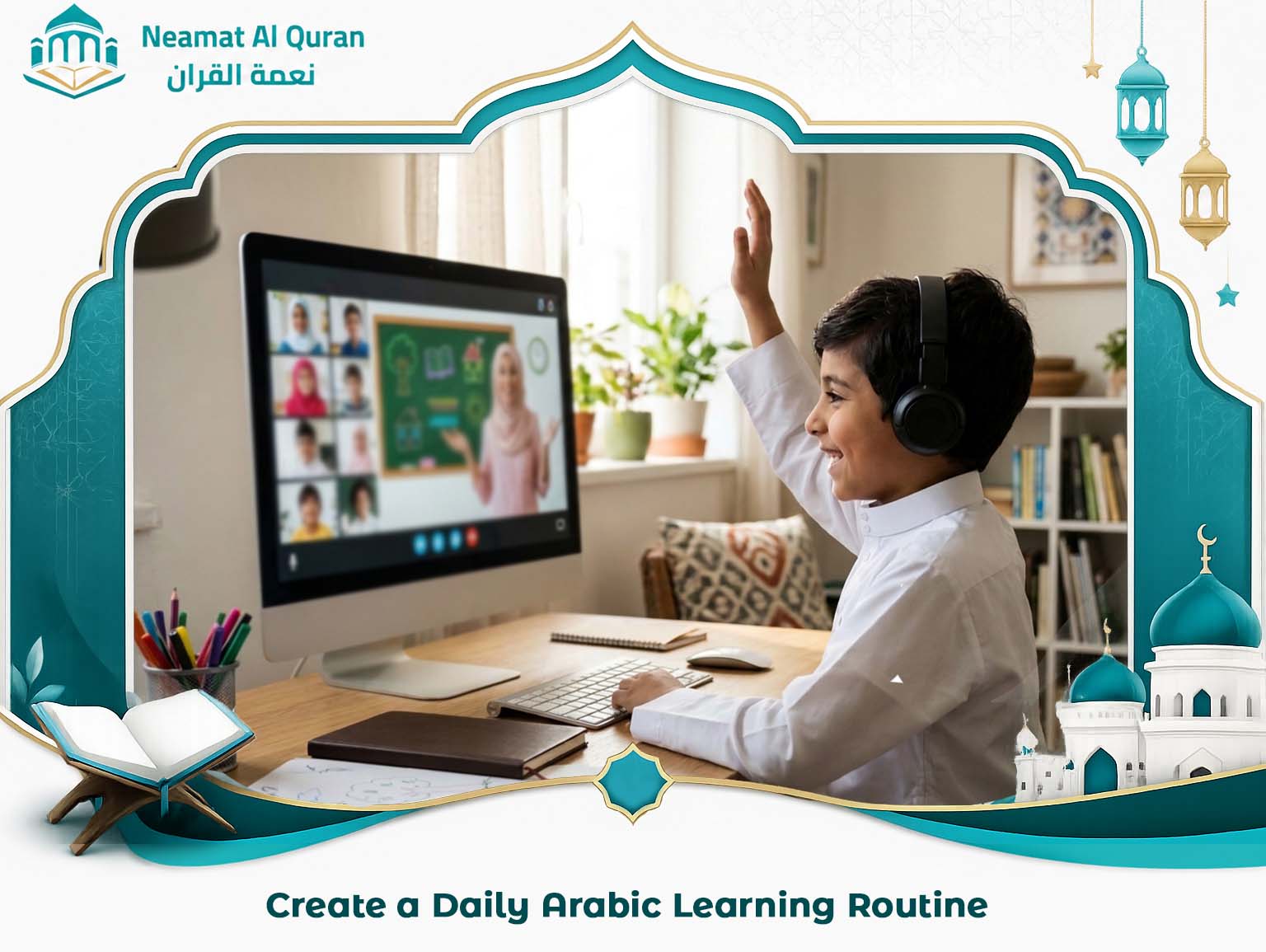
Consistency is one of the most important factors in language development. Studying for a short period every day can be more manageable than completing several hours of practice once a week.
However, a successful routine should include different activities. Repeating the same exercise every day may improve one skill while leaving other areas underdeveloped.
Follow a Simple Daily Study Schedule
Beginners can start with a 30-minute routine and adjust it according to their progress.
| Activity | Suggested time |
|---|---|
| Reviewing previous vocabulary | 5 minutes |
| Learning new words or grammar | 10 minutes |
| Listening and pronunciation practice | 5 minutes |
| Reading a short passage | 5 minutes |
| Writing or speaking exercises | 5 minutes |
This schedule provides a starting point rather than a strict requirement. Students who have more time can extend individual activities, while busy learners can divide the routine into shorter sessions.
The best way to learn Arabic online is to choose a schedule that can be maintained consistently. A realistic routine is usually more useful than an ambitious plan that becomes difficult to follow.
Review Previous Lessons Regularly
Learning new material is important, but reviewing older lessons helps strengthen memory. Without revision, beginners may recognize a word during one lesson and struggle to remember it later. Use a simple review system:
- Review new material at the end of the lesson.
- Revisit it the following day.
- Test your understanding after several days.
- Include older topics in weekly practice.
- Return to difficult concepts whenever necessary.
Furthermore, keep a record of mistakes. This allows you to identify patterns and focus on areas that need additional attention.
Set Measurable Learning Goals
Instead of setting a general objective such as becoming fluent quickly, create smaller targets. For example:
- Recognize all Arabic letters.
- Read simple words independently.
- Learn ten useful vocabulary items.
- Understand a short audio recording.
- Write five basic Arabic sentences.
- Introduce yourself using simple expressions.
These milestones make progress easier to evaluate. They also help you understand whether your chosen best way to learn Arabic online is producing meaningful improvements.
Improve Arabic Listening and Speaking Skills
Listening and speaking are essential components of language learning. Although beginners often spend considerable time studying written material, they also need to become familiar with how Arabic sounds in real conversations.
Developing these skills requires regular exposure and active participation.
Listen to Arabic Every Day
Choose audio materials that match your current level. Beginners should avoid starting with fast conversations or complicated broadcasts because unfamiliar vocabulary can make comprehension difficult. Instead, consider:
- Short Arabic dialogues.
- Beginner listening exercises.
- Recordings of common expressions.
- Simple educational videos.
- Slow spoken Arabic passages.
- Audio lessons that explain new vocabulary.
Listen to the same recording more than once. During the first attempt, focus on understanding the general meaning. Next, identify familiar words and expressions. Finally, listen again while following a written transcript if one is available.
For many students, this is an important part of the best way to learn Arabic online because repeated exposure gradually improves their ability to recognize words in natural speech.
Practice Speaking Even as a Beginner
You do not need to know hundreds of words before beginning to speak Arabic. Start with simple expressions and short sentences. For instance, practice:
- Introducing yourself.
- Asking someone’s name.
- Describing your daily routine.
- Naming familiar objects.
- Asking simple questions.
- Explaining basic preferences.
Speak aloud instead of silently reading the examples. This helps you become more comfortable producing Arabic sounds.
Additionally, record your voice occasionally and compare it with accurate pronunciation examples. Although self-recording cannot replace professional feedback, it can help you notice unclear sounds and hesitation.
The best way to learn Arabic online should provide opportunities to use the language actively rather than limiting learning to watching lessons.
Use Repetition and Shadowing
Shadowing is a listening and speaking exercise in which learners repeat words or sentences shortly after hearing a speaker. To practice:
- Select a short recording.
- Listen to the complete sentence.
- Replay it in smaller sections.
- Repeat the words with attention to pronunciation.
- Try to reproduce the sentence without reading.
- Record your attempt when useful.
This technique can improve listening attention, pronunciation, and speaking confidence. Nevertheless, beginners should select recordings that are not significantly above their current level.
Develop Arabic Reading and Writing Skills
Reading and writing help learners understand how vocabulary and grammar work together. They also provide opportunities to apply language concepts outside spoken conversations.
Although these skills require patience, a gradual approach makes them easier to develop.
Start Reading Short Arabic Texts
Choose simple reading materials containing familiar vocabulary. Children’s stories, beginner dialogues, and short educational passages can provide suitable starting points. While reading, follow these steps:
- Identify letters and vowel marks.
- Separate unfamiliar words.
- Look for recognizable vocabulary.
- Read sentences aloud.
- Check meanings using a reliable dictionary.
- Revisit difficult passages after studying their vocabulary.
Avoid translating every single word immediately. First, try to understand the general idea of the passage. Then investigate unfamiliar expressions that are important to its meaning.
The best way to learn Arabic online includes reading activities that gradually increase in difficulty as students become more confident.
Understand Short Vowels and Written Marks
Arabic uses diacritical marks to indicate certain short vowels and pronunciation details. Beginners should understand the basic role of Fatha, Kasra, and Damma. These marks can help learners distinguish between words and pronounce written material more accurately.
As their reading ability develops, students can practice with texts that contain fewer vowel marks. However, the transition should happen gradually so that comprehension remains the priority.
Practice Writing in Arabic
Writing reinforces vocabulary, spelling, and sentence construction. Begin with individual letters before progressing toward complete sentences and short paragraphs. Useful exercises include:
- Copying familiar Arabic words.
- Writing vocabulary from memory.
- Completing missing letters.
- Constructing simple sentences.
- Describing everyday activities.
- Keeping a short Arabic learning journal.
If you make mistakes, correct them and rewrite the sentence. This process is more useful than simply completing exercises without reviewing the answers.
Use Online Arabic Learning Resources Effectively
Digital resources can support different stages of Arabic education. However, using too many applications and websites at the same time can create confusion. Learners who need structured reading practice can explore a Quran reading course for non-Arabic speakers alongside their other study materials. A better approach is to select a small collection of resources and assign a clear purpose to each one.
Use Digital Dictionaries
An Arabic dictionary can help learners understand unfamiliar words, explore meanings, and identify examples of usage. When selecting a dictionary, look for one that provides:
- Accurate word meanings.
- Clear spelling.
- Pronunciation guidance where available.
- Useful examples.
- Information about common word forms.
Do not rely entirely on automatic translation. A single Arabic word may have several meanings depending on its context.
Choose Appropriate Learning Videos
Educational videos can explain pronunciation, grammar, vocabulary, and reading techniques. Nevertheless, the quality and difficulty of online material vary considerably.
Before following a video series, check whether the lessons have a logical sequence and whether explanations are suitable for beginners. Learners interested in understanding Quranic vocabulary can also consider a Quranic Arabic course online.
The best way to learn Arabic online is not to watch dozens of unrelated videos. Instead, follow a consistent learning path and use additional videos only when they clarify a specific topic.
Use Flashcards for Vocabulary Retention
Flashcards provide a simple method for reviewing words. One side can display the Arabic word, while the other shows its meaning or an example sentence. For better results:
- Review difficult words more frequently.
- Include words from previous lessons.
- Avoid adding too many new cards at once.
- Use example sentences to understand context.
- Test yourself instead of only reading the answers.
These activities make vocabulary revision more active and help students recognize which words require additional practice.
Learn Arabic Through Immersion and Everyday Activities
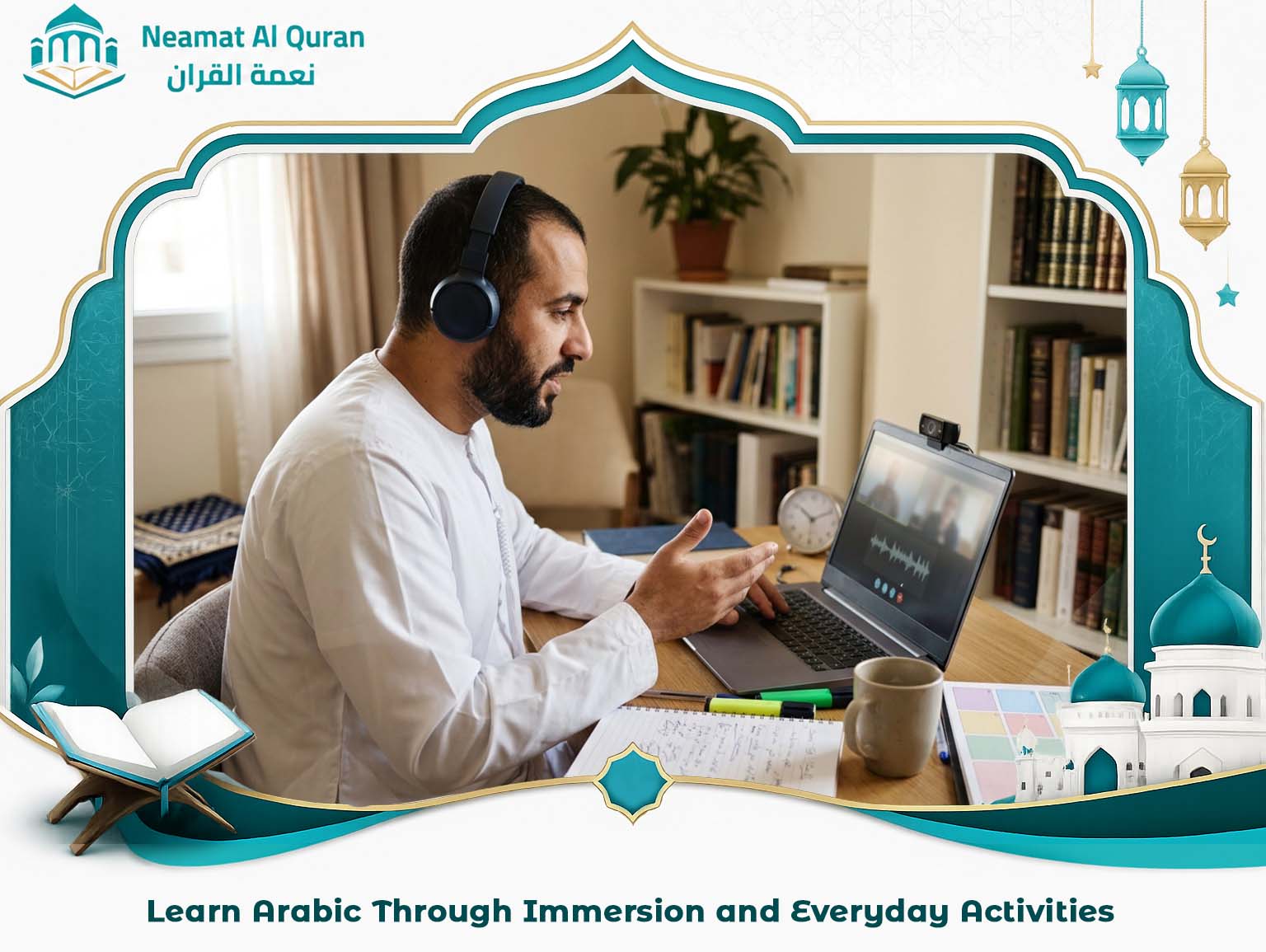
Language immersion does not always require traveling to an Arabic-speaking country. Learners can create opportunities for regular exposure at home by incorporating Arabic into their daily routines.
Although this approach requires patience, it can make the language feel more familiar.
Add Arabic to Your Daily Environment
Start with small changes that do not interfere with your normal activities. For example:
-
Label familiar household objects in Arabic.
-
Read a short Arabic sentence each morning.
-
Listen to beginner audio lessons while completing simple tasks.
-
Follow Arabic educational content.
-
Write your shopping list using familiar Arabic words.
-
Practice common expressions with a study partner.
These activities increase exposure without requiring a separate long study session. For adults balancing work and other responsibilities, online Arabic classes for adults can complement everyday practice and make vocabulary easier to recognize.
Practice with Arabic Speakers
Communicating with Arabic speakers provides opportunities to use vocabulary in meaningful situations. You can practice greetings, ask simple questions, and discuss familiar topics.
If you cannot find a conversation partner locally, online language communities or a one-on-one Arabic tutor online may provide opportunities to practice speaking and receive individual feedback.
However, beginners should avoid conversations that are too advanced. Choose simple topics and explain when you need someone to speak more slowly.
Understand the Difference Between Formal Arabic and Dialects
Arabic includes Modern Standard Arabic and several regional dialects. Modern Standard Arabic is widely used in formal writing, education, and news broadcasting. Dialects, meanwhile, are common in everyday communication across different regions. Your learning objectives should determine which variety receives greater attention.
For example, a learner interested in reading formal texts may prioritize Modern Standard Arabic. Someone preparing to communicate with people in a particular country may also study its local dialect. This distinction helps students select the best way to learn Arabic online according to their intended use of the language.
How to Learn Arabic Online Faster as a Beginner?
Progress does not depend only on the number of hours spent studying. The quality of practice, lesson organization, and consistency also matter. Therefore, beginners should focus on methods that make each learning session useful.
Study One Main Concept at a Time
Trying to learn pronunciation, grammar, vocabulary, and complex reading rules simultaneously may overwhelm new students.
Instead, choose one main objective for each session. For example, dedicate one lesson to Arabic letters and another to common expressions.
After understanding the new concept, connect it with previously learned material. This approach supports gradual progress and reduces unnecessary confusion.
Combine Different Learning Methods
Relying on a single resource can limit the development of language skills. Reading alone does not provide enough speaking practice, while listening without understanding vocabulary may produce limited results. A balanced learning session should include:
- Visual learning through written examples.
- Listening to accurate Arabic pronunciation.
- Speaking through repetition and conversation.
- Reading short passages.
- Writing vocabulary and sentences.
- Reviewing previous lessons.
This combination represents a practical way to learn Arabic online because it addresses several language skills rather than focusing on only one.
Receive Feedback on Your Progress
Independent practice is valuable, but learners may not always recognize their own mistakes. Feedback can help identify incorrect pronunciation, spelling problems, and misunderstandings of grammar.
A teacher can explain why an answer is incorrect and demonstrate how to improve it. Furthermore, regular feedback makes it easier to identify areas that deserve more attention.
When evaluating the best way to learn Arabic online, consider whether the learning approach allows you to ask questions and receive useful explanations.
Common Mistakes to Avoid When Learning Arabic Online
Some learning difficulties develop because beginners follow unsuitable study habits. Recognizing these problems early can make the educational process more organized.
Trying to Learn Everything at Once
Arabic has several areas of study, including pronunciation, grammar, vocabulary, reading, and writing. Attempting to master all of them immediately can create unnecessary pressure.
Start with essential concepts and move forward gradually. As your knowledge grows, introduce more challenging lessons.
Memorizing Words Without Understanding Their Context
Memorizing vocabulary lists may help with recognition, but it does not always teach students how to use words correctly.
Whenever possible, learn new vocabulary through short sentences and practical examples. This helps you understand how words function in real communication.
Ignoring Pronunciation
A student may recognize a written word but pronounce it incorrectly. This problem can become more difficult to correct if inaccurate pronunciation is repeated over an extended period.
Listen carefully, practice difficult sounds, and request feedback when possible.
Studying Without a Clear Plan
Moving randomly between applications, videos, and grammar explanations can make learning less organized.
Choose a suitable program, define weekly objectives, and review your progress. This gives the best way to learn Arabic online a clear direction and helps prevent unnecessary repetition.
Expecting Immediate Fluency
Language development takes time. Beginners should not compare their first lessons with the abilities of advanced speakers.
Instead, measure progress through achievable milestones, such as reading a new paragraph or understanding a short conversation. Consistent improvement is more meaningful than expecting instant results.
How Neamat Al Quran Academy Fits into an Arabic Learning Journey?
Choosing an appropriate learning environment is an important part of studying Arabic online. Some students prefer independent study, while others benefit from organized instruction and opportunities to ask questions.
Neamat Al Quran Academy can be considered by learners exploring online Arabic education and looking for an educational setting that relates to their learning objectives.
Before selecting any program, students should identify the subjects they want to study and confirm that the available lessons match their requirements.
Connect Your Learning Goals with Suitable Lessons
A beginner interested in Arabic reading may need a different starting point from someone who already recognizes the alphabet.
Therefore, it is useful to clarify your current level before choosing a learning program. Ask about the topics covered, the expected learning progression, and the types of exercises included.
For students considering Neamat Al Quran Academy, these questions can help determine whether its available educational options correspond to their individual objectives.
Ask About Instruction and Learning Support
Effective language education involves more than presenting information. Students may also need explanations, opportunities to practice, and feedback on their understanding. When evaluating Neamat Al Quran Academy, prospective learners can ask about:
- The Arabic subjects available.
- The appropriate starting level for beginners.
- The structure of lessons.
- Opportunities for speaking and reading practice.
- How students can ask questions.
- The way learning progress is reviewed, if available.
These details should be confirmed directly with the academy before enrollment rather than assumed.
Make Your Online Learning Plan Practical
A suitable educational program should fit into the student’s daily routine. Before starting, consider how much time you can dedicate to lessons and independent revision.
Additionally, establish clear objectives so that you can evaluate whether your studies are meeting your expectations.
Neamat Al Quran Academy may be one option to explore when researching the best way to learn Arabic online. However, the final decision should depend on the available course details, teaching approach, schedule, and suitability for your needs.
How to Stay Motivated While Learning Arabic Online?
Motivation can change throughout the learning process. Beginners may feel excited during their first lessons but become discouraged when they encounter unfamiliar grammar or difficult pronunciation.
Maintaining realistic expectations is part of the best way to learn Arabic online, especially when progress feels slow.
Set Short-Term and Long-Term Goals
Long-term goals provide direction, while short-term objectives make progress easier to measure. For example, your long-term objective might be to understand simple Arabic conversations.
To reach it, establish smaller targets such as learning common expressions, recognizing familiar vocabulary, and completing beginner listening exercises. The best way to learn Arabic online includes goals that are specific enough to guide daily practice.
Celebrate Small Improvements
Progress does not always involve completing an entire course or understanding a long conversation. Recognizing individual achievements can help maintain motivation. You might celebrate when you:
- Recognize a letter without assistance.
- Read your first complete Arabic sentence.
- Understand a familiar expression.
- Pronounce a difficult sound more accurately.
- Write a short paragraph independently.
These improvements show that the best way to learn Arabic online is by helping you develop useful skills through consistent practice.
Accept Mistakes as Part of Learning
Making mistakes is a normal part of acquiring a language. Incorrect pronunciation, forgotten vocabulary, and grammatical errors provide opportunities to identify areas that need additional attention.
Instead of avoiding difficult activities, approach them gradually. Review corrections, repeat challenging exercises, and ask for explanations whenever necessary.
Students following the best way to learn Arabic online understand that improvement requires patience and regular effort rather than perfect performance from the beginning.
Build a Weekly Arabic Study Plan
A weekly plan can help beginners organize different language skills without spending too much time on one activity. The following example offers a practical approach to the best way to learn Arabic online. Adjust it according to your level, schedule, and learning objectives.
| Day | Main learning activity | Practice task |
|---|---|---|
| Monday | Arabic alphabet | Recognize and write selected letters |
| Tuesday | Vocabulary | Learn and review common words |
| Wednesday | Pronunciation | Listen and repeat short expressions |
| Thursday | Grammar | Construct simple sentences |
| Friday | Reading | Read a beginner-level passage |
| Saturday | Listening and speaking | Practice a short dialogue |
| Sunday | Weekly revision | Review mistakes and previous lessons |
Adjust the Plan as Your Skills Improve
The schedule should not remain unchanged forever. Once you become comfortable recognizing Arabic letters, for example, you can reduce alphabet exercises and dedicate more time to reading.
Likewise, learners who understand basic sentences may benefit from additional listening and conversation practice. A flexible schedule keeps the best way to learn Arabic online relevant as your abilities develop.
Evaluate Your Progress Every Week
At the end of each week, review what you have learned. Ask yourself whether you can remember the vocabulary, understand the grammar concepts, and complete the reading exercises independently.
Write down the areas that remain difficult and include them in the following week’s plan. This evaluation helps you follow the best way to learn Arabic online without moving forward before understanding essential concepts.
Frequently Asked Questions About the Best Way to Learn Arabic Online
This section answers common questions about the best way to learn Arabic online, including study time, learning difficulties, and choosing the right Arabic variety.
1. How many Arabic words should a beginner learn each day?
There is no fixed number suitable for every learner. Beginners can start with five to ten useful words daily, provided they review them regularly and understand how to use them in sentences. Remembering vocabulary in context is generally more useful than memorizing large lists without practice.
2. Can someone learn Arabic if their native language uses a different alphabet?
Yes. People who speak languages using Latin, Cyrillic, or other writing systems can learn Arabic. They should begin by understanding the Arabic alphabet, letter connections, and pronunciation before progressing toward longer reading exercises.
3. Should I learn Modern Standard Arabic or a regional dialect first?
The appropriate choice depends on your purpose. Modern Standard Arabic is useful for formal reading, education, and written communication. However, if your main objective is everyday conversation in a particular country, studying its regional dialect may also be beneficial.
4. How can I measure my Arabic proficiency without taking an exam?
You can evaluate your progress through practical tasks. Try reading an unfamiliar beginner passage, understanding a short recording, writing a paragraph, and having a simple conversation. Comparing your performance over several weeks can reveal improvements and identify skills that require further practice.
Conclusion
The best way to learn Arabic online is to combine structured lessons, daily practice, and suitable learning resources. Start with the alphabet and pronunciation, then develop your vocabulary, grammar, reading, and speaking skills.
Additionally, set realistic goals and review previous lessons regularly to maintain steady progress. The best way to learn Arabic online should match your level, schedule, and learning objectives.
Neamat Al Quran Academy is an option to explore when choosing online Arabic education. Confirm its available courses and teaching arrangements before enrolling.
Ultimately, the best way to learn Arabic online depends on consistency, patience, and effective practice. With the right approach, you can gradually improve your ability to read, understand, and communicate in Arabic.